

spills. As a rule, plans are only made to combat an oil spill if the thickness of the oil
layer is not much below 0.1 mm, unless sensitive beaches, coastal stretches, or bird
life have to be protected.
The oil film on the surface moves with water currents and wind drift. This makes it
possible to predict its drift. It can roughly be estimated that the film will move at 60%
of the water current rate and 2%-4% of the wind speed. This rate of drift is of ecological significance because the oil film is displaced vis-a-vis the body of water in such
a way that fresh quantities of seawater come into contact with the oil and can
release components from it, without accumulating high concentrations of these toxic
substances.
b) Evaporation: As the number of carbon atoms increases, the vapor pressure of the
various hydrocarbon compounds decreases. In this respect, paraffms do not differ significantly from aromatic compounds (Butler 1976). Evaporation is strongest during
the first few hours. Spilled crude oil can only catch fire in the first half hour. After
that, there is an insufficient amount of easily volatile compounds in the layer of oil
on the surface of the water. At the end of one day, half of the compounds with 1314 carbon atoms are vaporized, at the end of three weeks, half of the compounds with
17 carbon atoms. The vaporization process extends over a period of months, possibly
years, and eventually leads to more viscous and, in the end, tar-like clumps.
The extent to which oil vaporizes off the surface of the water depends on many
other factors. When cold, only a small quantity of oil vaporizes. Wave activity fosters
vaporization, but at the same time leads to the more rapid formation of water-in-oil
emulsion. Oil no longer floating on the surface of the water cannot vaporize either.
Gasoline vaporizes quickly and disappears completely from the surface while heavy
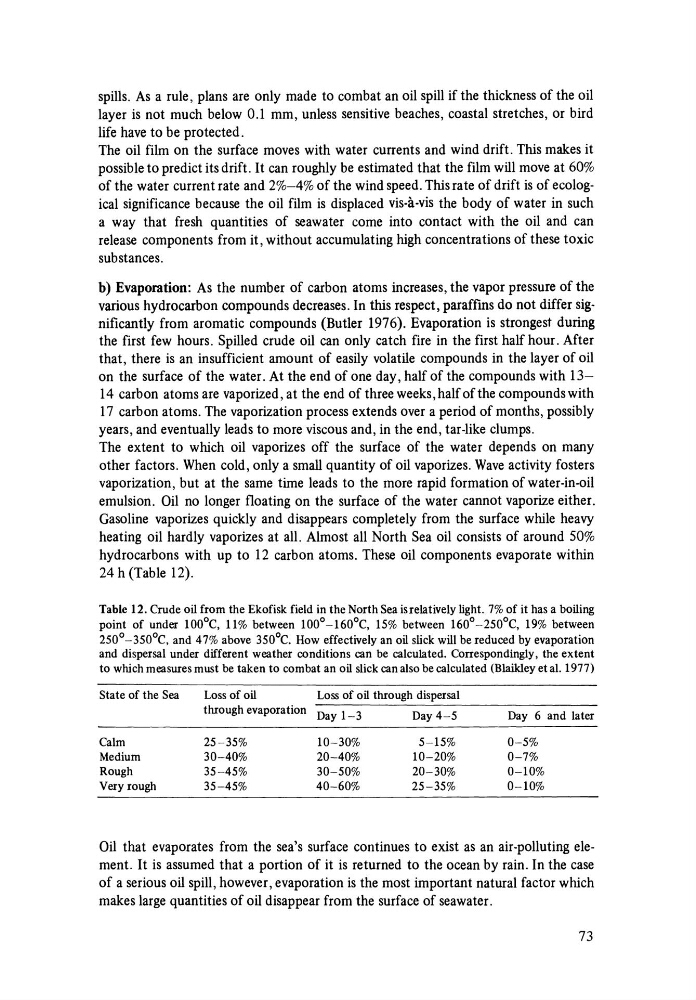
heating oil hardly vaporizes at all. Almost all North Sea oil consists of around 50%
hydrocarbons with up to 12 carbon atoms. These oil components evaporate within
24 h (Table 12).
Table 12. Crude oil from the Ekofisk field in the North Sea is relatively light. 7% of it has a boiling
point of under 100°C, 11% between 100°-160°C, 15% between 160°-250°C, 19% between
250° -350°C, and 47% above 350°C. How effectively an oil slick will be reduced by evaporation
and dispersal under different weather conditions can be calculated. Correspondingly, the extent
to which measures must be taken to combat an oil slick can also be calculated (B1aikley et al. 1977)
Sta te of the Sea
Loss of oil
Loss of oil through dispersal
through evaporation Day 1-3
Day 4-5
Day 6 and later
Calm
25-35%
10-30%
5-15%
0-5%
Medium
30-40%
20-40%
10-20%
0-7%
Rough
35-45%
30-50%
20-30%
0-10%
Very rough
35-45%
40-60%
25-35%
0-10%
Oil that evaporates from the sea's surface continues to exist as an air-polluting element. It is assumed that a portion of it is returned to the ocean by rain. In the case
of a serious oil spill, however, evaporation is the most important natural factor which
makes large quantities of oil disappear from the surface of seawater.
73
layer is not much below 0.1 mm, unless sensitive beaches, coastal stretches, or bird
life have to be protected.
The oil film on the surface moves with water currents and wind drift. This makes it
possible to predict its drift. It can roughly be estimated that the film will move at 60%
of the water current rate and 2%-4% of the wind speed. This rate of drift is of ecological significance because the oil film is displaced vis-a-vis the body of water in such
a way that fresh quantities of seawater come into contact with the oil and can
release components from it, without accumulating high concentrations of these toxic
substances.
b) Evaporation: As the number of carbon atoms increases, the vapor pressure of the
various hydrocarbon compounds decreases. In this respect, paraffms do not differ significantly from aromatic compounds (Butler 1976). Evaporation is strongest during
the first few hours. Spilled crude oil can only catch fire in the first half hour. After
that, there is an insufficient amount of easily volatile compounds in the layer of oil
on the surface of the water. At the end of one day, half of the compounds with 1314 carbon atoms are vaporized, at the end of three weeks, half of the compounds with
17 carbon atoms. The vaporization process extends over a period of months, possibly
years, and eventually leads to more viscous and, in the end, tar-like clumps.
The extent to which oil vaporizes off the surface of the water depends on many
other factors. When cold, only a small quantity of oil vaporizes. Wave activity fosters
vaporization, but at the same time leads to the more rapid formation of water-in-oil
emulsion. Oil no longer floating on the surface of the water cannot vaporize either.
Gasoline vaporizes quickly and disappears completely from the surface while heavy
heating oil hardly vaporizes at all. Almost all North Sea oil consists of around 50%
hydrocarbons with up to 12 carbon atoms. These oil components evaporate within
24 h (Table 12).
Table 12. Crude oil from the Ekofisk field in the North Sea is relatively light. 7% of it has a boiling
point of under 100°C, 11% between 100°-160°C, 15% between 160°-250°C, 19% between
250° -350°C, and 47% above 350°C. How effectively an oil slick will be reduced by evaporation
and dispersal under different weather conditions can be calculated. Correspondingly, the extent
to which measures must be taken to combat an oil slick can also be calculated (B1aikley et al. 1977)
Sta te of the Sea
Loss of oil
Loss of oil through dispersal
through evaporation Day 1-3
Day 4-5
Day 6 and later
Calm
25-35%
10-30%
5-15%
0-5%
Medium
30-40%
20-40%
10-20%
0-7%
Rough
35-45%
30-50%
20-30%
0-10%
Very rough
35-45%
40-60%
25-35%
0-10%
Oil that evaporates from the sea's surface continues to exist as an air-polluting element. It is assumed that a portion of it is returned to the ocean by rain. In the case
of a serious oil spill, however, evaporation is the most important natural factor which
makes large quantities of oil disappear from the surface of seawater.
73