

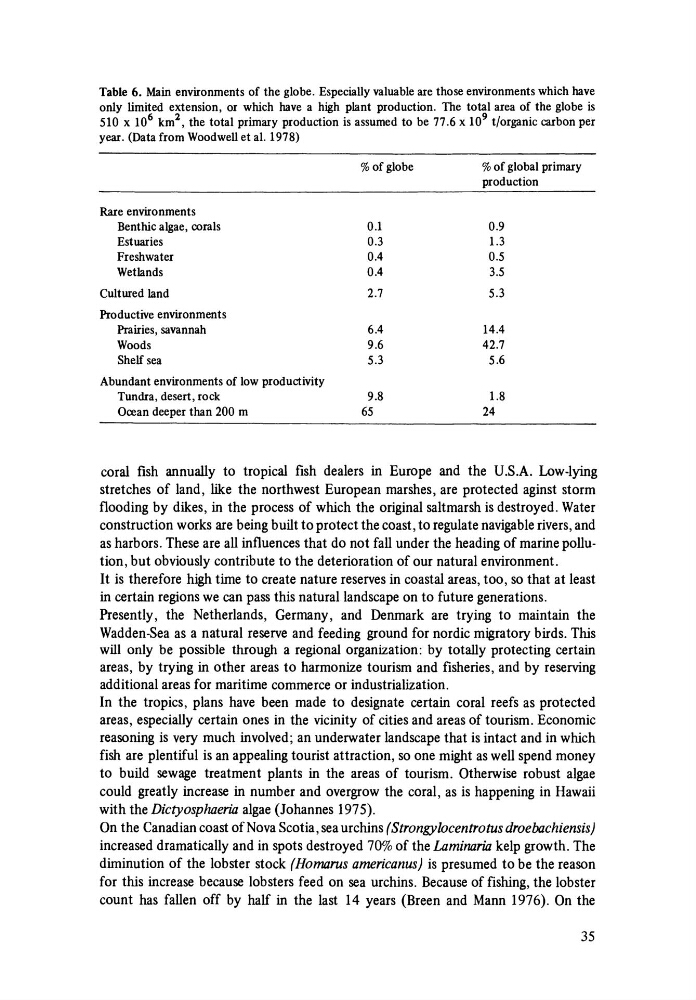
Table 6. Main environments of the globe. Especially valuable are those environments which have
only limited extension, or which have a high plant production. The total area of the globe is
510 x 10 6 km 2 , the total primary production is assumed to be 77.6 x 10 9 t/organic carbon per
year. (Data from Woodwell et a1. 1978)
% of globe
% of global primary
production
Rare environments
Benthic algae, corals
0.1
0.9
Estuaries
0.3
1.3
Freshwater
0.4
0.5
Wetlands
0.4
3.5
Cultured land
2.7
5.3
Productive environments
Prairies, savannah
6.4
14.4
Woods
9.6
42.7
Shelf sea
5.3
5.6
Abundant environments of low productivity
Tundra, desert, rock
9.8
1.8
Ocean deeper than 200 m
65
24
coral fish annually to tropical fish dealers in Europe and the U.S.A. Low-lying
stretches of land, like the northwest European marshes, are protected aginst storm
flooding by dikes, in the process of which the original saltmarsh is destroyed. Water
construction works are being built to protect the coast, to regulate navigable rivers, and
as harbors. These are all influences that do not fall under the heading of marine pollution, but obviously contribute to the deterioration of our natural environment.
It is therefore high time to create nature reserves in coastal areas, too, so that at least
in certain regions we can pass this natural landscape on to future generations.
Presently, the Netherlands, Germany, and Denmark are trying to maintain the
Wadden-Sea as a natural reserve and feeding ground for nordic migratory birds. This
will only be possible through a regional organization: by totally protecting certain
areas, by trying in other areas to harmonize tourism and fisheries, and by reserving
additional areas for maritime commerce or industrialization.
In the tropics, plans have been made to designate certain coral reefs as protected
areas, especially certain ones in the vicinity of cities and areas of tourism. Economic
reasoning is very much involved; an underwater landscape that is intact and in which
fish are plentiful is an appealing tourist attraction, so one might as well spend money
to build sewage treatment plants in the areas of tourism. Otherwise robust algae
could greatly increase in number and overgrow the coral, as is happening in Hawaii
with the Dictyosphaeria algae (Johannes 1975).
On the Canadian coast of Nova Scotia, sea urchins (Strongylocentrotus droebachiensis)
increased dramatically and in spots destroyed 70% of the Laminaria kelp growth. The
diminution of the lobster stock (Hornarus american us) is presumed to be the reason
for this increase because lobsters feed on sea urchins. Because of fishing, the lobster
count has fallen off by half in the last 14 years (Breen and Mann 1976). On the
35
only limited extension, or which have a high plant production. The total area of the globe is
510 x 10 6 km 2 , the total primary production is assumed to be 77.6 x 10 9 t/organic carbon per
year. (Data from Woodwell et a1. 1978)
% of globe
% of global primary
production
Rare environments
Benthic algae, corals
0.1
0.9
Estuaries
0.3
1.3
Freshwater
0.4
0.5
Wetlands
0.4
3.5
Cultured land
2.7
5.3
Productive environments
Prairies, savannah
6.4
14.4
Woods
9.6
42.7
Shelf sea
5.3
5.6
Abundant environments of low productivity
Tundra, desert, rock
9.8
1.8
Ocean deeper than 200 m
65
24
coral fish annually to tropical fish dealers in Europe and the U.S.A. Low-lying
stretches of land, like the northwest European marshes, are protected aginst storm
flooding by dikes, in the process of which the original saltmarsh is destroyed. Water
construction works are being built to protect the coast, to regulate navigable rivers, and
as harbors. These are all influences that do not fall under the heading of marine pollution, but obviously contribute to the deterioration of our natural environment.
It is therefore high time to create nature reserves in coastal areas, too, so that at least
in certain regions we can pass this natural landscape on to future generations.
Presently, the Netherlands, Germany, and Denmark are trying to maintain the
Wadden-Sea as a natural reserve and feeding ground for nordic migratory birds. This
will only be possible through a regional organization: by totally protecting certain
areas, by trying in other areas to harmonize tourism and fisheries, and by reserving
additional areas for maritime commerce or industrialization.
In the tropics, plans have been made to designate certain coral reefs as protected
areas, especially certain ones in the vicinity of cities and areas of tourism. Economic
reasoning is very much involved; an underwater landscape that is intact and in which
fish are plentiful is an appealing tourist attraction, so one might as well spend money
to build sewage treatment plants in the areas of tourism. Otherwise robust algae
could greatly increase in number and overgrow the coral, as is happening in Hawaii
with the Dictyosphaeria algae (Johannes 1975).
On the Canadian coast of Nova Scotia, sea urchins (Strongylocentrotus droebachiensis)
increased dramatically and in spots destroyed 70% of the Laminaria kelp growth. The
diminution of the lobster stock (Hornarus american us) is presumed to be the reason
for this increase because lobsters feed on sea urchins. Because of fishing, the lobster
count has fallen off by half in the last 14 years (Breen and Mann 1976). On the
35