

sedimentation rate of lead from 2-10 mg/m 2 per year to 9-21 mg/m 2 per year can
as well be the result of industrial pollution from the nearby city of Los Angeles
(Chow 1973; see Chap. 8.5 and Fig. 81 for comparable mercury discussion). Unfortunately, there are, apparently, no time series of lead concentrations in biological
material available to demonstrate an increase of lead concentrations during the past
century. Therefore one has to rely on general speculations regarding the conclusion
that marine organisms, too, at present may have about 20 times higher lead concentrations than some thousand years ago.
Lead is not as toxic for marine organisms as mercury or cadmium. Usually, values of
around 0.1 mg/l are indicated as threshold at which adverse effects become apparent;
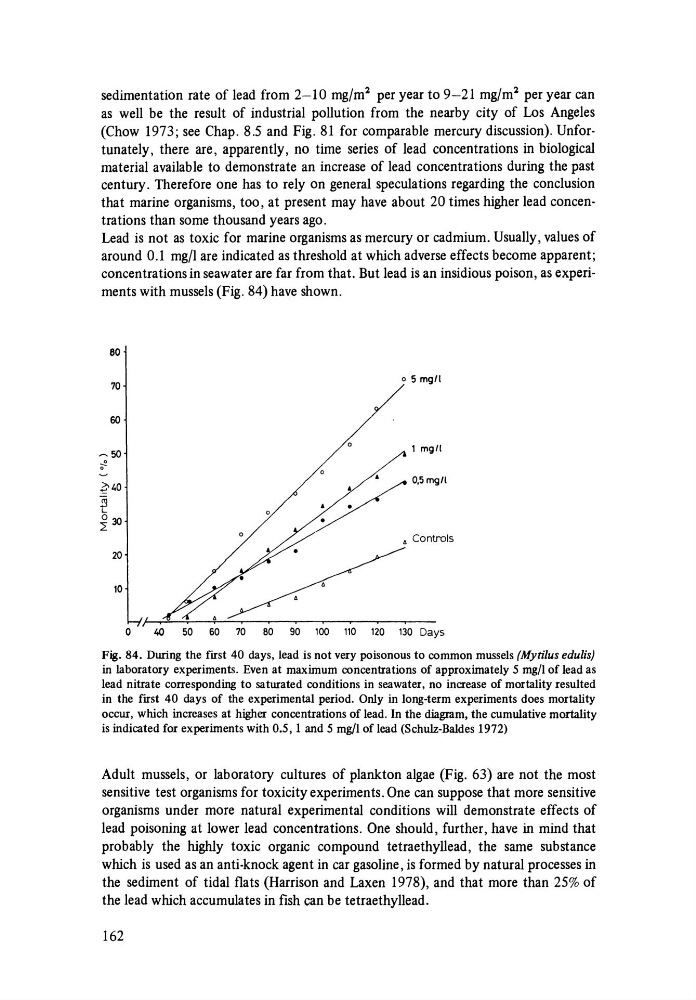
concentrations in seawater are far from that. But lead is an insidious poison, as experiments with mussels (Fig. 84) have shown.
eo
70
o 5 mgtl
60
~50
1 mgtl
-t~40
~ L
~30
~
o
•
•
O,5mgfl
• •
.
o Controls
20
10
,
0
50
60
70
BO
90
100
110
120
130 Days
Fig. 84. During the first 40 days, lead is not very poisonous to common mussels (Mytilus edulis)
in laboratory experiments. Even at maximum concentrations of approximately 5 mg/l of lead as
lead nitrate corresponding to saturated conditions in seawater, no increase of mortality resulted
in the first 40 days of the experimental period. Only in long-term experiments does mortality
occur, which increases at higher concentrations of lead. In the diagram, the cumulative mortality
is indicated for experiments with 0.5,1 and 5 mg/l of lead (Schulz-Baldes 1972)
Adult mussels, or laboratory cultures of plankton algae (Fig. 63) are not the most
sensitive test organisms for toxicity experiments. One can suppose that more sensitive
organisms under more natural experimental conditions will demonstrate effects of
lead poisoning at lower lead concentrations. One should, further, have in mind that
probably the highly toxic organic compound tetraethyllead, the same substance
which is used as an anti-knock agent in car gasoline, is formed by natural processes in
the sediment of tidal flats (Harrison and Laxen 1978), and that more than 25% of
the lead which accumulates in fish can be tetraethyllead.
162
as well be the result of industrial pollution from the nearby city of Los Angeles
(Chow 1973; see Chap. 8.5 and Fig. 81 for comparable mercury discussion). Unfortunately, there are, apparently, no time series of lead concentrations in biological
material available to demonstrate an increase of lead concentrations during the past
century. Therefore one has to rely on general speculations regarding the conclusion
that marine organisms, too, at present may have about 20 times higher lead concentrations than some thousand years ago.
Lead is not as toxic for marine organisms as mercury or cadmium. Usually, values of
around 0.1 mg/l are indicated as threshold at which adverse effects become apparent;
concentrations in seawater are far from that. But lead is an insidious poison, as experiments with mussels (Fig. 84) have shown.
eo
70
o 5 mgtl
60
~50
1 mgtl
-t~40
~ L
~30
~
o
•
•
O,5mgfl
• •
.
o Controls
20
10
,
0
50
60
70
BO
90
100
110
120
130 Days
Fig. 84. During the first 40 days, lead is not very poisonous to common mussels (Mytilus edulis)
in laboratory experiments. Even at maximum concentrations of approximately 5 mg/l of lead as
lead nitrate corresponding to saturated conditions in seawater, no increase of mortality resulted
in the first 40 days of the experimental period. Only in long-term experiments does mortality
occur, which increases at higher concentrations of lead. In the diagram, the cumulative mortality
is indicated for experiments with 0.5,1 and 5 mg/l of lead (Schulz-Baldes 1972)
Adult mussels, or laboratory cultures of plankton algae (Fig. 63) are not the most
sensitive test organisms for toxicity experiments. One can suppose that more sensitive
organisms under more natural experimental conditions will demonstrate effects of
lead poisoning at lower lead concentrations. One should, further, have in mind that
probably the highly toxic organic compound tetraethyllead, the same substance
which is used as an anti-knock agent in car gasoline, is formed by natural processes in
the sediment of tidal flats (Harrison and Laxen 1978), and that more than 25% of
the lead which accumulates in fish can be tetraethyllead.
162