

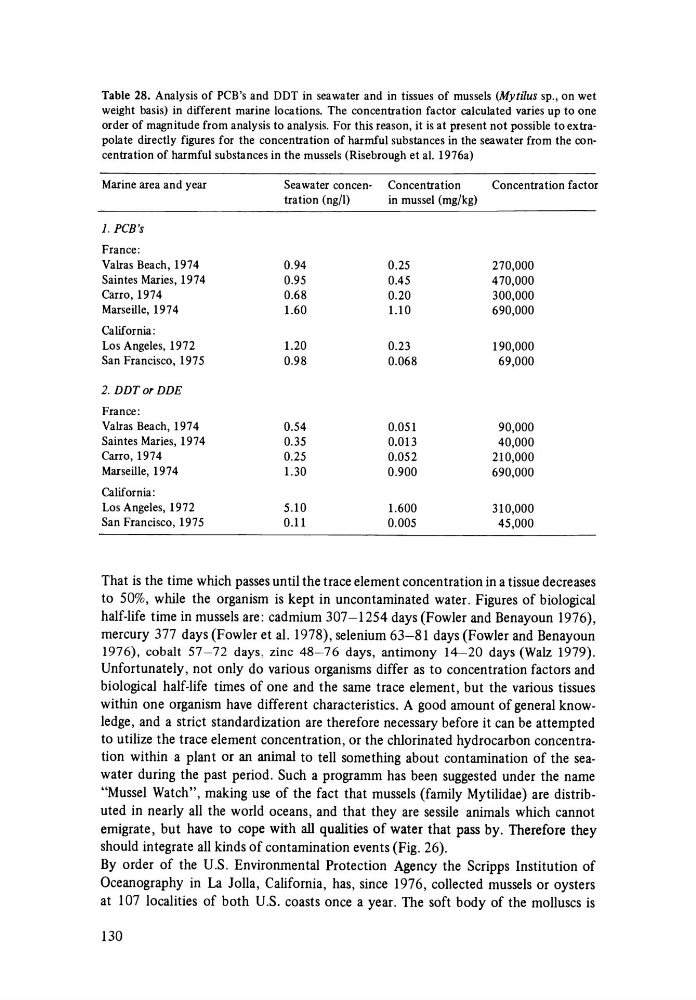
Table 28. Analysis of PCB's and DDT in seawater and in tissues of mussels (Mytilus sp., on wet
weight basis) in different marine locations. The concentration factor calculated varies up to one
order of magnitude from analysis to analysis. For this reason, it is at present not possible to extrapolate directly figures for the concentration of harmful substances in the seawater from the concentration of harmful substances in the mussels (Risebrough et al. 1976a)
Marine area and year
1. PCB's
France:
Valras Beach, 1974
Saintes Maries, 1974
Carro, 1974
Marseille, 1974
California:
Los Angeles, 1972
San Francisco, 1975
2. DDTorDDE
France:
Valras Beach, 1974
Saintes Maries, 1974
Carro, 1974
Marseille, 1974
California:
Los Angeles, 1972
San Francisco, 1975
Seawater concentration (ng/l)
0.94
0.95
0.68
1.60
1.20
0.98
0.54
0.35
0.25
1.30
5.10
0.11
Concentration
Concentration factor
in mussel (mg/kg)
0.25
270,000
0.45
470,000
0.20
300,000
1.10
690,000
0.23
190,000
0.068
69,000
0.051
90,000
0.013
40,000
0.052
210,000
0.900
690,000
1.600
310,000
0.005
45,000
That is the time which passes until the trace element concentration in a tissue decreases
to 50%, while the organism is kept in uncontaminated water. Figures of biological
half-life time in mussels are: cadmium 307-1254 days (Fowler and Benayoun 1976),
mercury 377 days (Fowler et al. 1978), selenium 63-81 days (Fowler and Benayoun
1976), cobalt 57-72 days, zinc 48-76 days, antimony 14-20 days (Walz 1979).
Unfortunately, not only do various organisms differ as to concentration factors and
biological half-life times of one and the same trace element, but the various tissues
within one organism have different characteristics. A good amount of general knowledge, and a strict standardization are therefore necessary before it can be attempted
to utilize the trace element concentration, or the chlorinated hydrocarbon concentration within a plant or an animal to tell something about contamination of the seawater during the past period. Such a programm has been suggested under the name
"Mussel Watch", making use of the fact that mussels (family Mytilidae) are distributed in nearly all the world oceans, and that they are sessile animals which cannot
emigrate, but have to cope with all qualities of water that pass by. Therefore they
should integrate all kinds of contamination events (Fig. 26).
By order of the U.S. Environmental Protection Agency the Scripps Institution of
Oceanography in La Jolla, California, has, since 1976, collected mussels or oysters
at 107 localities of both U.S. coasts once a year. The soft body of the molluscs is
130
weight basis) in different marine locations. The concentration factor calculated varies up to one
order of magnitude from analysis to analysis. For this reason, it is at present not possible to extrapolate directly figures for the concentration of harmful substances in the seawater from the concentration of harmful substances in the mussels (Risebrough et al. 1976a)
Marine area and year
1. PCB's
France:
Valras Beach, 1974
Saintes Maries, 1974
Carro, 1974
Marseille, 1974
California:
Los Angeles, 1972
San Francisco, 1975
2. DDTorDDE
France:
Valras Beach, 1974
Saintes Maries, 1974
Carro, 1974
Marseille, 1974
California:
Los Angeles, 1972
San Francisco, 1975
Seawater concentration (ng/l)
0.94
0.95
0.68
1.60
1.20
0.98
0.54
0.35
0.25
1.30
5.10
0.11
Concentration
Concentration factor
in mussel (mg/kg)
0.25
270,000
0.45
470,000
0.20
300,000
1.10
690,000
0.23
190,000
0.068
69,000
0.051
90,000
0.013
40,000
0.052
210,000
0.900
690,000
1.600
310,000
0.005
45,000
That is the time which passes until the trace element concentration in a tissue decreases
to 50%, while the organism is kept in uncontaminated water. Figures of biological
half-life time in mussels are: cadmium 307-1254 days (Fowler and Benayoun 1976),
mercury 377 days (Fowler et al. 1978), selenium 63-81 days (Fowler and Benayoun
1976), cobalt 57-72 days, zinc 48-76 days, antimony 14-20 days (Walz 1979).
Unfortunately, not only do various organisms differ as to concentration factors and
biological half-life times of one and the same trace element, but the various tissues
within one organism have different characteristics. A good amount of general knowledge, and a strict standardization are therefore necessary before it can be attempted
to utilize the trace element concentration, or the chlorinated hydrocarbon concentration within a plant or an animal to tell something about contamination of the seawater during the past period. Such a programm has been suggested under the name
"Mussel Watch", making use of the fact that mussels (family Mytilidae) are distributed in nearly all the world oceans, and that they are sessile animals which cannot
emigrate, but have to cope with all qualities of water that pass by. Therefore they
should integrate all kinds of contamination events (Fig. 26).
By order of the U.S. Environmental Protection Agency the Scripps Institution of
Oceanography in La Jolla, California, has, since 1976, collected mussels or oysters
at 107 localities of both U.S. coasts once a year. The soft body of the molluscs is
130