

100000
10000
'-C 1000
~
c:
Q
.t c
~
100
8
10
"~.-2,4,5, 2',4',5' - Hexachlorobiphenyl
' \ ._2,3,4,2',5'- Pentachlorobiphenyl
DOE'\;
/2,4,5,2',5'- Pentachlorobiphenyl
DOD ~oo02,5,2', 5' - Tetrachlorobiphenyl
DDT~"o/
HC. B------~~·, 2,5,2' - Trichlorobiphenyl
Aldrin--· "
Dieldrin
' :e/Endrin
Methoxychlor--. ~·<----Heptachlorepoxide .~ \Endrin
0(- Endosulfan
'" , .--PCP
, , , ,
0< -HCH-. •
.r- HCHL•
I
I
I
0.001
0.D1
0.1
I
10
"" ~ish data ( 0 )
, ,
, o,Tetrachlorethylene
, ,
o ,
i' CarboQtetrachloride
Lmollusc data ( • )
I
I
100 1000 mg /I
solubility
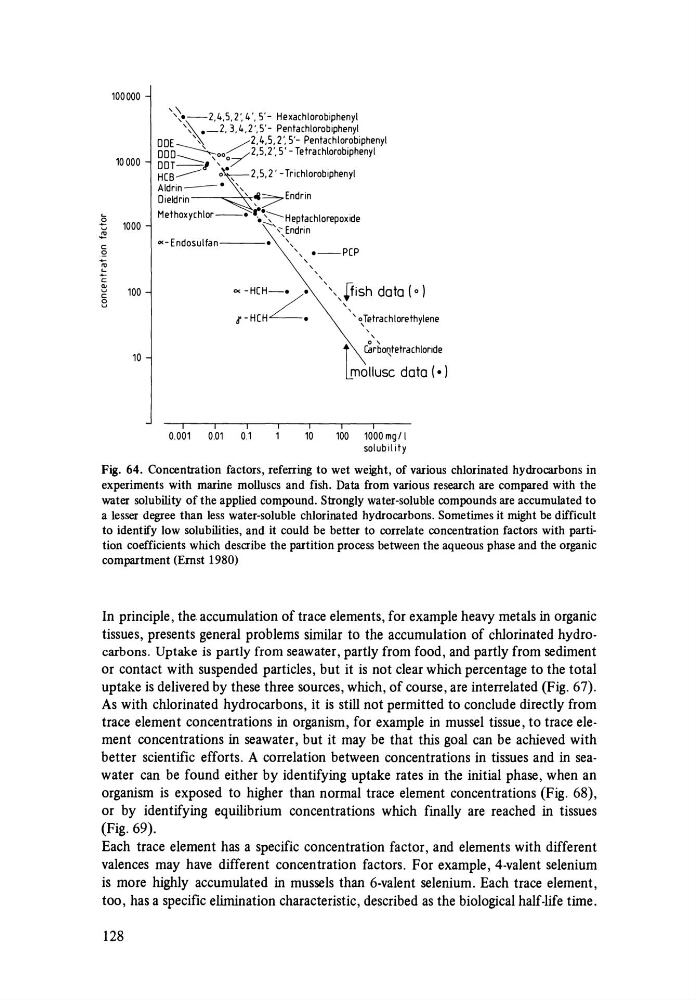
Fig. 64. Concentration factors, referring to wet weight, of various chlorinated hydrocarbons in
experiments with marine molluscs and fish. Data from various research are compared with the
water solubility of the applied compound. Strongly water-soluble compounds are accumulated to
a lesser degree than less water-soluble chlorinated hydrocarbons. Sometimes it might be difficult
to identify low solubilities, and it could be better to correlate concentration factors with partition coefficients which describe the partition process between the aqueous phase and the organic
compartment (Ernst 1980)
In principle, the accumulation of trace elements, for example heavy metals in organic
tissues, presents general problems similar to the accumulation of chlorinated hydrocarbons. Uptake is partly from seawater, partly from food, and partly from sediment
or contact with suspended particles, but it is not clear which percentage to the total
uptake is delivered by these three sources, which, of course, are interrelated (Fig. 67).
As with chlorinated hydrocarbons, it is still not permitted to conclude directly from
trace element concentrations in organism, for example in mussel tissue, to trace element concentrations in seawater, but it may be that this goal can be achieved with
better scientific efforts. A correlation between concentrations in tissues and in seawater can be found either by identifying uptake rates in the initial phase, when an
organism is exposed to higher than normal trace element concentrations (Fig. 68),
or by identifying equilibrium concentrations which finally are reached in tissues
(Fig. 69).
Each trace element has a specific concentration factor, and elements with different
valences may have different concentration factors. For example, 4-valent selenium
is more highly accumulated in mussels than 6-valent selenium. Each trace element,
too, has a specific elimination characteristic, described as the biological half-life time.
128
10000
'-C 1000
~
c:
Q
.t c
~
100
8
10
"~.-2,4,5, 2',4',5' - Hexachlorobiphenyl
' \ ._2,3,4,2',5'- Pentachlorobiphenyl
DOE'\;
/2,4,5,2',5'- Pentachlorobiphenyl
DOD ~oo02,5,2', 5' - Tetrachlorobiphenyl
DDT~"o/
HC. B------~~·, 2,5,2' - Trichlorobiphenyl
Aldrin--· "
Dieldrin
' :e/Endrin
Methoxychlor--. ~·<----Heptachlorepoxide .~ \Endrin
0(- Endosulfan
'" , .--PCP
, , , ,
0< -HCH-. •
.r- HCHL•
I
I
I
0.001
0.D1
0.1
I
10
"" ~ish data ( 0 )
, ,
, o,Tetrachlorethylene
, ,
o ,
i' CarboQtetrachloride
Lmollusc data ( • )
I
I
100 1000 mg /I
solubility
Fig. 64. Concentration factors, referring to wet weight, of various chlorinated hydrocarbons in
experiments with marine molluscs and fish. Data from various research are compared with the
water solubility of the applied compound. Strongly water-soluble compounds are accumulated to
a lesser degree than less water-soluble chlorinated hydrocarbons. Sometimes it might be difficult
to identify low solubilities, and it could be better to correlate concentration factors with partition coefficients which describe the partition process between the aqueous phase and the organic
compartment (Ernst 1980)
In principle, the accumulation of trace elements, for example heavy metals in organic
tissues, presents general problems similar to the accumulation of chlorinated hydrocarbons. Uptake is partly from seawater, partly from food, and partly from sediment
or contact with suspended particles, but it is not clear which percentage to the total
uptake is delivered by these three sources, which, of course, are interrelated (Fig. 67).
As with chlorinated hydrocarbons, it is still not permitted to conclude directly from
trace element concentrations in organism, for example in mussel tissue, to trace element concentrations in seawater, but it may be that this goal can be achieved with
better scientific efforts. A correlation between concentrations in tissues and in seawater can be found either by identifying uptake rates in the initial phase, when an
organism is exposed to higher than normal trace element concentrations (Fig. 68),
or by identifying equilibrium concentrations which finally are reached in tissues
(Fig. 69).
Each trace element has a specific concentration factor, and elements with different
valences may have different concentration factors. For example, 4-valent selenium
is more highly accumulated in mussels than 6-valent selenium. Each trace element,
too, has a specific elimination characteristic, described as the biological half-life time.
128