

Little can be done for fish eggs and plankton in the water under the oil slick. They
are harmed mainly by the toxic hydrocarbon components of the oil which are released
into the water during the first few days after an oil spill.
If the oil slick moves toward a coast, the oil should be fought. Unfortunately the
many different measures to fight oil on the sea have not been completely successful
in rough weather on the open sea. One reason for this may be the lack of convincing
technical concepts, but certainly another reason is the lack of funds to really build
up effective oil-fighting units and oil recovery devices. Estimates from the U.S.A. are
that for each 150 km of coast line 20 million US $ investments and 2 million US $
annual maintenance costs are necessary, which adds up to 250 million US $ for all
U.S.A. coasts. This seems to be the amount of money spent for just one oil spill, the
"Amoco Cadiz" accident, if preliminary estimates of clean-up operations and remuneration for damage are correct. However, a cost-benefit calculation is difficult
because even with effective oil spill fighting precautions there is no 100% safety, and
after some oil spills some oil will reach the coast on spite of all efforts. In 1977, the
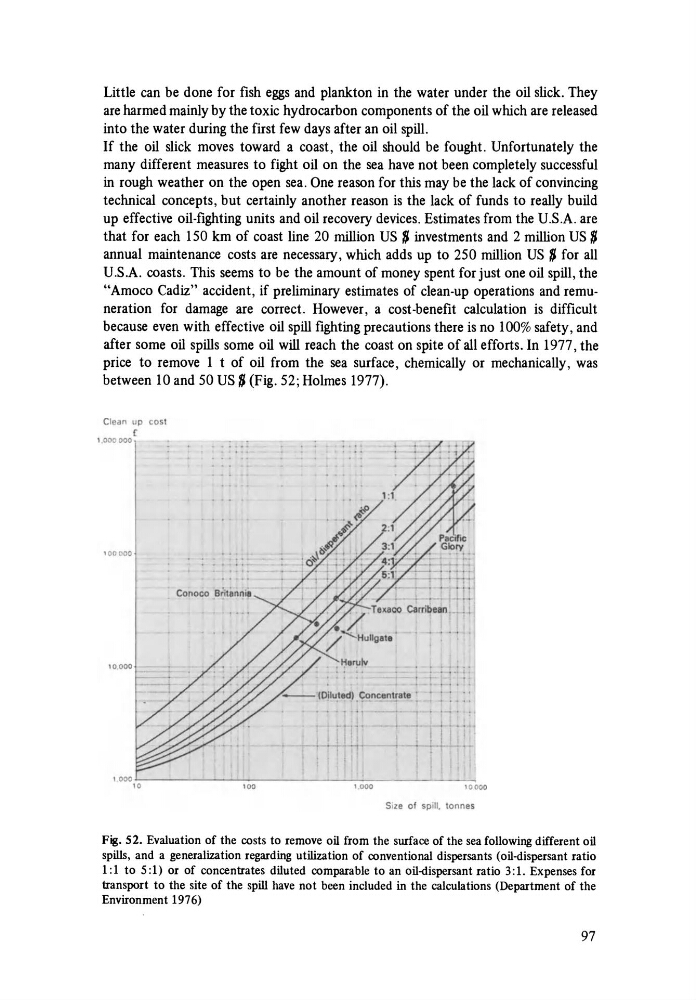
price to remove 1 t of oil from the sea surface, chemically or mechanically, was
between 10 and 50 US $ (Fig. 52; Holmes 1977).
Clean up cost
f
1 .000000
.~ 00 000
10.000
~
:'
~~~c
4· '
. .
.
.
5:1'
- . . :' -.
. . ..... ..
1 OOO,. ':-O-------I- OO,---------,.,-,- ,OOc-::O----'--~,00.00
Size of spill. tonnes
Fig. 52. Evaluation of the costs to remove oil from the surface of the sea following different oil
spills, and a generalization regarding utilization of conventional dispersants (oil-dispersant ratio
1:1 to 5:1) or of concentrates diluted comparable to an oil-dispersant ratio 3:1. Expenses for
transport to the site of the spill have not been included in the calculations (Department of the
Environment 1976)
97
are harmed mainly by the toxic hydrocarbon components of the oil which are released
into the water during the first few days after an oil spill.
If the oil slick moves toward a coast, the oil should be fought. Unfortunately the
many different measures to fight oil on the sea have not been completely successful
in rough weather on the open sea. One reason for this may be the lack of convincing
technical concepts, but certainly another reason is the lack of funds to really build
up effective oil-fighting units and oil recovery devices. Estimates from the U.S.A. are
that for each 150 km of coast line 20 million US $ investments and 2 million US $
annual maintenance costs are necessary, which adds up to 250 million US $ for all
U.S.A. coasts. This seems to be the amount of money spent for just one oil spill, the
"Amoco Cadiz" accident, if preliminary estimates of clean-up operations and remuneration for damage are correct. However, a cost-benefit calculation is difficult
because even with effective oil spill fighting precautions there is no 100% safety, and
after some oil spills some oil will reach the coast on spite of all efforts. In 1977, the
price to remove 1 t of oil from the sea surface, chemically or mechanically, was
between 10 and 50 US $ (Fig. 52; Holmes 1977).
Clean up cost
f
1 .000000
.~ 00 000
10.000
~
:'
~~~c
4· '
. .
.
.
5:1'
- . . :' -.
. . ..... ..
1 OOO,. ':-O-------I- OO,---------,.,-,- ,OOc-::O----'--~,00.00
Size of spill. tonnes
Fig. 52. Evaluation of the costs to remove oil from the surface of the sea following different oil
spills, and a generalization regarding utilization of conventional dispersants (oil-dispersant ratio
1:1 to 5:1) or of concentrates diluted comparable to an oil-dispersant ratio 3:1. Expenses for
transport to the site of the spill have not been included in the calculations (Department of the
Environment 1976)
97