

threatening. Mercury is obviously a poison and harmful to life processes, even in
those small amounts in which it naturally occurs in seawater. Where it accumulates
locally, the consequences are catastrophic. But the view is held that the quantity of
mercury released by man is insufficient to increase its concentration worldwide in
seawater significantly.
There are, however, still various other substances on the list of those that are potentially dangerous. Systematic research on the ecological behavior of synthetic organocompounds has just begun. One must not forget that ocean pollution is a very new
area of research.
Marine pollution research started 30 years ago with studies on radioactive wastes
dumped into the sea, and the first international congress on marine pollution took
place in 1959. But the true magnitude of the problem was not and could not be
appreciated at the time. It has only been 15 years since the German Research Society
put priority to studies on marine pollution (Caspers 1975). Numerous publications
describing research by the maritime nations on marine pollution are only found after
1966. To report on developments without the passage of time and the resulting
objectivity may seem superficial. It is, however, necessary to do so in order to account
for the funds consumed by research and to inform a public which is still very much
interested in the problems of marine pollution.
In the future, it will be increasingly difficult to present the entire sphere of marine
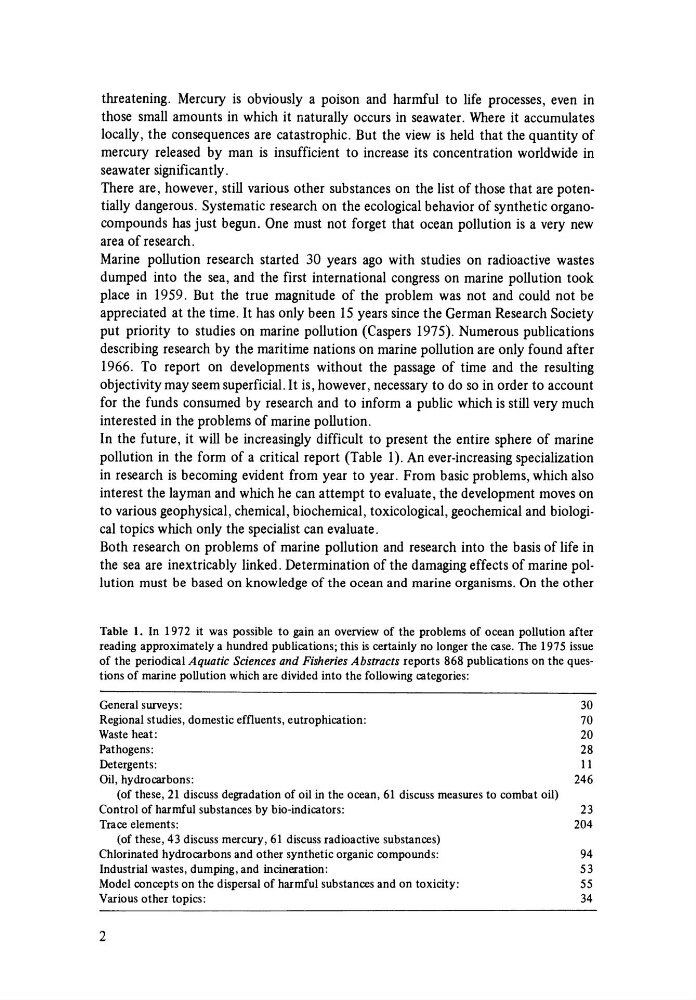
pollution in the form of a critical report (Table 1). An ever-increasing specialization
in research is becoming evident from year to year. From basic problems, which also
interest the layman and which he can attempt to evaluate, the development moves on
to various geophysical, chemical, biochemical, toxicological, geochemical and biological topics which only the specialist can evaluate.
Both research on problems of marine pollution and research into the basis of life in
the sea are inextricably linked. Determination of the damaging effects of marine pollution must be based on knowledge of the ocean and marine organisms. On the other
Table 1. In 1972 it was possible to gain an overview of the problems of ocean pollution after
reading approximately a hundred publications; this is certainly no longer the case. The 1975 issue
of the periodical Aquatic Sciences and Fisheries Abstracts reports 868 publications on the questions of marine pollution which are divided into the following categories:
General surveys:
30
Regional studies, domestic effluents, eutrophication:
70
Waste heat:
20
Pathogens:
28
Detergents:
11
Oil, hydrocarbons:
246
(of these, 21 discuss degradation of oil in the ocean, 61 discuss measures to combat oil)
Control of harmful substances by bio-indicators:
23
Trace elements:
204
(of these, 43 discuss mercury, 61 discuss radioactive substances)
Chlorinated hydrocarbons and other synthetic organic compounds:
94
Industrial wastes, dumping, and incineration:
53
Model concepts on the dispersal of harmful substances and on toxicity:
55
Various other topics:
34
2
those small amounts in which it naturally occurs in seawater. Where it accumulates
locally, the consequences are catastrophic. But the view is held that the quantity of
mercury released by man is insufficient to increase its concentration worldwide in
seawater significantly.
There are, however, still various other substances on the list of those that are potentially dangerous. Systematic research on the ecological behavior of synthetic organocompounds has just begun. One must not forget that ocean pollution is a very new
area of research.
Marine pollution research started 30 years ago with studies on radioactive wastes
dumped into the sea, and the first international congress on marine pollution took
place in 1959. But the true magnitude of the problem was not and could not be
appreciated at the time. It has only been 15 years since the German Research Society
put priority to studies on marine pollution (Caspers 1975). Numerous publications
describing research by the maritime nations on marine pollution are only found after
1966. To report on developments without the passage of time and the resulting
objectivity may seem superficial. It is, however, necessary to do so in order to account
for the funds consumed by research and to inform a public which is still very much
interested in the problems of marine pollution.
In the future, it will be increasingly difficult to present the entire sphere of marine
pollution in the form of a critical report (Table 1). An ever-increasing specialization
in research is becoming evident from year to year. From basic problems, which also
interest the layman and which he can attempt to evaluate, the development moves on
to various geophysical, chemical, biochemical, toxicological, geochemical and biological topics which only the specialist can evaluate.
Both research on problems of marine pollution and research into the basis of life in
the sea are inextricably linked. Determination of the damaging effects of marine pollution must be based on knowledge of the ocean and marine organisms. On the other
Table 1. In 1972 it was possible to gain an overview of the problems of ocean pollution after
reading approximately a hundred publications; this is certainly no longer the case. The 1975 issue
of the periodical Aquatic Sciences and Fisheries Abstracts reports 868 publications on the questions of marine pollution which are divided into the following categories:
General surveys:
30
Regional studies, domestic effluents, eutrophication:
70
Waste heat:
20
Pathogens:
28
Detergents:
11
Oil, hydrocarbons:
246
(of these, 21 discuss degradation of oil in the ocean, 61 discuss measures to combat oil)
Control of harmful substances by bio-indicators:
23
Trace elements:
204
(of these, 43 discuss mercury, 61 discuss radioactive substances)
Chlorinated hydrocarbons and other synthetic organic compounds:
94
Industrial wastes, dumping, and incineration:
53
Model concepts on the dispersal of harmful substances and on toxicity:
55
Various other topics:
34
2