

The Ecology of Avian Acoustical Signals
89
4
N'
~
8
I
N'
.::,c.
I
>.
~
(.)
2
c
>.
Q)
(.)
:J
c
4
cr
Q)
Q)
:J
~~ w I
.....
0"
LL
Q)
1 1 ~~ ~~ ~I 1 \~\ 1 ~\ ~ ~ ~~ ~
~
I...
I
, \ ! ~I !
LL
0
0
0
1
0.0
0.25
Time (s)
Time (ms)
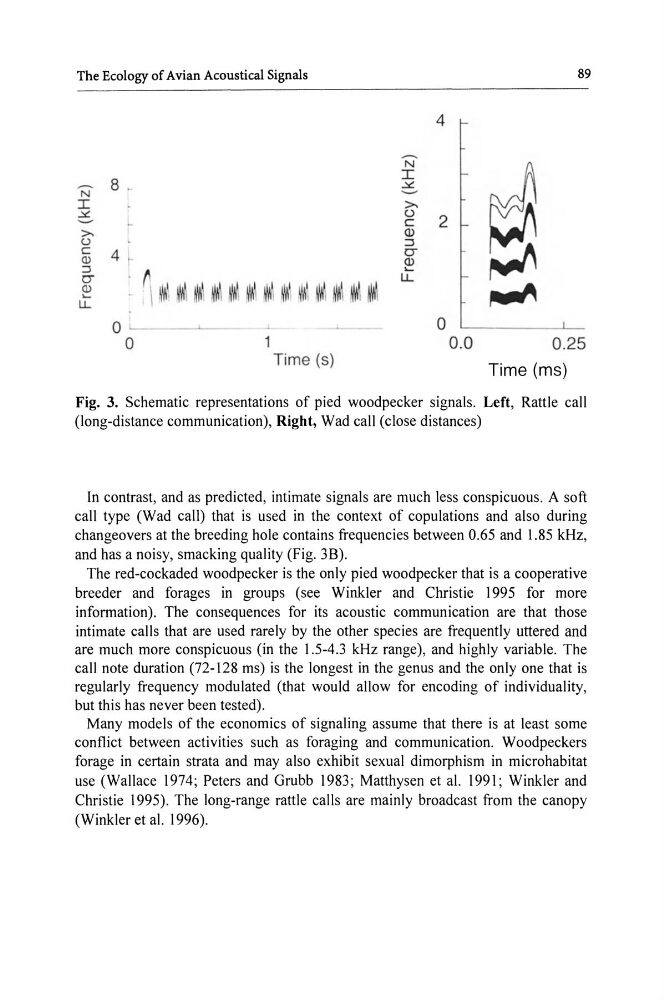
Fig. 3. Schematic representations of pied woodpecker signals. Left, Rattle call
(long-distance communication), Right, Wad call (close distances)
In contrast, and as predicted, intimate signals are much less conspicuous. A soft
call type (Wad call) that is used in the context of copulations and also during
changeovers at the breeding hole contains frequencies between 0.65 and 1.85 kHz,
and has a noisy, smacking quality (Fig. 3B).
The red-cockaded woodpecker is the only pied woodpecker that is a cooperative
breeder and forages in groups (see Winkler and Christie 1995 for more
information). The consequences for its acoustic communication are that those
intimate calls that are used rarely by the other species are frequently uttered and
are much more conspicuous (in the 1.5-4.3 kHz range), and highly variable. The
call note duration (72-128 ms) is the longest in the genus and the only one that is
regularly frequency modulated (that would allow for encoding of individuality,
but this has never been tested).
Many models of the economics of signaling assume that there is at least some
conflict between activities such as foraging and communication. Woodpeckers
forage in certain strata and may also exhibit sexual dimorphism in microhabitat
use (Wallace 1974; Peters and Grubb 1983; Matthysen et al. 1991 ; Winkler and
Christie 1995). The long-range rattle calls are mainly broadcast from the canopy
(Winkler et al. 1996).
89
4
N'
~
8
I
N'
.::,c.
I
>.
~
(.)
2
c
>.
Q)
(.)
:J
c
4
cr
Q)
Q)
:J
~~ w I
.....
0"
LL
Q)
1 1 ~~ ~~ ~I 1 \~\ 1 ~\ ~ ~ ~~ ~
~
I...
I
, \ ! ~I !
LL
0
0
0
1
0.0
0.25
Time (s)
Time (ms)
Fig. 3. Schematic representations of pied woodpecker signals. Left, Rattle call
(long-distance communication), Right, Wad call (close distances)
In contrast, and as predicted, intimate signals are much less conspicuous. A soft
call type (Wad call) that is used in the context of copulations and also during
changeovers at the breeding hole contains frequencies between 0.65 and 1.85 kHz,
and has a noisy, smacking quality (Fig. 3B).
The red-cockaded woodpecker is the only pied woodpecker that is a cooperative
breeder and forages in groups (see Winkler and Christie 1995 for more
information). The consequences for its acoustic communication are that those
intimate calls that are used rarely by the other species are frequently uttered and
are much more conspicuous (in the 1.5-4.3 kHz range), and highly variable. The
call note duration (72-128 ms) is the longest in the genus and the only one that is
regularly frequency modulated (that would allow for encoding of individuality,
but this has never been tested).
Many models of the economics of signaling assume that there is at least some
conflict between activities such as foraging and communication. Woodpeckers
forage in certain strata and may also exhibit sexual dimorphism in microhabitat
use (Wallace 1974; Peters and Grubb 1983; Matthysen et al. 1991 ; Winkler and
Christie 1995). The long-range rattle calls are mainly broadcast from the canopy
(Winkler et al. 1996).