

74
Heiner Romer
A
*
• hit
16.00 .1.
# false
tl
alarm
'I
'I
I'
T
# # #
#
• # # # # # #
"·" ·~ ~~~~~ ~1+11f '+~ + ~ ~~~~I
B
16.00
18.45
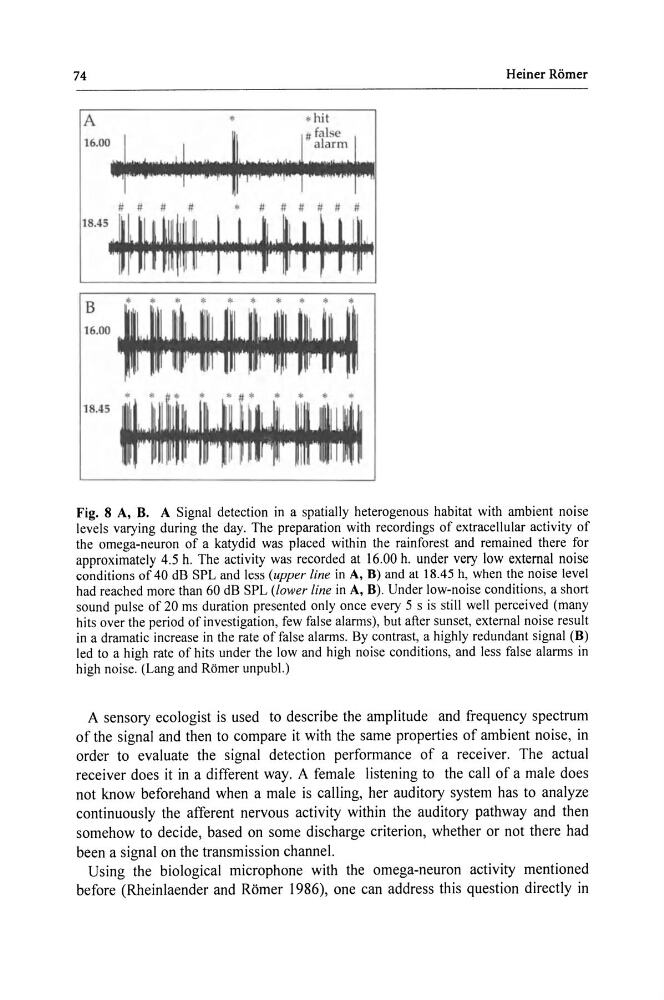
Fig. 8 A, B. A Signal detection in a spatially heterogenous habitat with ambient noise
levels varying during the day. The preparation with recordings of extracellular activity of
the omega-neuron of a katydid was placed within the rainforest and remained there for
approximately 4.5 h. The activity was recorded at 16.00 h. under very low external noise
conditions of 40 dB SPL and less (upper line in A, B) and at 18.45 h, when the noise level
had reached more than 60 dB SPL (lower line in A, B). Under low-noise conditions, a short
sound pulse of 20 ms duration presented only once every 5 s is still well perceived (many
hits over the period of investigation, few false alarms), but after sunset, external noise result
in a dramatic increase in the rate of false alarms. By contrast, a highly redundant signal (B)
led to a high rate of hits under the low and high noise conditions, and less false alarms in
high noise. (Lang and Romer unpubl.)
A sensory ecologist is used to describe the amplitude and frequency spectrum
of the signal and then to compare it with the same properties of ambient noise, in
order to evaluate the signal detection performance of a receiver. The actual
receiver does it in a different way. A female listening to the call of a male does
not know beforehand when a male is calling, her auditory system has to analyze
continuously the afferent nervous activity within the auditory pathway and then
somehow to decide, based on some discharge criterion, whether or not there had
been a signal on the transmission channel.
Using the biological microphone with the omega-neuron activity mentioned
before (Rheinlaender and Romer I 986), one can address this question directly in
Heiner Romer
A
*
• hit
16.00 .1.
# false
tl
alarm
'I
'I
I'
T
# # #
#
• # # # # # #
"·" ·~ ~~~~~ ~1+11f '+~ + ~ ~~~~I
B
16.00
18.45
Fig. 8 A, B. A Signal detection in a spatially heterogenous habitat with ambient noise
levels varying during the day. The preparation with recordings of extracellular activity of
the omega-neuron of a katydid was placed within the rainforest and remained there for
approximately 4.5 h. The activity was recorded at 16.00 h. under very low external noise
conditions of 40 dB SPL and less (upper line in A, B) and at 18.45 h, when the noise level
had reached more than 60 dB SPL (lower line in A, B). Under low-noise conditions, a short
sound pulse of 20 ms duration presented only once every 5 s is still well perceived (many
hits over the period of investigation, few false alarms), but after sunset, external noise result
in a dramatic increase in the rate of false alarms. By contrast, a highly redundant signal (B)
led to a high rate of hits under the low and high noise conditions, and less false alarms in
high noise. (Lang and Romer unpubl.)
A sensory ecologist is used to describe the amplitude and frequency spectrum
of the signal and then to compare it with the same properties of ambient noise, in
order to evaluate the signal detection performance of a receiver. The actual
receiver does it in a different way. A female listening to the call of a male does
not know beforehand when a male is calling, her auditory system has to analyze
continuously the afferent nervous activity within the auditory pathway and then
somehow to decide, based on some discharge criterion, whether or not there had
been a signal on the transmission channel.
Using the biological microphone with the omega-neuron activity mentioned
before (Rheinlaender and Romer I 986), one can address this question directly in