

Impedance Matching in Sound Production and Hearing: a Comparative Study
43
Typically, the structure that is driven has resonant properties which control the
sound frequency within a narrow band. Examples of air-driven resonators are the
mammalian larynx or bird syrinx (for reviews, see Busnel 1963 ). In many of this
type of structure, a reed or membrane is set in vibration by the air current, the
velocity of which is modulated by the vibration of the mechanical element but the
overall tonal quality may also be affected by accessory structures (see section
3.4).
A wide variety of stridulatory mechanisms is found in insects, usually with a
file or row of teeth that makes periodic contact with a ridge whereby, with the
passage of one across the other, a series of impacts is produced. The effect of these
impacts depends on the shape of the teeth and scraper, the speed of the cycle of
catch and release of the teeth and on the nature of the structures that receive the
impacts (Dumortier 1963a, b).
Many of this type of structure appear to be resonant (see e.g Nocke 1971 and,
for a recent review, Bennet-Clark 1999). The resonant properties depend on the
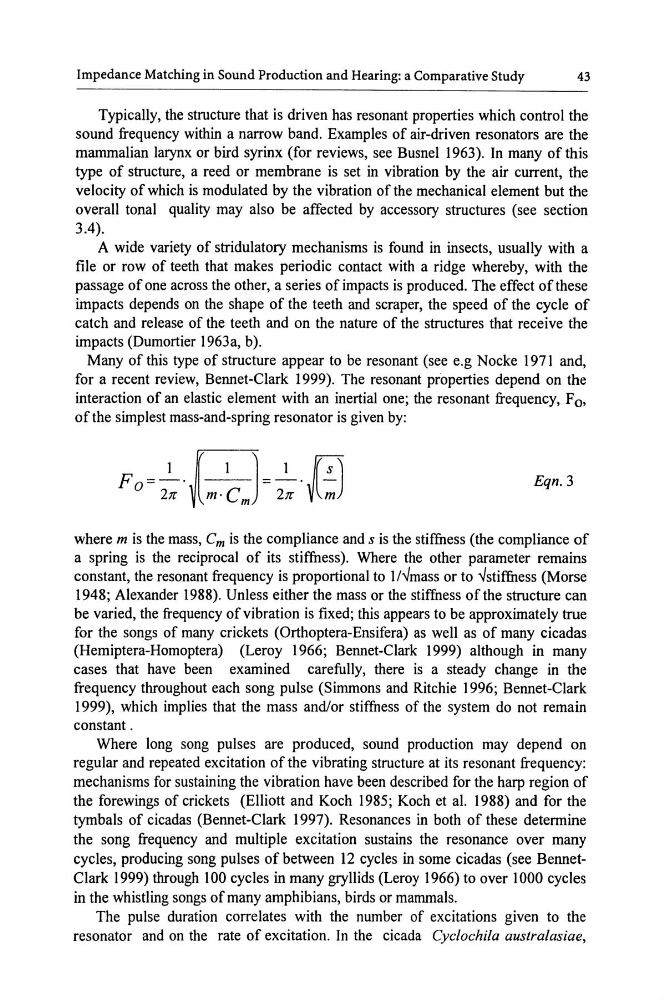
interaction of an elastic element with an inertial one; the resonant frequency, F 0 ,
of the simplest mass-and-spring resonator is given by:
Fo=-1 . r'l ]=-1 . fs)
21l vl~J 2;r v~-;;;J
Eqn.3
where m is the mass, Cm is the compliance and s is the stiffness (the compliance of
a spring is the reciprocal of its stiffness). Where the other parameter remains
constant, the resonant frequency is proportional to 1/...Jrnass or to ...Jstiffness (Morse
1948; Alexander 1988). Unless either the mass or the stiffness of the structure can
be varied, the frequency of vibration is fixed; this appears to be approximately true
for the songs of many crickets (Orthoptera-Ensifera) as well as of many cicadas
(Hemiptera-Homoptera) (Leroy 1966; Bennet-Clark 1999) although in many
cases that have been examined carefully, there is a steady change in the
frequency throughout each song pulse (Simmons and Ritchie 1996; Bennet-Clark
1999), which implies that the mass and/or stiffness of the system do not remain
constant.
Where long song pulses are produced, sound production may depend on
regular and repeated excitation of the vibrating structure at its resonant frequency:
mechanisms for sustaining the vibration have been described for the harp region of
the forewings of crickets (Elliott and Koch I985; Koch eta!. I988) and for the
tymbals of cicadas (Bennet-Clark I997). Resonances in both of these determine
the song frequency and multiple excitation sustains the resonance over many
cycles, producing song pulses of between 12 cycles in some cicadas (see BennetClark 1999) through I 00 cycles in many gryllids (Leroy I966) to over I 000 cycles
in the whistling songs of many amphibians, birds or mammals.
The pulse duration correlates with the number of excitations given to the
resonator and on the rate of excitation. In the cicada Cyclochila australasiae,
43
Typically, the structure that is driven has resonant properties which control the
sound frequency within a narrow band. Examples of air-driven resonators are the
mammalian larynx or bird syrinx (for reviews, see Busnel 1963 ). In many of this
type of structure, a reed or membrane is set in vibration by the air current, the
velocity of which is modulated by the vibration of the mechanical element but the
overall tonal quality may also be affected by accessory structures (see section
3.4).
A wide variety of stridulatory mechanisms is found in insects, usually with a
file or row of teeth that makes periodic contact with a ridge whereby, with the
passage of one across the other, a series of impacts is produced. The effect of these
impacts depends on the shape of the teeth and scraper, the speed of the cycle of
catch and release of the teeth and on the nature of the structures that receive the
impacts (Dumortier 1963a, b).
Many of this type of structure appear to be resonant (see e.g Nocke 1971 and,
for a recent review, Bennet-Clark 1999). The resonant properties depend on the
interaction of an elastic element with an inertial one; the resonant frequency, F 0 ,
of the simplest mass-and-spring resonator is given by:
Fo=-1 . r'l ]=-1 . fs)
21l vl~J 2;r v~-;;;J
Eqn.3
where m is the mass, Cm is the compliance and s is the stiffness (the compliance of
a spring is the reciprocal of its stiffness). Where the other parameter remains
constant, the resonant frequency is proportional to 1/...Jrnass or to ...Jstiffness (Morse
1948; Alexander 1988). Unless either the mass or the stiffness of the structure can
be varied, the frequency of vibration is fixed; this appears to be approximately true
for the songs of many crickets (Orthoptera-Ensifera) as well as of many cicadas
(Hemiptera-Homoptera) (Leroy 1966; Bennet-Clark 1999) although in many
cases that have been examined carefully, there is a steady change in the
frequency throughout each song pulse (Simmons and Ritchie 1996; Bennet-Clark
1999), which implies that the mass and/or stiffness of the system do not remain
constant.
Where long song pulses are produced, sound production may depend on
regular and repeated excitation of the vibrating structure at its resonant frequency:
mechanisms for sustaining the vibration have been described for the harp region of
the forewings of crickets (Elliott and Koch I985; Koch eta!. I988) and for the
tymbals of cicadas (Bennet-Clark I997). Resonances in both of these determine
the song frequency and multiple excitation sustains the resonance over many
cycles, producing song pulses of between 12 cycles in some cicadas (see BennetClark 1999) through I 00 cycles in many gryllids (Leroy I966) to over I 000 cycles
in the whistling songs of many amphibians, birds or mammals.
The pulse duration correlates with the number of excitations given to the
resonator and on the rate of excitation. In the cicada Cyclochila australasiae,