

24
Lars Chittka and Adriana Briscoe
4 Molecular Tuning, Constraints, and Adaptation
To understand how easily visual pigments can be matched to the colored
environment, it is necessary to look at their molecular structure, the mechanisms
of tuning, and the genes that encode the pigments. For example, we would expect
that color receptors readily adapt if small genetic changes (e.g., single mutations)
cause large changes in spectral sensitivity. We predict slower adaptation if most
mutations are adaptively neutral. Or if several mutations are necessary in
conjunction to alter spectral sensitivity, this may mean that any functional changes
require a comparatively improbable sequence of mutation events.
Cytoplasmic
Extracellular
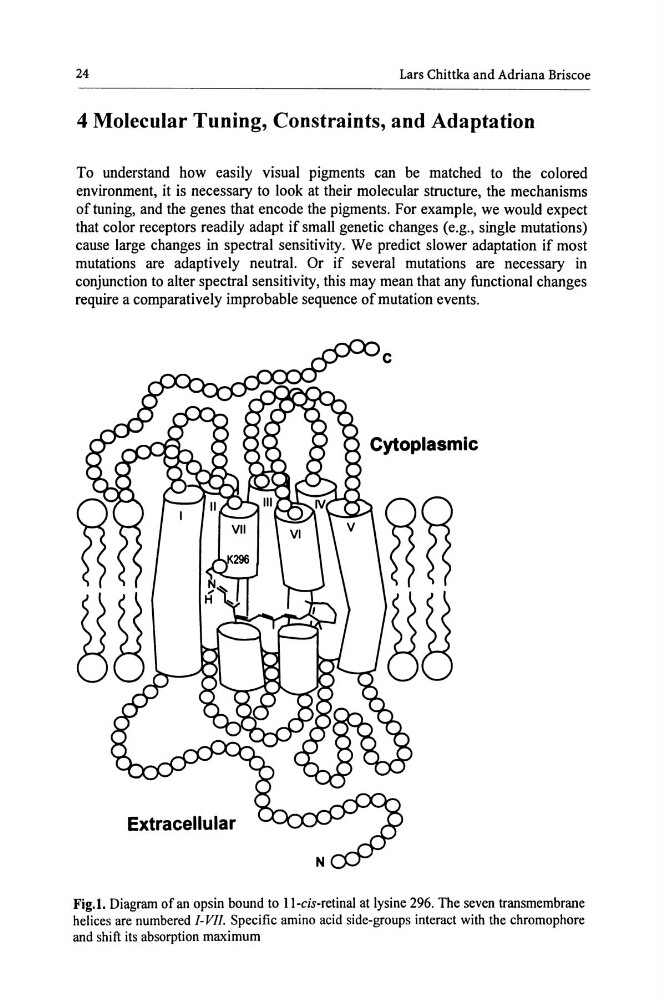
Fig.l. Diagram of an opsin bound to 11-cis-retinal at lysine 296. The seven transmembrane
helices are numbered I-VII. Specific amino acid side-groups interact with the chromophore
and shift its absorption maximum
Lars Chittka and Adriana Briscoe
4 Molecular Tuning, Constraints, and Adaptation
To understand how easily visual pigments can be matched to the colored
environment, it is necessary to look at their molecular structure, the mechanisms
of tuning, and the genes that encode the pigments. For example, we would expect
that color receptors readily adapt if small genetic changes (e.g., single mutations)
cause large changes in spectral sensitivity. We predict slower adaptation if most
mutations are adaptively neutral. Or if several mutations are necessary in
conjunction to alter spectral sensitivity, this may mean that any functional changes
require a comparatively improbable sequence of mutation events.
Cytoplasmic
Extracellular
Fig.l. Diagram of an opsin bound to 11-cis-retinal at lysine 296. The seven transmembrane
helices are numbered I-VII. Specific amino acid side-groups interact with the chromophore
and shift its absorption maximum