

326
Gerhard von der Emde
4 Three-Dimensional Location of Objects
For a long time it was thought impossible to localize an object in threedimensional space using active electrolocation. Instead, it was assumed that the
electric images provide ambiguous information when a fish has to determine
object distance without knowing object size, impedance or shape. Figure 3
illustrates these ambiguities by showing the electric images of two small metal
spheres located at different distances from the skin of a G. petersii.
-
MeiCI"cwe2cm
-
MaiO" clbe 4cm
-
Plasllc clbe 2cm
-
Plasllc clbe 4cm
- - . Metal sphefe 4cm
1.0
Distance from Mouth [em]
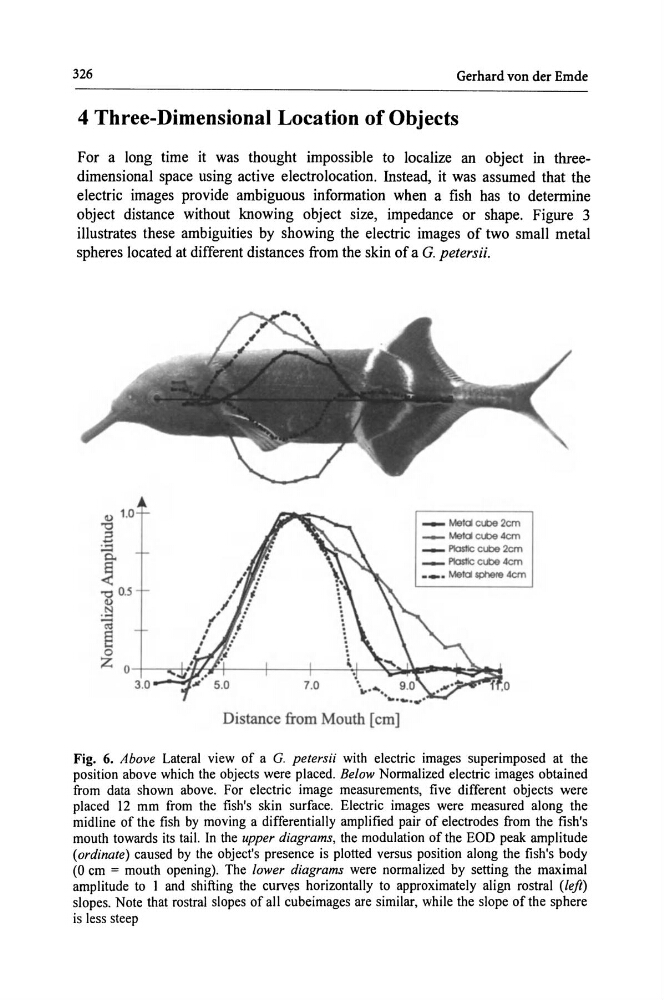
Fig. 6. Above Lateral view of a G. p etersii with electric images superimposed at the
position above which the objects were placed. Below Normalized electric images obtained
from data shown above. For electric image measurements, five different objects were
placed 12 mm from the fish's skin surface. Electric images were measured along the
midline of the fish by moving a differentially amplified pair of electrodes from the fish's
mouth towards its tail. In the upper diagrams, the modulation of the EOD peak amplitude
(ordinate) caused by the object's presence is plotted versus position along the fish's body
(0 em = mouth opening). The lower diagrams were normalized by setting the maximal
amplitude to I and shifting the curves horizontally to approximately align rostral (left)
slopes. Note that rostral slopes of all cubeimages are similar, while the slope of the sphere
is less steep
Gerhard von der Emde
4 Three-Dimensional Location of Objects
For a long time it was thought impossible to localize an object in threedimensional space using active electrolocation. Instead, it was assumed that the
electric images provide ambiguous information when a fish has to determine
object distance without knowing object size, impedance or shape. Figure 3
illustrates these ambiguities by showing the electric images of two small metal
spheres located at different distances from the skin of a G. petersii.
-
MeiCI"cwe2cm
-
MaiO" clbe 4cm
-
Plasllc clbe 2cm
-
Plasllc clbe 4cm
- - . Metal sphefe 4cm
1.0
Distance from Mouth [em]
Fig. 6. Above Lateral view of a G. p etersii with electric images superimposed at the
position above which the objects were placed. Below Normalized electric images obtained
from data shown above. For electric image measurements, five different objects were
placed 12 mm from the fish's skin surface. Electric images were measured along the
midline of the fish by moving a differentially amplified pair of electrodes from the fish's
mouth towards its tail. In the upper diagrams, the modulation of the EOD peak amplitude
(ordinate) caused by the object's presence is plotted versus position along the fish's body
(0 em = mouth opening). The lower diagrams were normalized by setting the maximal
amplitude to I and shifting the curves horizontally to approximately align rostral (left)
slopes. Note that rostral slopes of all cubeimages are similar, while the slope of the sphere
is less steep