

Electric Fields and Electroreception
315
Electric organs of weakly electric fish produce EODs of only a few volts,
which are undetectable for animals lacking specialized electroreceptors. These fish
use them for orientation in their habitat and for electrocommunication. Many
species of weakly electric fish have evolved in Africa and South America, where
they live in tropical freshwater streams, rivers, and lakes. These aquatic habitats
have several features in common. ( 1) They all contain low concentrations of ions
resulting in a low electrical conductivity (between 10 and 150 f.LScm" 1 ), which
favors the spatial spreading of electrical fields. (2) Water temperature often is
rather high (between 25 and 35 °C). (3) The pH is low. Besides these similarities,
different habitats vary considerably. The water may be fast-flowing or stagnant,
the bottom may be sandy, rocky, or covered by decaying plant material. The
visibility may be high or low because of turbid, muddy water. Water depth may be
very shallow or rather deep. Great depths together with turbid waters result in
habitats such as the Amazon River at depths below ca. 7 m with complete
darkness all the time. In this diversity of habitats many different species of weakly
electric fish have evolved in both Africa (more than 200 species) and South
America (more than 100 species).
Gnathonemus petersii
Gymnotus carapo
~ · ~---L~--------"0
~
c.
E
Frequency (Hz)
~ "
" "
"
::.»
Q.
E"'
I
v v v v
v v
5 ms
-
Frequency (Hz)
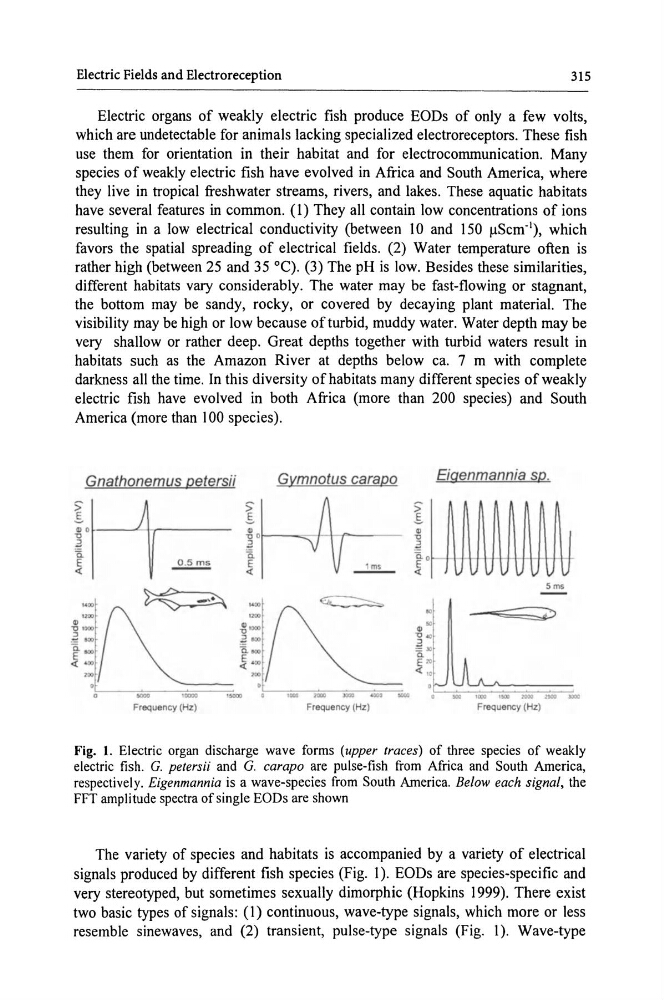
Fig. 1. Electric organ discharge wave forms (upper traces) of three species of weakly
electric fish. G. petersii and G. carapo are pulse-fish from Africa and South America,
respectively. Eigenmannia is a wave-species from South America. Below each signal, the
FFT amplitude spectra of single EODs are shown
The variety of species and habitats is accompanied by a variety of electrical
signals produced by different fish species (Fig. 1 ). EODs are species-specific and
very stereotyped, but sometimes sexually dimorphic (Hopkins 1999). There exist
two basic types of signals: (1) continuous, wave-type signals, which more or less
resemble sinewaves, and (2) transient, pulse-type signals (Fig. 1 ). Wave-type
315
Electric organs of weakly electric fish produce EODs of only a few volts,
which are undetectable for animals lacking specialized electroreceptors. These fish
use them for orientation in their habitat and for electrocommunication. Many
species of weakly electric fish have evolved in Africa and South America, where
they live in tropical freshwater streams, rivers, and lakes. These aquatic habitats
have several features in common. ( 1) They all contain low concentrations of ions
resulting in a low electrical conductivity (between 10 and 150 f.LScm" 1 ), which
favors the spatial spreading of electrical fields. (2) Water temperature often is
rather high (between 25 and 35 °C). (3) The pH is low. Besides these similarities,
different habitats vary considerably. The water may be fast-flowing or stagnant,
the bottom may be sandy, rocky, or covered by decaying plant material. The
visibility may be high or low because of turbid, muddy water. Water depth may be
very shallow or rather deep. Great depths together with turbid waters result in
habitats such as the Amazon River at depths below ca. 7 m with complete
darkness all the time. In this diversity of habitats many different species of weakly
electric fish have evolved in both Africa (more than 200 species) and South
America (more than 100 species).
Gnathonemus petersii
Gymnotus carapo
~ · ~---L~--------"0
~
c.
E
Frequency (Hz)
~ "
" "
"
::.»
Q.
E"'
I
v v v v
v v
5 ms
-
Frequency (Hz)
Fig. 1. Electric organ discharge wave forms (upper traces) of three species of weakly
electric fish. G. petersii and G. carapo are pulse-fish from Africa and South America,
respectively. Eigenmannia is a wave-species from South America. Below each signal, the
FFT amplitude spectra of single EODs are shown
The variety of species and habitats is accompanied by a variety of electrical
signals produced by different fish species (Fig. 1 ). EODs are species-specific and
very stereotyped, but sometimes sexually dimorphic (Hopkins 1999). There exist
two basic types of signals: (1) continuous, wave-type signals, which more or less
resemble sinewaves, and (2) transient, pulse-type signals (Fig. 1 ). Wave-type