

The Geomagnetic Field and its Role in Directional Orientation
301
direction when it was presented at light levels of 0.0020 or 0.0030 wm- 2 ; at
0.0150 wm· 2 , in contrast, a significant counterclockwise shift of about 70° was
observed (W. Wiltschko and R. Wiltschko 2000). The interpretation of this finding
is difficult. A change in response at higher intensities of white light was not
observed. The crucial point appears to be that the relatively bright light consists
only of a very narrow band of wavelengths; but how this disruption of the natural
balance between the various wavelengths causes a change in behavior is unclear.
uv violet blue
green
yellow
red
IR
400
450
500
550
600
650
700 nm
Newt Notophthalmus viridescens:
shoreward orientation
+
+ e -? - -
e
homeward orientation
+
e
e
e
Migratory orientation of birds:
Silvereyes, Zosterops latera/is
+
+
e
European Robin, Erithacus rubecula
+
+
+ e ee
Garden Warbler, Sylvia borin
+
+ e e
Homing pigeons, Columba Iivia
+
e e
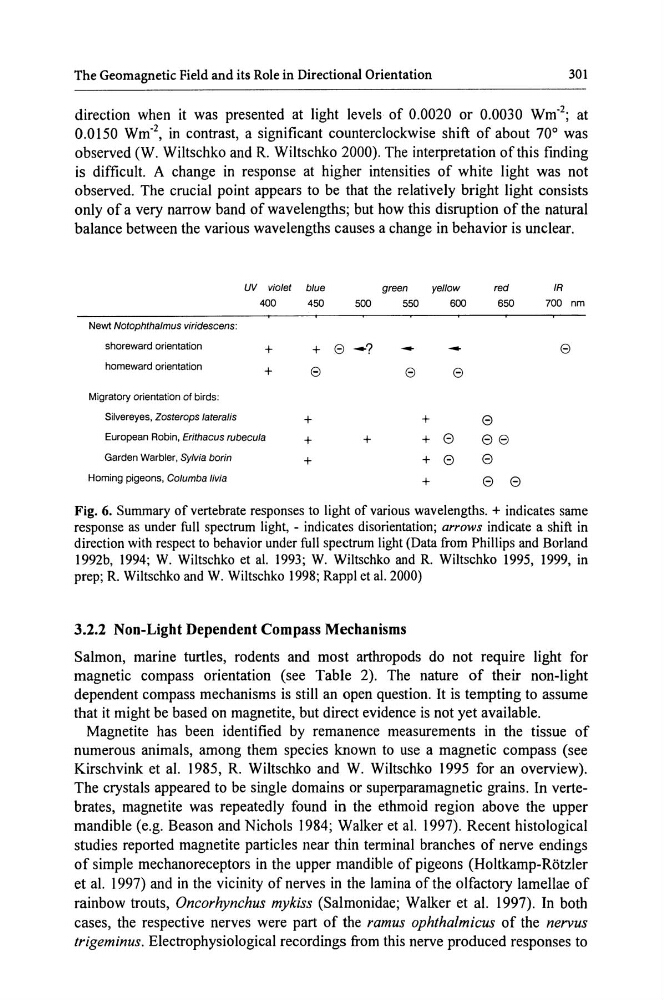
Fig. 6. Summary of vertebrate responses to light of various wavelengths. + indicates same
response as under full spectrum light, - indicates disorientation; arrows indicate a shift in
direction with respect to behavior under full spectrum light (Data from Phillips and Borland
1992b, 1994; W. Wiltschko eta!. 1993; W. Wiltschko and R. Wiltschko 1995, 1999, in
prep; R. Wiltschko and W. Wiltschko 1998; Rappl eta!. 2000)
3.2.2 Non-Light Dependent Compass Mechanisms
Salmon, marine turtles, rodents and most arthropods do not require light for
magnetic compass orientation (see Table 2). The nature of their non-light
dependent compass mechanisms is still an open question. It is tempting to assume
that it might be based on magnetite, but direct evidence is not yet available.
Magnetite has been identified by remanence measurements in the tissue of
numerous animals, among them species known to use a magnetic compass (see
Kirschvink et al. 1985, R. Wiltschko and W. Wiltschko 1995 for an overview).
The crystals appeared to be single domains or superparamagnetic grains. In vertebrates, magnetite was repeatedly found in the ethmoid region above the upper
mandible (e.g. Beason and Nichols 1984; Walker eta!. 1997). Recent histological
studies reported magnetite particles near thin terminal branches of nerve endings
of simple mechanoreceptors in the upper mandible of pigeons (Holtkamp-Rotzler
et a!. 1997) and in the vicinity of nerves in the lamina of the olfactory lamellae of
rainbow trouts, Oncorhynchus mykiss (Salmonidae; Walker et a!. 1997). In both
cases, the respective nerves were part of the ramus ophthalmicus of the nervus
trigeminus. Electrophysiological recordings from this nerve produced responses to
301
direction when it was presented at light levels of 0.0020 or 0.0030 wm- 2 ; at
0.0150 wm· 2 , in contrast, a significant counterclockwise shift of about 70° was
observed (W. Wiltschko and R. Wiltschko 2000). The interpretation of this finding
is difficult. A change in response at higher intensities of white light was not
observed. The crucial point appears to be that the relatively bright light consists
only of a very narrow band of wavelengths; but how this disruption of the natural
balance between the various wavelengths causes a change in behavior is unclear.
uv violet blue
green
yellow
red
IR
400
450
500
550
600
650
700 nm
Newt Notophthalmus viridescens:
shoreward orientation
+
+ e -? - -
e
homeward orientation
+
e
e
e
Migratory orientation of birds:
Silvereyes, Zosterops latera/is
+
+
e
European Robin, Erithacus rubecula
+
+
+ e ee
Garden Warbler, Sylvia borin
+
+ e e
Homing pigeons, Columba Iivia
+
e e
Fig. 6. Summary of vertebrate responses to light of various wavelengths. + indicates same
response as under full spectrum light, - indicates disorientation; arrows indicate a shift in
direction with respect to behavior under full spectrum light (Data from Phillips and Borland
1992b, 1994; W. Wiltschko eta!. 1993; W. Wiltschko and R. Wiltschko 1995, 1999, in
prep; R. Wiltschko and W. Wiltschko 1998; Rappl eta!. 2000)
3.2.2 Non-Light Dependent Compass Mechanisms
Salmon, marine turtles, rodents and most arthropods do not require light for
magnetic compass orientation (see Table 2). The nature of their non-light
dependent compass mechanisms is still an open question. It is tempting to assume
that it might be based on magnetite, but direct evidence is not yet available.
Magnetite has been identified by remanence measurements in the tissue of
numerous animals, among them species known to use a magnetic compass (see
Kirschvink et al. 1985, R. Wiltschko and W. Wiltschko 1995 for an overview).
The crystals appeared to be single domains or superparamagnetic grains. In vertebrates, magnetite was repeatedly found in the ethmoid region above the upper
mandible (e.g. Beason and Nichols 1984; Walker eta!. 1997). Recent histological
studies reported magnetite particles near thin terminal branches of nerve endings
of simple mechanoreceptors in the upper mandible of pigeons (Holtkamp-Rotzler
et a!. 1997) and in the vicinity of nerves in the lamina of the olfactory lamellae of
rainbow trouts, Oncorhynchus mykiss (Salmonidae; Walker et a!. 1997). In both
cases, the respective nerves were part of the ramus ophthalmicus of the nervus
trigeminus. Electrophysiological recordings from this nerve produced responses to