

The Geomagnetic Field and its Role in Directional Orientation
299
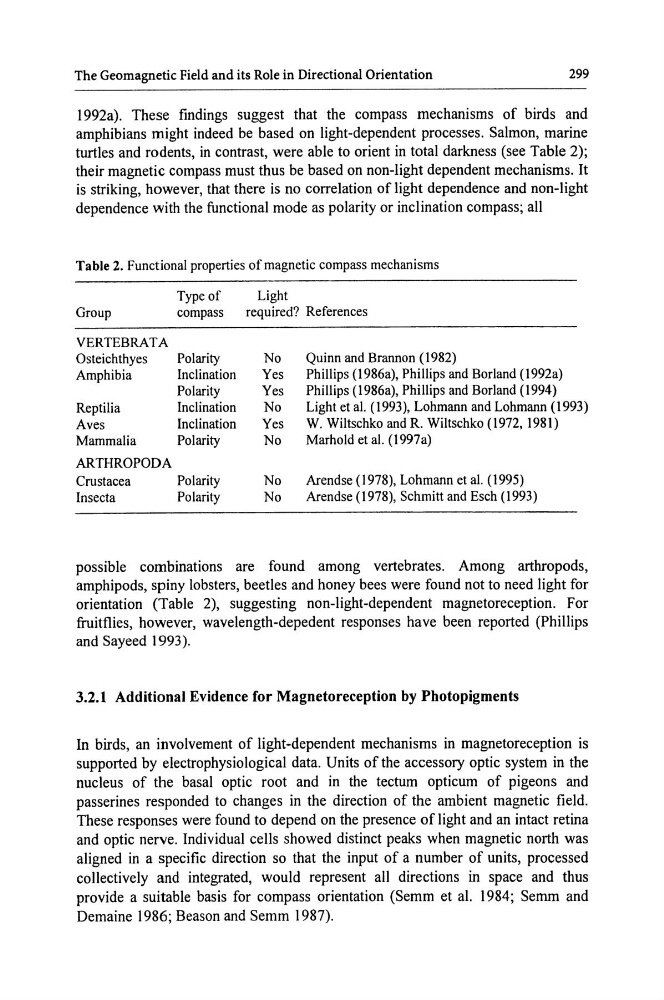
1992a). These findings suggest that the compass mechanisms of birds and
amphibians might indeed be based on light-dependent processes. Salmon, marine
turtles and rodents, in contrast, were able to orient in total darkness (see Table 2);
their magnetic compass must thus be based on non-light dependent mechanisms. It
is striking, however, that there is no correlation of light dependence and non-light
dependence with the functional mode as polarity or inclination compass; all
Table 2. Functional properties of magnetic compass mechanisms
Type of
Light
Group
compass required? References
VERTEBRATA
Osteichthyes
Polarity
No
Quinn and Brannon (1982)
Amphibia
Inclination
Yes Phillips (1986a), Phillips and Borland (1992a)
Polarity
Yes Phillips (1986a), Phillips and Borland (1994)
Reptilia
Inclination
No
Light et al. (1993), Lohmann and Lohmann (1993)
Aves
Inclination
Yes W. Wiltschko and R. Wiltschko (1972, 1981)
Mammalia
Polarity
No
Marhold et al. (1997a)
ARTHROPODA
Crustacea
Polarity
No
Arendse (1978), Lohmann et al. (1995)
Insecta
Polarity
No
Arendse (1978), Schmitt and Esch (1993)
possible combinations are found among vertebrates. Among arthropods,
amphipods, spiny lobsters, beetles and honey bees were found not to need light for
orientation (Table 2), suggesting non-light-dependent magnetoreception. For
fruitflies, however, wavelength-depedent responses have been reported (Phillips
and Sayeed 1993).
3.2.1 Additional Evidence for Magnetoreception by Photopigments
In birds, an involvement of light-dependent mechanisms in magnetoreception is
supported by electrophysiological data. Units of the accessory optic system in the
nucleus of the basal optic root and in the tectum opticum of pigeons and
passerines responded to changes in the direction of the ambient magnetic field.
These responses were found to depend on the presence of light and an intact retina
and optic nerve. Individual cells showed distinct peaks when magnetic north was
aligned in a specific direction so that the input of a number of units, processed
collectively and integrated, would represent all directions in space and thus
provide a suitable basis for compass orientation (Semm et al. 1984; Semm and
Demaine 1986; Beason and Semm 1987).
299
1992a). These findings suggest that the compass mechanisms of birds and
amphibians might indeed be based on light-dependent processes. Salmon, marine
turtles and rodents, in contrast, were able to orient in total darkness (see Table 2);
their magnetic compass must thus be based on non-light dependent mechanisms. It
is striking, however, that there is no correlation of light dependence and non-light
dependence with the functional mode as polarity or inclination compass; all
Table 2. Functional properties of magnetic compass mechanisms
Type of
Light
Group
compass required? References
VERTEBRATA
Osteichthyes
Polarity
No
Quinn and Brannon (1982)
Amphibia
Inclination
Yes Phillips (1986a), Phillips and Borland (1992a)
Polarity
Yes Phillips (1986a), Phillips and Borland (1994)
Reptilia
Inclination
No
Light et al. (1993), Lohmann and Lohmann (1993)
Aves
Inclination
Yes W. Wiltschko and R. Wiltschko (1972, 1981)
Mammalia
Polarity
No
Marhold et al. (1997a)
ARTHROPODA
Crustacea
Polarity
No
Arendse (1978), Lohmann et al. (1995)
Insecta
Polarity
No
Arendse (1978), Schmitt and Esch (1993)
possible combinations are found among vertebrates. Among arthropods,
amphipods, spiny lobsters, beetles and honey bees were found not to need light for
orientation (Table 2), suggesting non-light-dependent magnetoreception. For
fruitflies, however, wavelength-depedent responses have been reported (Phillips
and Sayeed 1993).
3.2.1 Additional Evidence for Magnetoreception by Photopigments
In birds, an involvement of light-dependent mechanisms in magnetoreception is
supported by electrophysiological data. Units of the accessory optic system in the
nucleus of the basal optic root and in the tectum opticum of pigeons and
passerines responded to changes in the direction of the ambient magnetic field.
These responses were found to depend on the presence of light and an intact retina
and optic nerve. Individual cells showed distinct peaks when magnetic north was
aligned in a specific direction so that the input of a number of units, processed
collectively and integrated, would represent all directions in space and thus
provide a suitable basis for compass orientation (Semm et al. 1984; Semm and
Demaine 1986; Beason and Semm 1987).