

Problems in Hygro- and Thermoreception
- - - - -
rapid step-like
slowly oscillating
temperature change
temperature change
steady temperature
signal-to-noise ratio as
indicated by dendritic outlines
[(imp/s)I"C]
[(imp/s)/("C/s))
1 40
2
700
-36
~:';:~a,,:,
-600 600 Spenphye<
+35
soo
-30 30 Periplaneta
-24
Spenphye. <
-330
400 Antheroea
300
- 19
20 Locuttu
:!08 200 ~~rpfgneta
[(imp/s)I"C]
r .. m 0 • 1 J
3 2.0
4 30
22 20
Spenphye.<
-IS
Periplaneta
10
8
6
10
4 .5
Antheraea
-0.9 0.9 Antheraea
+0,8 0.8 Locus to
0.7
2.4
2.0 2
IAcu.rta
Pl!riplaneta
+0.66
Cupitnnius
0.6
1.0 I Cupienniu.t
l A __ •_ o _ _ _ _ _ _ _ l03 IOO Cupien _n _lu _. • _ _ _ _ _ _ _
Cupienniu.1 · Periplaneta Locu.,·ta Antheraea Speophye.> ·
c
0.51lm
Periplaneta
\)
Locust a
o"ogo
ooo';pa
Cupiennius
0
281
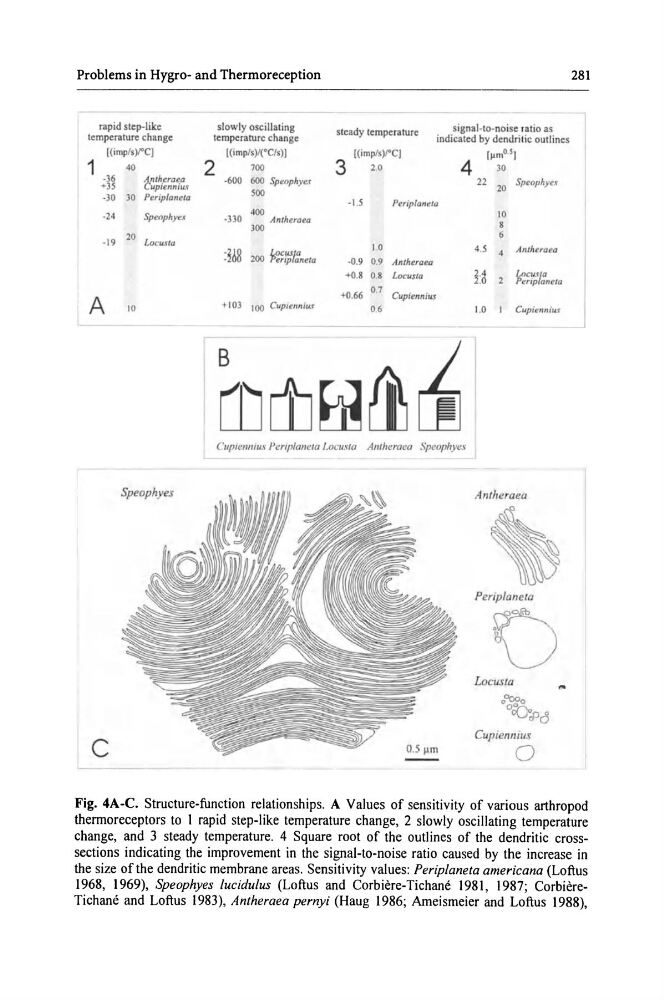
Fig. 4A-C. Structure-function relationships. A Values of sensitivity of various arthropod
therrnoreceptors to I rapid step-like temperature change, 2 slowly oscillating temperature
change, and 3 steady temperature. 4 Square root of the outlines of the dendritic crosssections indicating the improvement in the signal-to-noise ratio caused by the increase in
the size of the dendritic membrane areas. Sensitivity values: Periplaneta americana (Loftus
1968, 1969), Speophyes lucidulus (Loftus and Corbiere-Tichane 1981 , 1987; CorbiereTichane and Loftus 1983 ), A ntheraea pernyi (Haug 1986; Ameismeier and Loftus 1988),
- - - - -
rapid step-like
slowly oscillating
temperature change
temperature change
steady temperature
signal-to-noise ratio as
indicated by dendritic outlines
[(imp/s)I"C]
[(imp/s)/("C/s))
1 40
2
700
-36
~:';:~a,,:,
-600 600 Spenphye<
+35
soo
-30 30 Periplaneta
-24
Spenphye. <
-330
400 Antheroea
300
- 19
20 Locuttu
:!08 200 ~~rpfgneta
[(imp/s)I"C]
r .. m 0 • 1 J
3 2.0
4 30
22 20
Spenphye.<
-IS
Periplaneta
10
8
6
10
4 .5
Antheraea
-0.9 0.9 Antheraea
+0,8 0.8 Locus to
0.7
2.4
2.0 2
IAcu.rta
Pl!riplaneta
+0.66
Cupitnnius
0.6
1.0 I Cupienniu.t
l A __ •_ o _ _ _ _ _ _ _ l03 IOO Cupien _n _lu _. • _ _ _ _ _ _ _
Cupienniu.1 · Periplaneta Locu.,·ta Antheraea Speophye.> ·
c
0.51lm
Periplaneta
\)
Locust a
o"ogo
ooo';pa
Cupiennius
0
281
Fig. 4A-C. Structure-function relationships. A Values of sensitivity of various arthropod
therrnoreceptors to I rapid step-like temperature change, 2 slowly oscillating temperature
change, and 3 steady temperature. 4 Square root of the outlines of the dendritic crosssections indicating the improvement in the signal-to-noise ratio caused by the increase in
the size of the dendritic membrane areas. Sensitivity values: Periplaneta americana (Loftus
1968, 1969), Speophyes lucidulus (Loftus and Corbiere-Tichane 1981 , 1987; CorbiereTichane and Loftus 1983 ), A ntheraea pernyi (Haug 1986; Ameismeier and Loftus 1988),