

Problems in Hygro- and Thermoreception
A Periplaneta americana
m
Q Carausius morosus
8
E
A pis mellif era
Bombyxmori
279
C Locus/a migrator/a
Cupiennius solei
........
. -.... . .
. -..... .
. . . . . . . -
.. -.... .
. -- ... -.. . . . -. . ..
. . . . . . . .
. . . . - ...
. . . ------------.
--.- .....
. . . . . . -~
.... - .
. . . . . -...
. ....... .
. . . . --.. . - . .. - .
... - .. . .
. . . . . . . - .
. . ..... -. .
•
cuticular exoskeleton § .. osory cuticle 0 sheath cells !;;I dendritic sheath • m dense material f deose droplet
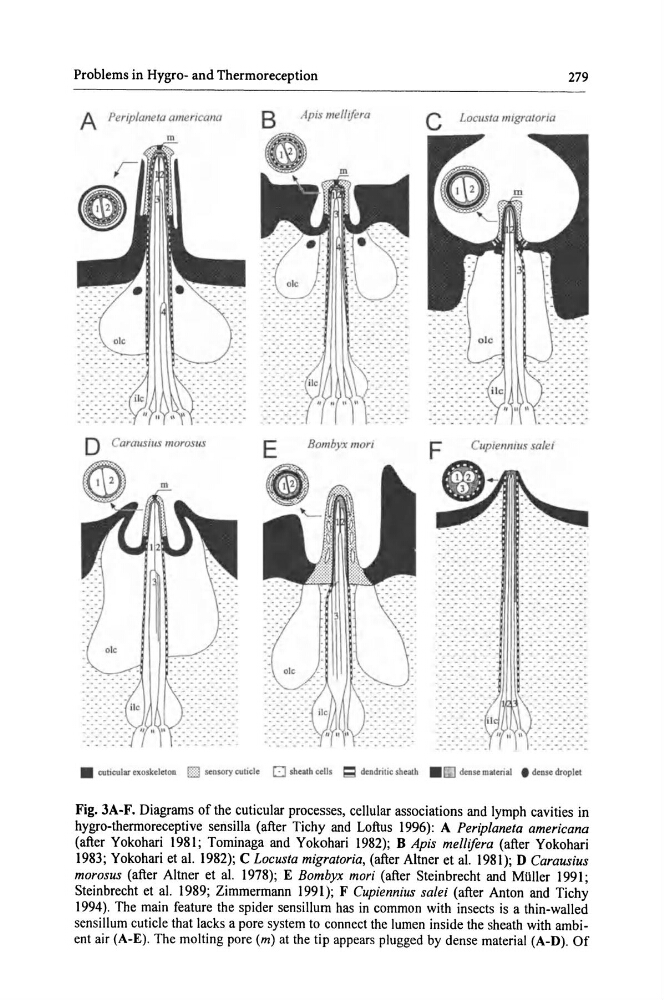
Fig. 3A-F. Diagrams of the cuticular processes, cellular associations and lymph cavities in
hygro-thermoreceptive sensilla (after Tichy and Loftus 1996): A Periplaneta americana
(after Yokohari 1981; Tominaga and Yokohari 1982); 8 Apis mellifera (after Yokohari
1983; Yokohari et al. 1982); C Locusta migratoria, (after Altner et al. 1981); D Carausius
morosus (after Altner et al. 1978); E Bombyx mori (after Steinbrecht and MUller 1991;
Steinbrecht et al. 1989; Zimmermann 1991 ); F Cupiennius salei (after Anton and Tichy
1994). The main feature the spider sensillum has in common with insects is a thin-walled
sensillum cuticle that lacks a pore system to connect the lumen inside the sheath with ambient air (A-E). The molting pore (m) at the tip appears plugged by dense material (A-D). Of
A Periplaneta americana
m
Q Carausius morosus
8
E
A pis mellif era
Bombyxmori
279
C Locus/a migrator/a
Cupiennius solei
........
. -.... . .
. -..... .
. . . . . . . -
.. -.... .
. -- ... -.. . . . -. . ..
. . . . . . . .
. . . . - ...
. . . ------------.
--.- .....
. . . . . . -~
.... - .
. . . . . -...
. ....... .
. . . . --.. . - . .. - .
... - .. . .
. . . . . . . - .
. . ..... -. .
•
cuticular exoskeleton § .. osory cuticle 0 sheath cells !;;I dendritic sheath • m dense material f deose droplet
Fig. 3A-F. Diagrams of the cuticular processes, cellular associations and lymph cavities in
hygro-thermoreceptive sensilla (after Tichy and Loftus 1996): A Periplaneta americana
(after Yokohari 1981; Tominaga and Yokohari 1982); 8 Apis mellifera (after Yokohari
1983; Yokohari et al. 1982); C Locusta migratoria, (after Altner et al. 1981); D Carausius
morosus (after Altner et al. 1978); E Bombyx mori (after Steinbrecht and MUller 1991;
Steinbrecht et al. 1989; Zimmermann 1991 ); F Cupiennius salei (after Anton and Tichy
1994). The main feature the spider sensillum has in common with insects is a thin-walled
sensillum cuticle that lacks a pore system to connect the lumen inside the sheath with ambient air (A-E). The molting pore (m) at the tip appears plugged by dense material (A-D). Of