

274
Harald Tichy and Ewald Gingl
F
_ W _hen_T _a_ n_ d_R _w _• H, Then F colD• FM0151, FDRY
I
..0.
- -.:: 1l" :--- --' 1l" ,______, 1l" ,__
F-- --"' 1)- -
- __, ..0. :_ _ _ _:-: ..0.
..0.
-
____jt_ 1)..0.
iL _..0. _
..0. ..0.
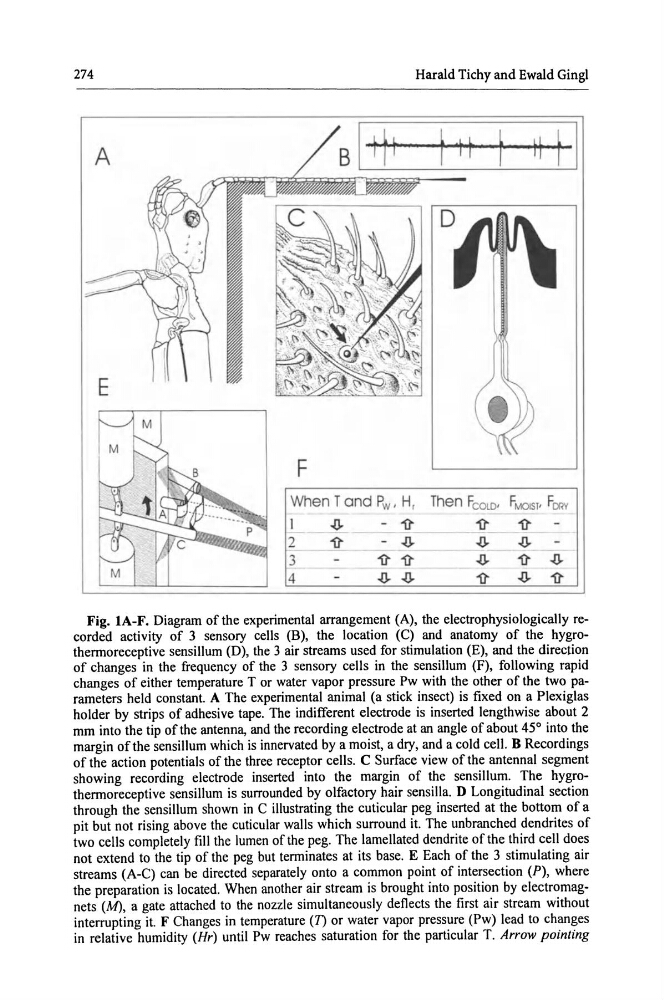
1)..0. 1)Fig. lA-F. Diagram of the experimental arrangement (A), the electrophysiologically recorded activity of 3 sensory cells (B), the location (C) and anatomy of the hygrothermoreceptive sensillum (D), the 3 air streams used for stimulation (E), and the direction
of changes in the frequency of the 3 sensory cells in the sensillum (F), following rapid
changes of either temperature T or water vapor pressure Pw with the other of the two parameters held constant. A The experimental animal (a stick insect) is fixed on a Plexiglas
holder by strips of adhesive tape. The indifferent electrode is inserted lengthwise about 2
mm into the tip of the antenna, and the recording electrode at an angle of about 45° into the
margin of the sensillum which is innervated by a moist, a dry, and a cold cell. B Recordings
of the action potentials of the three receptor cells. C Surface view of the antenna! segment
showing recording electrode inserted into the margin of the sensillum. The hygrothermoreceptive sensillum is surrounded by olfactory hair sensilla. D Longitudinal section
through the sensillum shown in C illustrating the cuticular peg inserted at the bottom of a
pit but not rising above the cuticular walls which surround it. The unbranched dendrites of
two cells completely fill the lumen of the peg. The lamellated dendrite of the third cell does
not extend to the tip of the peg but terminates at its base. E Each of the 3 stimulating air
streams (A-C) can be directed separately onto a common point of intersection (P), where
the preparation is located. When another air stream is brought into position by electromagnets (M), a gate attached to the nozzle simultaneously deflects the first air stream without
interrupting it. F Changes in temperature (7) or water vapor pressure (Pw) lead to changes
in relative humidity (Hr) until Pw reaches saturation for the particular T. Arrow pointing
Harald Tichy and Ewald Gingl
F
_ W _hen_T _a_ n_ d_R _w _• H, Then F colD• FM0151, FDRY
I
..0.
- -.:: 1l" :--- --' 1l" ,______, 1l" ,__
F-- --"' 1)- -
- __, ..0. :_ _ _ _:-: ..0.
..0.
-
____jt_ 1)..0.
iL _..0. _
..0. ..0.
1)..0. 1)Fig. lA-F. Diagram of the experimental arrangement (A), the electrophysiologically recorded activity of 3 sensory cells (B), the location (C) and anatomy of the hygrothermoreceptive sensillum (D), the 3 air streams used for stimulation (E), and the direction
of changes in the frequency of the 3 sensory cells in the sensillum (F), following rapid
changes of either temperature T or water vapor pressure Pw with the other of the two parameters held constant. A The experimental animal (a stick insect) is fixed on a Plexiglas
holder by strips of adhesive tape. The indifferent electrode is inserted lengthwise about 2
mm into the tip of the antenna, and the recording electrode at an angle of about 45° into the
margin of the sensillum which is innervated by a moist, a dry, and a cold cell. B Recordings
of the action potentials of the three receptor cells. C Surface view of the antenna! segment
showing recording electrode inserted into the margin of the sensillum. The hygrothermoreceptive sensillum is surrounded by olfactory hair sensilla. D Longitudinal section
through the sensillum shown in C illustrating the cuticular peg inserted at the bottom of a
pit but not rising above the cuticular walls which surround it. The unbranched dendrites of
two cells completely fill the lumen of the peg. The lamellated dendrite of the third cell does
not extend to the tip of the peg but terminates at its base. E Each of the 3 stimulating air
streams (A-C) can be directed separately onto a common point of intersection (P), where
the preparation is located. When another air stream is brought into position by electromagnets (M), a gate attached to the nozzle simultaneously deflects the first air stream without
interrupting it. F Changes in temperature (7) or water vapor pressure (Pw) lead to changes
in relative humidity (Hr) until Pw reaches saturation for the particular T. Arrow pointing