

258
I oop I .A. van Loon, Marcel Dicke
isothiocyanates that are entirely absent from emissions collected from solanaceous
plants. By now it is well established that specialist herbivorous arthropods make
use of these taxonomic patterns during host plant selection.
25
53.8%
spider-mite infested
20
15
10
- "C 5
c
\/:1\
CD
:c
00
......
~
.!!
2
4
6
8
10 12 14 16 18 20 22 24 26 28 30 32 34 36 38
i 25
I
0
::mechanically damaged' 147.2%
>
I I
ii 20
I I
I I
-
:36%
0
-
I
0
15
I
I
~
I
0
I
c 10
I
I
ftl
I
CD
~
I
E 5
I,
I
-
I I
I
-
I I
I
I
'.1'1.
c
J. b..
•• ,, '
,lb
•'
:I
0
00
2
4
6
8
10 12 14 16 18 20 22 24 26 28 30 32 34 36 38
E ftl 25
CD
'•
undamaged
I
>
'•
I
I I
I
i 20
I I
I
I I
I
G)
: 1 34.9%
:53%
a:
I
15
I
I
I
I
10
I
I
I
I
I
5
I
I
I
. .
,•-....
I
~ .... ~ .....
_/ \.. ':'~~ ...
..
00
4
6
8
10 12 14 16 18 20 22 24 26 28 30 32 34 36 38
Compound number
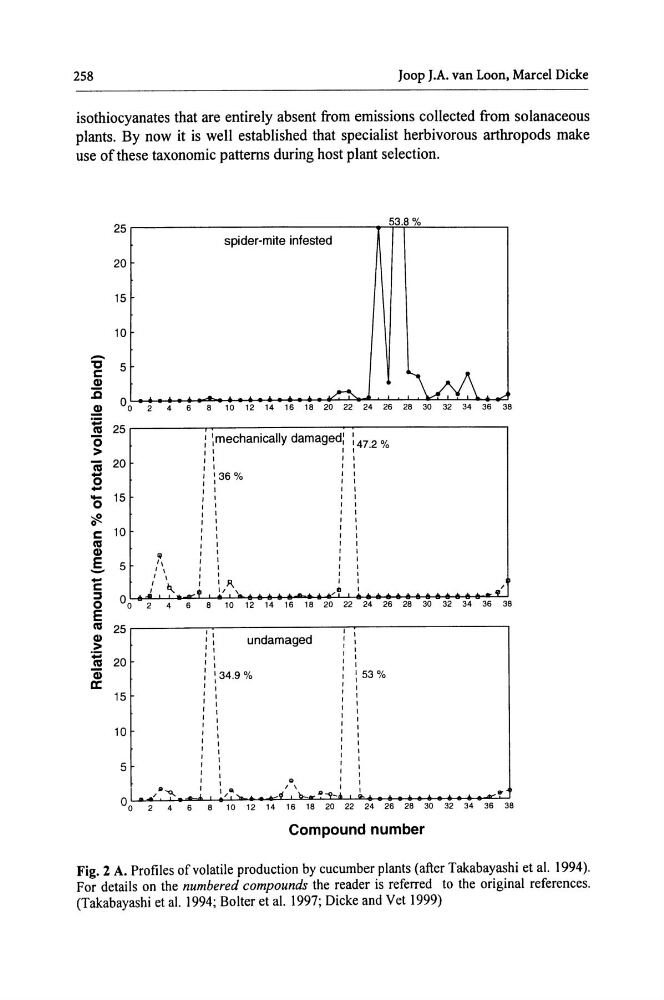
Fig. 2 A. Profiles of volatile production by cucumber plants (after Takabayashi et al. 1994).
For details on the numbered compounds the reader is referred to the original references.
(Takabayashi et al. 1994; Bolter et a!. 1997; Dicke and Vet 1999)
I oop I .A. van Loon, Marcel Dicke
isothiocyanates that are entirely absent from emissions collected from solanaceous
plants. By now it is well established that specialist herbivorous arthropods make
use of these taxonomic patterns during host plant selection.
25
53.8%
spider-mite infested
20
15
10
- "C 5
c
\/:1\
CD
:c
00
......
~
.!!
2
4
6
8
10 12 14 16 18 20 22 24 26 28 30 32 34 36 38
i 25
I
0
::mechanically damaged' 147.2%
>
I I
ii 20
I I
I I
-
:36%
0
-
I
0
15
I
I
~
I
0
I
c 10
I
I
ftl
I
CD
~
I
E 5
I,
I
-
I I
I
-
I I
I
I
'.1'1.
c
J. b..
•• ,, '
,lb
•'
:I
0
00
2
4
6
8
10 12 14 16 18 20 22 24 26 28 30 32 34 36 38
E ftl 25
CD
'•
undamaged
I
>
'•
I
I I
I
i 20
I I
I
I I
I
G)
: 1 34.9%
:53%
a:
I
15
I
I
I
I
10
I
I
I
I
I
5
I
I
I
. .
,•-....
I
~ .... ~ .....
_/ \.. ':'~~ ...
..
00
4
6
8
10 12 14 16 18 20 22 24 26 28 30 32 34 36 38
Compound number
Fig. 2 A. Profiles of volatile production by cucumber plants (after Takabayashi et al. 1994).
For details on the numbered compounds the reader is referred to the original references.
(Takabayashi et al. 1994; Bolter et a!. 1997; Dicke and Vet 1999)