

12
Temporal
Prolate a
Oblate a
Fore I aft
Prolate a
Oblate a
Lateral
Prolate a
Oblate a
David B. Dusenbery
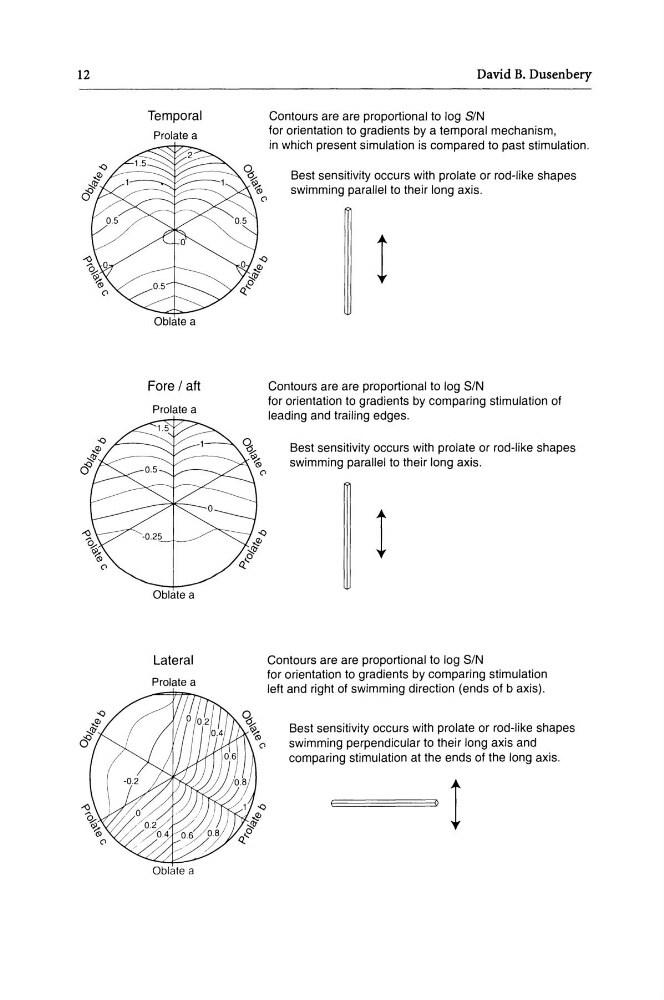
Contours are are proportional to Jog S/N
for orientation to gradients by a temporal mechanism,
in which present simulation is compared to past stimulation.
Best sensitivity occurs with prolate or rod-like shapes
swimming parallel to their long axis.
1
Contours are are proportional to log S/N
for orientation to gradients by comparing stimulation of
leading and trailing edges.
Best sensitivity occurs with prolate or rod-like shapes
swimming parallel to their long axis.
1
Contours are are proportional to log S/N
for orientation to gradients by comparing stimulation
left and right of swimming direction (ends of b axis).
Best sensitivity occurs with prolate or rod-like shapes
swimming perpendicular to their long axis and
comparing stimulation at the ends of the long axis.
!
Temporal
Prolate a
Oblate a
Fore I aft
Prolate a
Oblate a
Lateral
Prolate a
Oblate a
David B. Dusenbery
Contours are are proportional to Jog S/N
for orientation to gradients by a temporal mechanism,
in which present simulation is compared to past stimulation.
Best sensitivity occurs with prolate or rod-like shapes
swimming parallel to their long axis.
1
Contours are are proportional to log S/N
for orientation to gradients by comparing stimulation of
leading and trailing edges.
Best sensitivity occurs with prolate or rod-like shapes
swimming parallel to their long axis.
1
Contours are are proportional to log S/N
for orientation to gradients by comparing stimulation
left and right of swimming direction (ends of b axis).
Best sensitivity occurs with prolate or rod-like shapes
swimming perpendicular to their long axis and
comparing stimulation at the ends of the long axis.
!