

V. 1 Selectivity in Chemical Communication
Systems of Arthropods
Stefan Schulz
Institut fiir Organische Chemie, Technische Universitiit Braunschweig, Hagenring 30,
38106 Braunschweig, Germany
Abstract
The structural diversity of insect and arachnid pheromones is discussed in relation to
the required uniqueness of a chemical signal to be perceived against the background
of chemical noise. Various levels of structural elaboration can be found, depending
on the requirements of a species its environment. The physical properties needed
for proper function and the biosynthetic routes used for the production of these
compounds are also discussed. The wide variability of communication systems is
presented, showing the difficulties of drawing general rules useful for understanding the structural diversity in arthropod pheromone communication.
Key words Pheromones, structural diversity, biosynthesis, physical properties of
pheromones, spiders
1 Introduction and Terminology
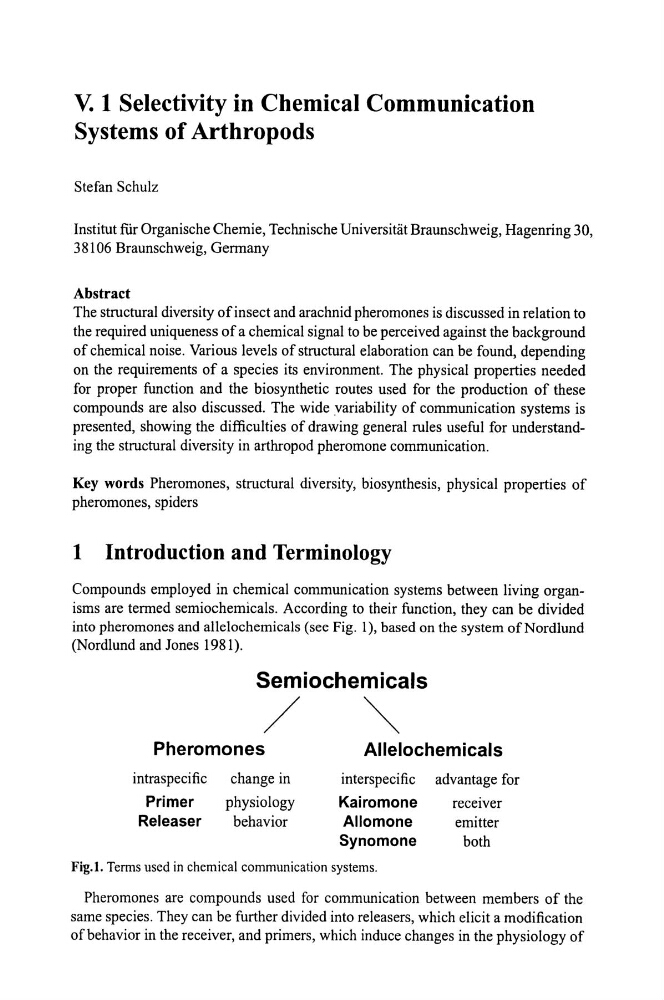
Compounds employed in chemical communication systems between living organisms are termed semiochemicals. According to their function, they can be divided
into pheromones and allelochemicals (see Fig. 1), based on the system ofNordlund
(Nordlund and Jones 1981).
Semiochemicals
/
~
Pheromones
Allelochemicals
intraspecific
Primer
Releaser
change in
physiology
behavior
interspecific
Kairomone
Allomone
Synomone
Fig. I. Terms used in chemical communication systems.
advantage for
recetver
emitter
both
Pheromones are compounds used for communication between members of the
same species. They can be further divided into releasers, which elicit a modification
of behavior in the receiver, and primers, which induce changes in the physiology of
Systems of Arthropods
Stefan Schulz
Institut fiir Organische Chemie, Technische Universitiit Braunschweig, Hagenring 30,
38106 Braunschweig, Germany
Abstract
The structural diversity of insect and arachnid pheromones is discussed in relation to
the required uniqueness of a chemical signal to be perceived against the background
of chemical noise. Various levels of structural elaboration can be found, depending
on the requirements of a species its environment. The physical properties needed
for proper function and the biosynthetic routes used for the production of these
compounds are also discussed. The wide variability of communication systems is
presented, showing the difficulties of drawing general rules useful for understanding the structural diversity in arthropod pheromone communication.
Key words Pheromones, structural diversity, biosynthesis, physical properties of
pheromones, spiders
1 Introduction and Terminology
Compounds employed in chemical communication systems between living organisms are termed semiochemicals. According to their function, they can be divided
into pheromones and allelochemicals (see Fig. 1), based on the system ofNordlund
(Nordlund and Jones 1981).
Semiochemicals
/
~
Pheromones
Allelochemicals
intraspecific
Primer
Releaser
change in
physiology
behavior
interspecific
Kairomone
Allomone
Synomone
Fig. I. Terms used in chemical communication systems.
advantage for
recetver
emitter
both
Pheromones are compounds used for communication between members of the
same species. They can be further divided into releasers, which elicit a modification
of behavior in the receiver, and primers, which induce changes in the physiology of