

10
David B. Dusenbery
As seen in Fig. 3, this analysis has led to the surprising conclusion that rod-like
shapes with axial ratios greater than two (as have most motile bacteria) increase
hydrodynamic drag. However, elongated rod-like shapes slow rotation caused by
Brownian motion, and this increases the time available to measure concentration
gradients. This provides large benefits in detecting gradients, especially by
temporal comparison. This explains why rods with axial ratios greater than two are
common among motile bacteria.
In addition, it explains why temporal comparison is the common mechanism of
gradient detection, which is not necessarily superior to spatial comparison for
spherical cells (Dusenbery 1998b ).
0.99
m
' !-..' bI -
Q)
0.9
~0
c
0'-'bQ)
~
0>
·' ::-..0
0<::'
-
~
C$
0
0.5
f$:'0
~0
c
~
~0
0
~0
+-'
u
ctl
0.1
..__
LL
0.01
-1
0
2
log Length (Jlm)
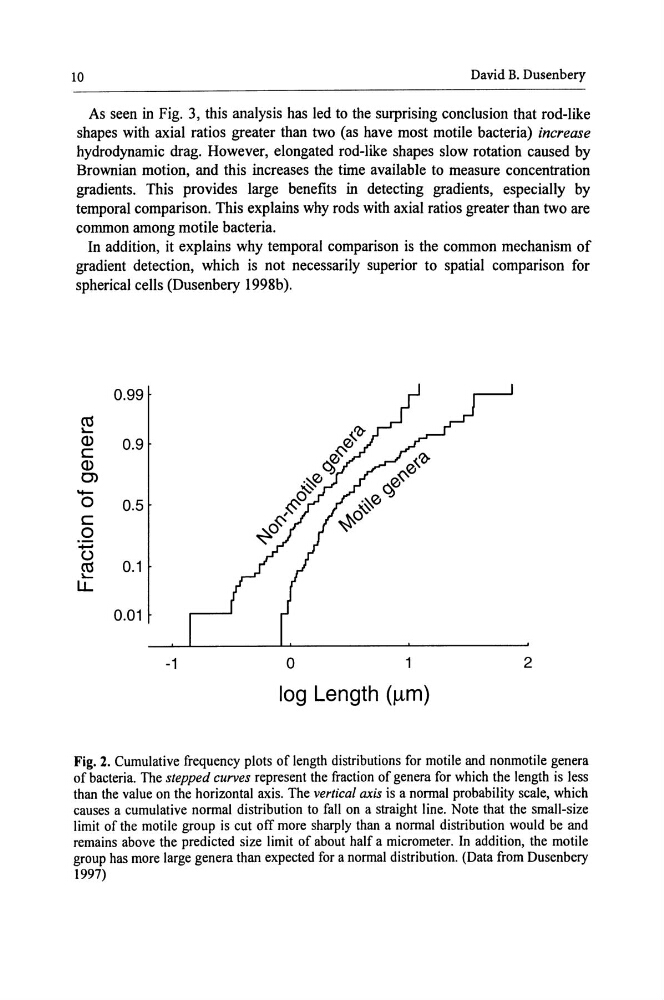
Fig. 2. Cumulative frequency plots of length distributions for motile and nonmotile genera
of bacteria. The stepped curves represent the fraction of genera for which the length is less
than the value on the horizontal axis. The vertical axis is a nonnal probability scale, which
causes a cumulative nonnal distribution to fall on a straight line. Note that the small-size
limit of the motile group is cut off more sharply than a normal distribution would be and
remains above the predicted size limit of about half a micrometer. In addition, the motile
group has more large genera than expected for a normal distribution. (Data from Dusenbery
1997)
David B. Dusenbery
As seen in Fig. 3, this analysis has led to the surprising conclusion that rod-like
shapes with axial ratios greater than two (as have most motile bacteria) increase
hydrodynamic drag. However, elongated rod-like shapes slow rotation caused by
Brownian motion, and this increases the time available to measure concentration
gradients. This provides large benefits in detecting gradients, especially by
temporal comparison. This explains why rods with axial ratios greater than two are
common among motile bacteria.
In addition, it explains why temporal comparison is the common mechanism of
gradient detection, which is not necessarily superior to spatial comparison for
spherical cells (Dusenbery 1998b ).
0.99
m
' !-..' bI -
Q)
0.9
~0
c
0'-'bQ)
~
0>
·' ::-..0
0<::'
-
~
C$
0
0.5
f$:'0
~0
c
~
~0
0
~0
+-'
u
ctl
0.1
..__
LL
0.01
-1
0
2
log Length (Jlm)
Fig. 2. Cumulative frequency plots of length distributions for motile and nonmotile genera
of bacteria. The stepped curves represent the fraction of genera for which the length is less
than the value on the horizontal axis. The vertical axis is a nonnal probability scale, which
causes a cumulative nonnal distribution to fall on a straight line. Note that the small-size
limit of the motile group is cut off more sharply than a normal distribution would be and
remains above the predicted size limit of about half a micrometer. In addition, the motile
group has more large genera than expected for a normal distribution. (Data from Dusenbery
1997)