

The Design of Compound Eyes and the Illumination of Natural Habitats
205
Toxorhynchites has an open rhabdom, with the individual rhabdomeres separated
and rod-like. As in higher flies, it is likely that this mosquito possesses neural
diurnal
nocturnal
A
moon
succi
mid
room
lafc
afternoon
ligh•
ligh<
dusk
ligh<
0
o- A pis worker do"'
0
- o- Tbtory (op1ics olonc)
- s - Thtory (summotion)
Log (Intensity, photons/1-trrNsec/sr)
c
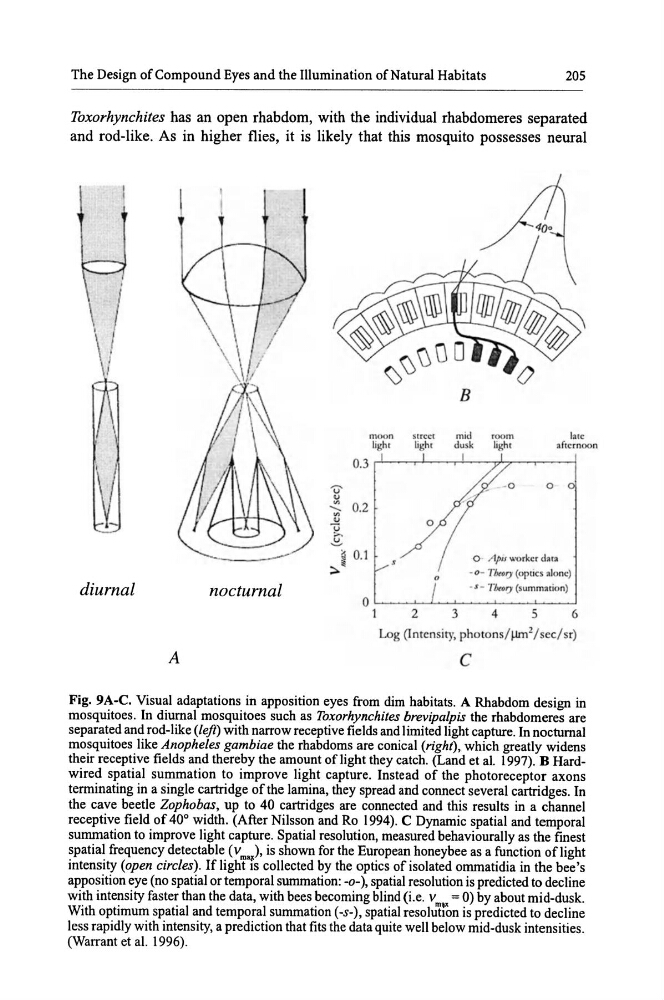
Fig. 9A-C. Visual adaptations in apposition eyes from dim habitats. A Rhabdom design in
mosquitoes. In diurnal mosquitoes such as Toxorhynchites brevipalpis the rhabdomeres are
separated and rod-like (left) with narrow receptive fields and limited light capture. In nocturnal
mosquitoes like Anopheles gambiae the rhabdoms are conical (right), which greatly widens
their receptive fields and thereby the amount of light they catch. (Land et al. 1997). B Hardwired spatial summation to improve light capture. Instead of the photoreceptor axons
terminating in a single cartridge of the lamina, they spread and connect several cartridges. In
the cave beetle Zophobas, up to 40 cartridges are connected and this results in a channel
receptive field of 40° width. (After Nilsson and Ro 1994). C Dynamic spatial and temporal
summation to improve light capture. Spatial resolution, measured behaviourally as the finest
spatial frequency detectable ( v m ), is shown for the European honeybee as a function of light
intensity (open circles). !flight is collected by the optics of isolated ommatidia in the bee's
apposition eye (no spatial or temporal summation: -o-), spatial resolution is predicted to decline
with intensity faster than the data, with bees becoming blind (i.e. v = 0) by about mid-dusk.
With optimum spatial and temporal summation (-s-), spatial resolution is predicted to decline
less rapidly with intensity, a prediction that fits the data quite well below mid-dusk intensities.
(Warrant eta!. 1996).
205
Toxorhynchites has an open rhabdom, with the individual rhabdomeres separated
and rod-like. As in higher flies, it is likely that this mosquito possesses neural
diurnal
nocturnal
A
moon
succi
mid
room
lafc
afternoon
ligh•
ligh<
dusk
ligh<
0
o- A pis worker do"'
0
- o- Tbtory (op1ics olonc)
- s - Thtory (summotion)
Log (Intensity, photons/1-trrNsec/sr)
c
Fig. 9A-C. Visual adaptations in apposition eyes from dim habitats. A Rhabdom design in
mosquitoes. In diurnal mosquitoes such as Toxorhynchites brevipalpis the rhabdomeres are
separated and rod-like (left) with narrow receptive fields and limited light capture. In nocturnal
mosquitoes like Anopheles gambiae the rhabdoms are conical (right), which greatly widens
their receptive fields and thereby the amount of light they catch. (Land et al. 1997). B Hardwired spatial summation to improve light capture. Instead of the photoreceptor axons
terminating in a single cartridge of the lamina, they spread and connect several cartridges. In
the cave beetle Zophobas, up to 40 cartridges are connected and this results in a channel
receptive field of 40° width. (After Nilsson and Ro 1994). C Dynamic spatial and temporal
summation to improve light capture. Spatial resolution, measured behaviourally as the finest
spatial frequency detectable ( v m ), is shown for the European honeybee as a function of light
intensity (open circles). !flight is collected by the optics of isolated ommatidia in the bee's
apposition eye (no spatial or temporal summation: -o-), spatial resolution is predicted to decline
with intensity faster than the data, with bees becoming blind (i.e. v = 0) by about mid-dusk.
With optimum spatial and temporal summation (-s-), spatial resolution is predicted to decline
less rapidly with intensity, a prediction that fits the data quite well below mid-dusk intensities.
(Warrant eta!. 1996).