

194
Eric]. Warrant
D
B
D
M
M
L
Ghost Crab
v
Rock Crab
c
-60°
oo
so·
Backswimmer
Direction of view, a
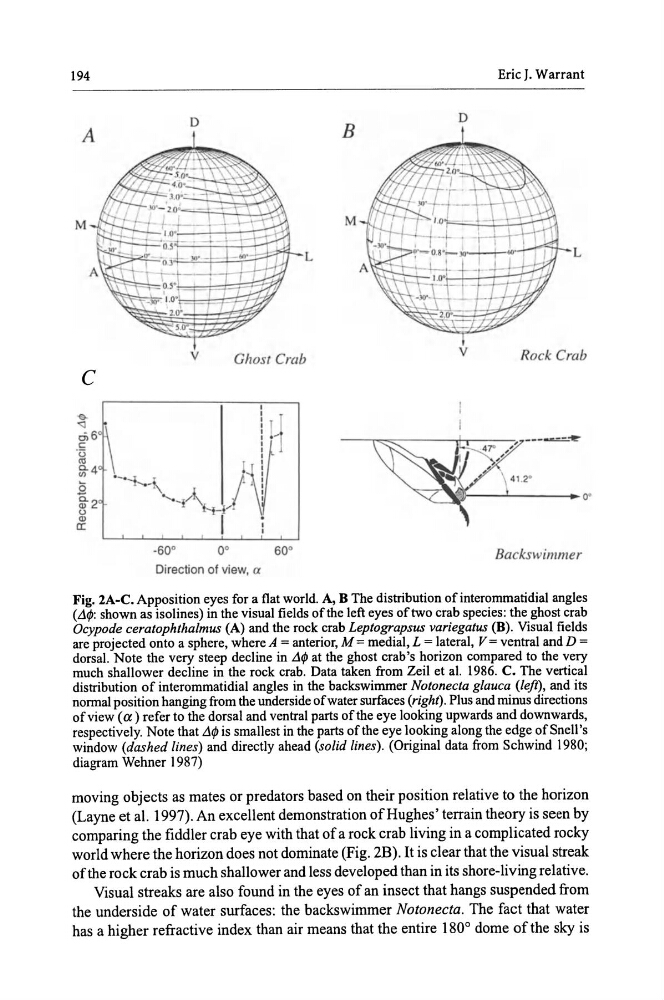
Fig. 2A-C. Apposition eyes for a flat world. A, B The distribution of interommatidial angles
(.11/J: shown as isolines) in the visual fields of the left eyes of two crab species: the ghost crab
Ocypode ceratophthalmus (A) and the rock crab Leptograpsus variegatus (B). Visual fields
are projected onto a sphere, where A = anterior, M = medial, L = lateral, V = ventral and D =
dorsal. Note the very steep decline in .11/J at the ghost crab's horizon compared to the very
much shallower decline in the rock crab. Data taken from Zeil et al. 1986. C. The vertical
distribution of interommatidial angles in the backswimrner Notonecta glauca (left), and its
normal position hanging from the underside of water surfaces (right). Plus and minus directions
of view (a) refer to the dorsal and ventral parts of the eye looking upwards and downwards,
respectively. Note that At{J is smallest in the parts of the eye looking along the edge of Snell's
window (dashed lines) and directly ahead (solid lines). (Original data from Schwind 1980;
diagram Wehner 1987)
moving objects as mates or predators based on their position relative to the horizon
(Layne et al. 1997). An excellent demonstration of Hughes' terrain theory is seen by
comparing the fiddler crab eye with that of a rock crab living in a complicated rocky
world where the horizon does not dominate (Fig. 2B). It is clear that the visual streak
of the rock crab is much shallower and less developed than in its shore-living relative.
Visual streaks are also found in the eyes of an insect that hangs suspended from
the underside of water surfaces: the backswimmer Notonecta. The fact that water
has a higher refractive index than air means that the entire 180° dome of the sky is
Eric]. Warrant
D
B
D
M
M
L
Ghost Crab
v
Rock Crab
c
-60°
oo
so·
Backswimmer
Direction of view, a
Fig. 2A-C. Apposition eyes for a flat world. A, B The distribution of interommatidial angles
(.11/J: shown as isolines) in the visual fields of the left eyes of two crab species: the ghost crab
Ocypode ceratophthalmus (A) and the rock crab Leptograpsus variegatus (B). Visual fields
are projected onto a sphere, where A = anterior, M = medial, L = lateral, V = ventral and D =
dorsal. Note the very steep decline in .11/J at the ghost crab's horizon compared to the very
much shallower decline in the rock crab. Data taken from Zeil et al. 1986. C. The vertical
distribution of interommatidial angles in the backswimrner Notonecta glauca (left), and its
normal position hanging from the underside of water surfaces (right). Plus and minus directions
of view (a) refer to the dorsal and ventral parts of the eye looking upwards and downwards,
respectively. Note that At{J is smallest in the parts of the eye looking along the edge of Snell's
window (dashed lines) and directly ahead (solid lines). (Original data from Schwind 1980;
diagram Wehner 1987)
moving objects as mates or predators based on their position relative to the horizon
(Layne et al. 1997). An excellent demonstration of Hughes' terrain theory is seen by
comparing the fiddler crab eye with that of a rock crab living in a complicated rocky
world where the horizon does not dominate (Fig. 2B). It is clear that the visual streak
of the rock crab is much shallower and less developed than in its shore-living relative.
Visual streaks are also found in the eyes of an insect that hangs suspended from
the underside of water surfaces: the backswimmer Notonecta. The fact that water
has a higher refractive index than air means that the entire 180° dome of the sky is