

192
Eric J. Warrant
which define spatial details in a scene. The relative proportion of noise (--IN IN, that
is, I !--IN ), and thus the unreliability of vision, will increase with decreasing light
intensities (i.e. lower N ). In other words, as light intensities fall, increasing noise
levels prevent animals from seeing finer contrasts, thus restricting their vision to
coarser details of higher contrast (which is analogous to a CCD video camera
providing noisier and less distinct images in dimmer light). Another reason why
vision becomes unreliable at low light levels is that the biochemical pathways
responsible for transduction can occasionally be activated in the absence of light
(Barlow 1956). These activations are thermal in origin, produce electrical impulses
indistinguishable from those produced by real photons, and are more frequent at
higher retinal temperatures. At very low light levels this dark noise can significantly
contaminate visual signals, especially in vertebrates whose measured rates of dark
noise tend to be high (see Aho et al. 1988). In invertebrates the rates of dark noise
measured to date have been quite low (see Warrant 1999). Finally, even if a photon is
unambiguously absorbed, the small voltage response it produces in the photoreceptor
(called a quantum bump) is not identical from one photon to the next. Bumps vary in
amplitude, latency and duration, and this inconsistency is also a form of noise, called
transducer noise, that adds to the uncertainty of vision (Lillywhite and Laughlin
1979).
Irrespective of their source, all types of noise have the same consequence for
vision: less reliable detection of contrasts in the natural world. In dim light, the only
solution to the problem is to have an eye design that maximises the capture of light,
even at the expense of other visual capacities. The way this has been achieved is best
seen in Land's extremely useful equation for the optical sensitivity S (Kirschfeld
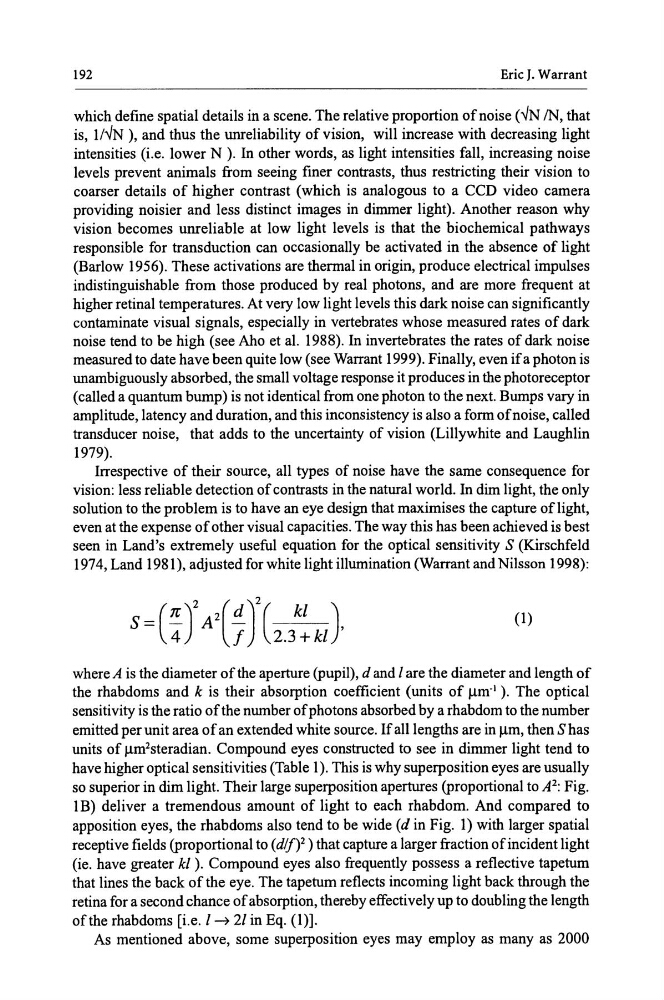
1974, Land 1981), adjusted for white light illumination (Warrant and Nilsson 1998):
(1)
where A is the diameter of the aperture (pupil), d and I are the diameter and length of
the rhabdoms and k is their absorption coefficient (units of J.lm· 1 ). The optical
sensitivity is the ratio of the number of photons absorbed by a rhabdom to the number
emitted per unit area of an extended white source. If all lengths are in J.lm, then S has
units of J.lm 2 steradian. Compound eyes constructed to see in dimmer light tend to
have higher optical sensitivities (Table 1 ). This is why superposition eyes are usually
so superior in dim light. Their large superposition apertures (proportional to A 2 : Fig.
lB) deliver a tremendous amount of light to each rhabdom. And compared to
apposition eyes, the rhabdoms also tend to be wide (din Fig. 1) with larger spatial
receptive fields (proportional to (d/f) 2 ) that capture a larger fraction of incident light
(ie. have greater kl ). Compound eyes also frequently possess a reflective tapetum
that lines the back of the eye. The tapetum reflects incoming light back through the
retina for a second chance of absorption, thereby effectively up to doubling the length
of the rhabdoms [i.e. I~ 21 in Eq. (1)].
As mentioned above, some superposition eyes may employ as many as 2000
Eric J. Warrant
which define spatial details in a scene. The relative proportion of noise (--IN IN, that
is, I !--IN ), and thus the unreliability of vision, will increase with decreasing light
intensities (i.e. lower N ). In other words, as light intensities fall, increasing noise
levels prevent animals from seeing finer contrasts, thus restricting their vision to
coarser details of higher contrast (which is analogous to a CCD video camera
providing noisier and less distinct images in dimmer light). Another reason why
vision becomes unreliable at low light levels is that the biochemical pathways
responsible for transduction can occasionally be activated in the absence of light
(Barlow 1956). These activations are thermal in origin, produce electrical impulses
indistinguishable from those produced by real photons, and are more frequent at
higher retinal temperatures. At very low light levels this dark noise can significantly
contaminate visual signals, especially in vertebrates whose measured rates of dark
noise tend to be high (see Aho et al. 1988). In invertebrates the rates of dark noise
measured to date have been quite low (see Warrant 1999). Finally, even if a photon is
unambiguously absorbed, the small voltage response it produces in the photoreceptor
(called a quantum bump) is not identical from one photon to the next. Bumps vary in
amplitude, latency and duration, and this inconsistency is also a form of noise, called
transducer noise, that adds to the uncertainty of vision (Lillywhite and Laughlin
1979).
Irrespective of their source, all types of noise have the same consequence for
vision: less reliable detection of contrasts in the natural world. In dim light, the only
solution to the problem is to have an eye design that maximises the capture of light,
even at the expense of other visual capacities. The way this has been achieved is best
seen in Land's extremely useful equation for the optical sensitivity S (Kirschfeld
1974, Land 1981), adjusted for white light illumination (Warrant and Nilsson 1998):
(1)
where A is the diameter of the aperture (pupil), d and I are the diameter and length of
the rhabdoms and k is their absorption coefficient (units of J.lm· 1 ). The optical
sensitivity is the ratio of the number of photons absorbed by a rhabdom to the number
emitted per unit area of an extended white source. If all lengths are in J.lm, then S has
units of J.lm 2 steradian. Compound eyes constructed to see in dimmer light tend to
have higher optical sensitivities (Table 1 ). This is why superposition eyes are usually
so superior in dim light. Their large superposition apertures (proportional to A 2 : Fig.
lB) deliver a tremendous amount of light to each rhabdom. And compared to
apposition eyes, the rhabdoms also tend to be wide (din Fig. 1) with larger spatial
receptive fields (proportional to (d/f) 2 ) that capture a larger fraction of incident light
(ie. have greater kl ). Compound eyes also frequently possess a reflective tapetum
that lines the back of the eye. The tapetum reflects incoming light back through the
retina for a second chance of absorption, thereby effectively up to doubling the length
of the rhabdoms [i.e. I~ 21 in Eq. (1)].
As mentioned above, some superposition eyes may employ as many as 2000