

The Metabolic Cost of Information - a Fundamental Factor in Visual Ecology
175
Barlow ( 1961) proposed that the goal of early visual processing is to fill the
limited information capacity of retinal neurons by coding signals efficiently. Its
neat packaging of information requires the removal of redundancy from the
incoming signals. Redundant components convey no new information because
they repeat, or can be predicted from, other parts of the data. Because natural
objects are not constructed at random, they have predictable parts and this
introduces redundancy into natural signals. Lateral inhibition and transient
responses, common processes in sensory systems, remove redundancy by
emphasizing the differences between neighbouring signals (Barlow 1961 ).
~
~:~
f
'•
. '
20
~
I
'
photoreceptor
LMC
mV
. .
I
0
' \
J\
~
~
--v---20
'e
.......... _.
-1
0
2
L v;;;; contrast
t
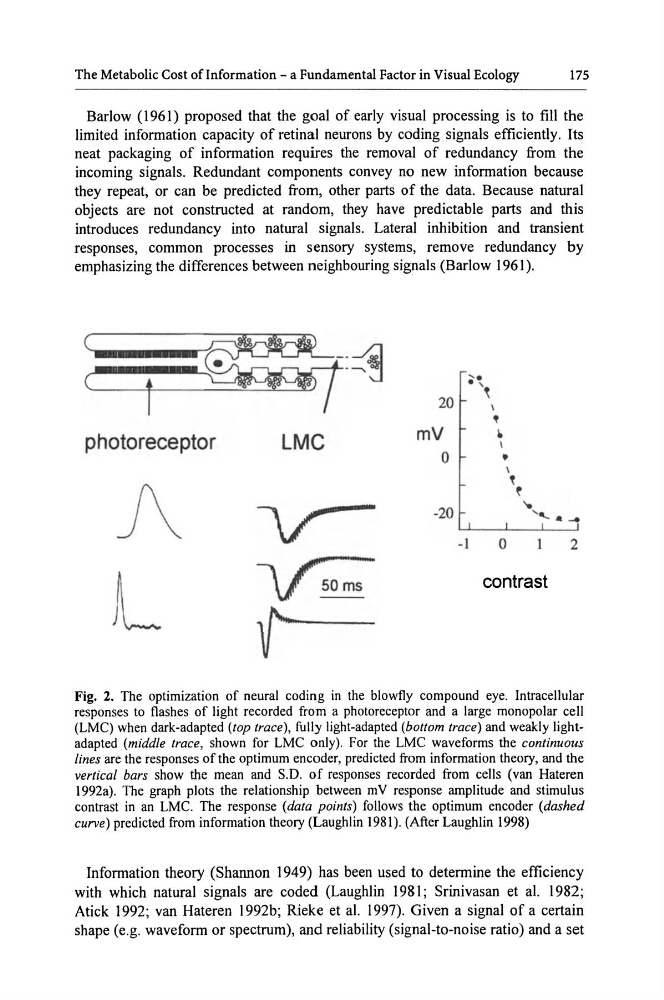
Fig. 2. The optimization of neural coding in the blowfly compound eye. Intracellular
responses to flashes of light recorded from a photoreceptor and a large monopolar cell
(LMC) when dark-adapted (top trace), fully light-adapted (bottom trace) and weakly lightadapted (middle trace, shown for LMC only). For the LMC waveforms the continuous
lines are the responses of the optimum encoder, predicted from information theory, and the
vertical bars show the mean and S.D. of responses recorded from cells (van Hateren
1992a). The graph plots the relationship between mY response amplitude and stimulus
contrast in an LMC. The response (data points) follows the optimum encoder (dashed
curve) predicted from information theory (Laughlin 1981). (After Laughlin 1998)
Information theory (Shannon 1949) has been used to determine the efficiency
with which natural signals are coded (Laughlin 1981; Srinivasan et al. 1982;
Atick 1992; van Hateren 1992b; Rieke et al. 1997). Given a signal of a certain
shape (e.g. waveform or spectrum), and reliability (signal-to-noise ratio) and a set
175
Barlow ( 1961) proposed that the goal of early visual processing is to fill the
limited information capacity of retinal neurons by coding signals efficiently. Its
neat packaging of information requires the removal of redundancy from the
incoming signals. Redundant components convey no new information because
they repeat, or can be predicted from, other parts of the data. Because natural
objects are not constructed at random, they have predictable parts and this
introduces redundancy into natural signals. Lateral inhibition and transient
responses, common processes in sensory systems, remove redundancy by
emphasizing the differences between neighbouring signals (Barlow 1961 ).
~
~:~
f
'•
. '
20
~
I
'
photoreceptor
LMC
mV
. .
I
0
' \
J\
~
~
--v---20
'e
.......... _.
-1
0
2
L v;;;; contrast
t
Fig. 2. The optimization of neural coding in the blowfly compound eye. Intracellular
responses to flashes of light recorded from a photoreceptor and a large monopolar cell
(LMC) when dark-adapted (top trace), fully light-adapted (bottom trace) and weakly lightadapted (middle trace, shown for LMC only). For the LMC waveforms the continuous
lines are the responses of the optimum encoder, predicted from information theory, and the
vertical bars show the mean and S.D. of responses recorded from cells (van Hateren
1992a). The graph plots the relationship between mY response amplitude and stimulus
contrast in an LMC. The response (data points) follows the optimum encoder (dashed
curve) predicted from information theory (Laughlin 1981). (After Laughlin 1998)
Information theory (Shannon 1949) has been used to determine the efficiency
with which natural signals are coded (Laughlin 1981; Srinivasan et al. 1982;
Atick 1992; van Hateren 1992b; Rieke et al. 1997). Given a signal of a certain
shape (e.g. waveform or spectrum), and reliability (signal-to-noise ratio) and a set