

158
Horst Bleckmann et a!.
In order to create more natural, complex lateral line stimuli, researchers (e.g.,
Wojtenek et al. 1998) have stimulated fishes with small moving objects. Such
objects cause short transient water motions followed by an ill-defined long-lasting
wake. If primary lateral line afferents are stimulated with water motions caused by
a moving object, they respond with excitation followed by inhibition or vice versa.
A given response pattern inverses when object motion direction is reversed. About
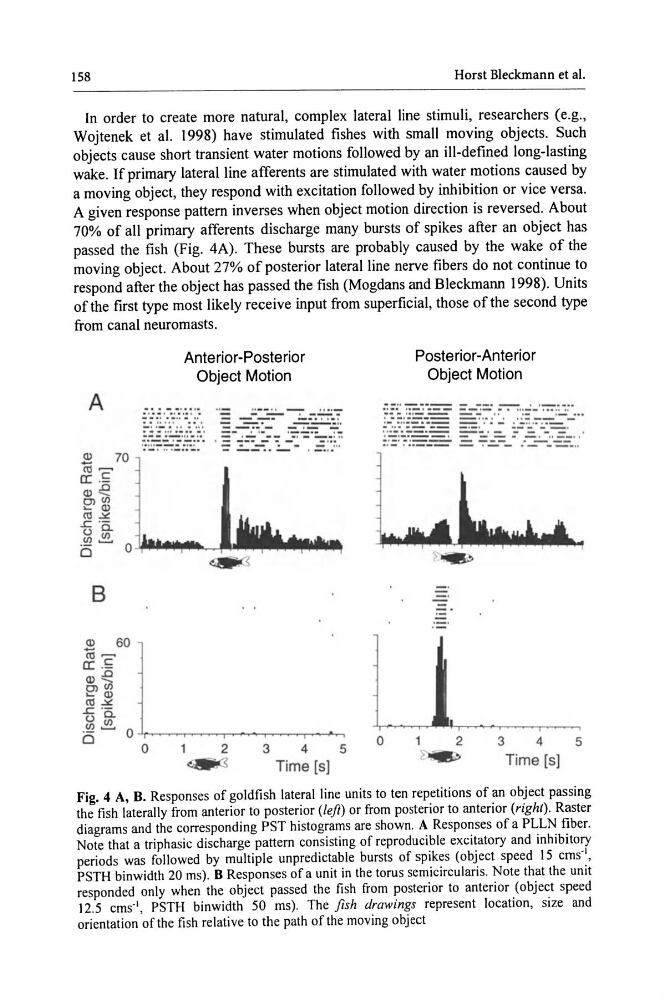
70% of all primary afferents discharge many bursts of spikes after an object has
passed the fish (Fig. 4A). These bursts are probably caused by the wake of the
moving object. About 27% of posterior lateral line nerve fibers do not continue to
respond after the object has passed the fish (Mogdans and Bleckmann 1998). Units
of the first type most likely receive input from superficial, those of the second type
from canal neuromasts.
A
B
Anterior-Posterior
Object Motion
... -..... .
• I e - I e t . •• 0 •
--·· ... . . . . .
.. ..... .. '
-··- . . .. . .. .
. -- ... ·- .... .
---·-. . ·-··
-·-- ·--···
..... __ ... , ..
·-· .. ·-··-·
1
2
~
3
4
5
Time [s]
0
Posterior-Anterior
Object Motion
1
2
~
3
4
5
Time [s]
Fig. 4 A, B. Responses of goldfish lateral line units to ten repetitions of an object passing
the fish laterally from anterior to posterior (left) or from posterior to anterior (right). Raster
diagrams and the corresponding PST histograms are shown. A Responses of a PLLN fiber.
Note that a triphasic discharge pattern consisting of reproducible excitatory and inhibitory
periods was followed by multiple unpredictable bursts of spikes (object speed 15 cms· 1 ,
PSTH binwidth 20 ms). B Responses of a unit in the torus semicircularis. Note that the unit
responded only when the object passed the fish from posterior to anterior (object speed
12.5 cms·l, PSTH binwidth 50 ms). The fish drawings represent location, size and
orientation of the fish relative to the path of the moving object
Horst Bleckmann et a!.
In order to create more natural, complex lateral line stimuli, researchers (e.g.,
Wojtenek et al. 1998) have stimulated fishes with small moving objects. Such
objects cause short transient water motions followed by an ill-defined long-lasting
wake. If primary lateral line afferents are stimulated with water motions caused by
a moving object, they respond with excitation followed by inhibition or vice versa.
A given response pattern inverses when object motion direction is reversed. About
70% of all primary afferents discharge many bursts of spikes after an object has
passed the fish (Fig. 4A). These bursts are probably caused by the wake of the
moving object. About 27% of posterior lateral line nerve fibers do not continue to
respond after the object has passed the fish (Mogdans and Bleckmann 1998). Units
of the first type most likely receive input from superficial, those of the second type
from canal neuromasts.
A
B
Anterior-Posterior
Object Motion
... -..... .
• I e - I e t . •• 0 •
--·· ... . . . . .
.. ..... .. '
-··- . . .. . .. .
. -- ... ·- .... .
---·-. . ·-··
-·-- ·--···
..... __ ... , ..
·-· .. ·-··-·
1
2
~
3
4
5
Time [s]
0
Posterior-Anterior
Object Motion
1
2
~
3
4
5
Time [s]
Fig. 4 A, B. Responses of goldfish lateral line units to ten repetitions of an object passing
the fish laterally from anterior to posterior (left) or from posterior to anterior (right). Raster
diagrams and the corresponding PST histograms are shown. A Responses of a PLLN fiber.
Note that a triphasic discharge pattern consisting of reproducible excitatory and inhibitory
periods was followed by multiple unpredictable bursts of spikes (object speed 15 cms· 1 ,
PSTH binwidth 20 ms). B Responses of a unit in the torus semicircularis. Note that the unit
responded only when the object passed the fish from posterior to anterior (object speed
12.5 cms·l, PSTH binwidth 50 ms). The fish drawings represent location, size and
orientation of the fish relative to the path of the moving object