

140
Peter M. Narins
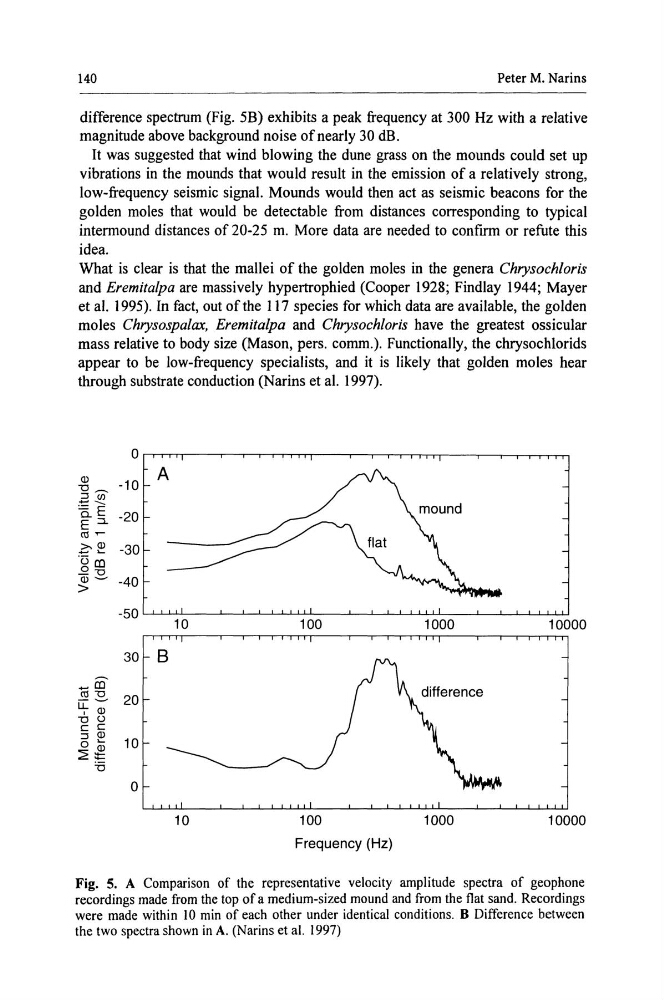
difference spectrum (Fig. 5B) exhibits a peak frequency at 300 Hz with a relative
magnitude above background noise of nearly 30 dB.
It was suggested that wind blowing the dune grass on the mounds could set up
vibrations in the mounds that would result in the emission of a relatively strong,
low-frequency seismic signal. Mounds would then act as seismic beacons for the
golden moles that would be detectable from distances corresponding to typical
intermound distances of 20-25 m. More data are needed to confirm or refute this
idea.
What is clear is that the mallei of the golden moles in the genera Chrysochloris
and Eremitalpa are massively hypertrophied (Cooper 1928; Findlay 1944; Mayer
et al. 1995). In fact, out of the 117 species for which data are available, the golden
moles Chrysospalax, Eremitalpa and Chrysochloris have the greatest ossicular
mass relative to body size (Mason, pers. comm.). Functionally, the chrysochlorids
appear to be low-frequency specialists, and it is likely that golden moles hear
through substrate conduction (Narins et al. 1997).
0
Q)
-10
"0~
:::J (f)
'5_E -20
E
:::l.
ro..>-Ol
- ..... -30
"[5 co
.2-o Q ) - -40
>
-50
10
100
1000
10000
30 B
_EO
Cll"O
20
u:::-6
Q)
(.)
c c
:::J Q)
10
0 .....
~~
'6
0
10
100
1000
10000
Frequency (Hz)
Fig. 5. A Comparison of the representative velocity amplitude spectra of geophone
recordings made from the top of a medium-sized mound and from the flat sand. Recordings
were made within 10 min of each other under identical conditions. B Difference between
the two spectra shown in A. (Narins et al. 1997)
Peter M. Narins
difference spectrum (Fig. 5B) exhibits a peak frequency at 300 Hz with a relative
magnitude above background noise of nearly 30 dB.
It was suggested that wind blowing the dune grass on the mounds could set up
vibrations in the mounds that would result in the emission of a relatively strong,
low-frequency seismic signal. Mounds would then act as seismic beacons for the
golden moles that would be detectable from distances corresponding to typical
intermound distances of 20-25 m. More data are needed to confirm or refute this
idea.
What is clear is that the mallei of the golden moles in the genera Chrysochloris
and Eremitalpa are massively hypertrophied (Cooper 1928; Findlay 1944; Mayer
et al. 1995). In fact, out of the 117 species for which data are available, the golden
moles Chrysospalax, Eremitalpa and Chrysochloris have the greatest ossicular
mass relative to body size (Mason, pers. comm.). Functionally, the chrysochlorids
appear to be low-frequency specialists, and it is likely that golden moles hear
through substrate conduction (Narins et al. 1997).
0
Q)
-10
"0~
:::J (f)
'5_E -20
E
:::l.
ro..>-Ol
- ..... -30
"[5 co
.2-o Q ) - -40
>
-50
10
100
1000
10000
30 B
_EO
Cll"O
20
u:::-6
Q)
(.)
c c
:::J Q)
10
0 .....
~~
'6
0
10
100
1000
10000
Frequency (Hz)
Fig. 5. A Comparison of the representative velocity amplitude spectra of geophone
recordings made from the top of a medium-sized mound and from the flat sand. Recordings
were made within 10 min of each other under identical conditions. B Difference between
the two spectra shown in A. (Narins et al. 1997)