

Vibration Communication in Vertebrates
137
also likely that mate attraction is entirely mediated by seismic signaling between
individuals in burrows.
Foot-drumming signals contain both auditory and seismic components.
Measurements within, and at various distances from a burrow revealed that only
the seismic component of the foot-drumming signal is detectable in the substrate
at distances corresponding to natural interburrow distances (3-4 m); the amplitude
of the acoustic component attenuates into the noise level within 1 m of the source
(Narins et al. 1992).
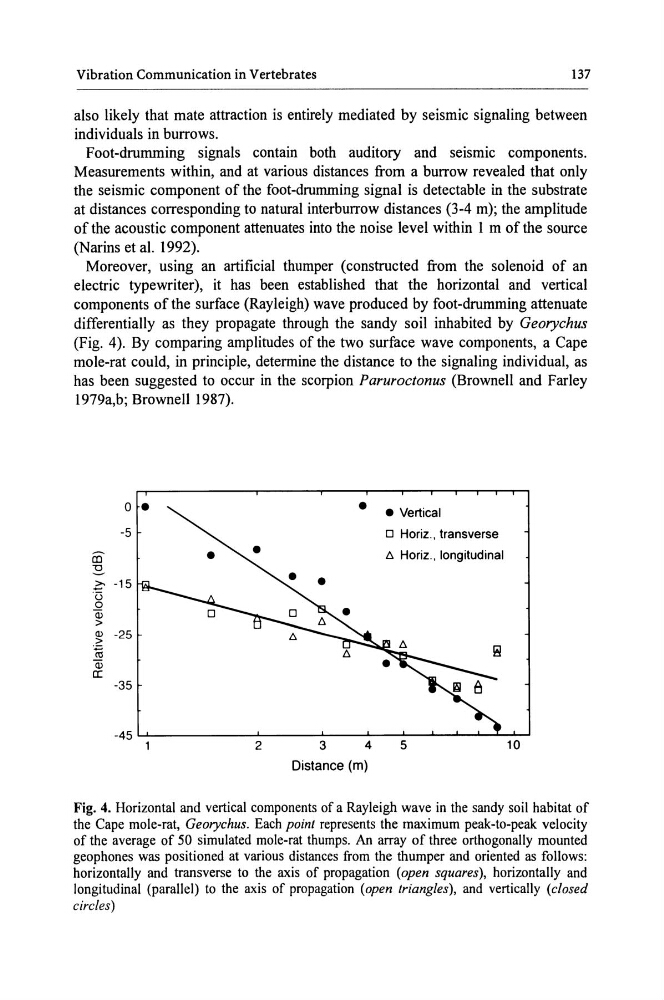
Moreover, using an artificial thumper (constructed from the solenoid of an
electric typewriter), it has been established that the horizontal and vertical
components of the surface (Rayleigh) wave produced by foot-drumming attenuate
differentially as they propagate through the sandy soil inhabited by Georychus
(Fig. 4). By comparing amplitudes of the two surface wave components, a Cape
mole-rat could, in principle, determine the distance to the signaling individual, as
has been suggested to occur in the scorpion Paruroctonus (Brownell and Farley
1979a,b; Brownell 1987).
0
-5
ro
~
Z' -15
·c::;
.Q
Q)
>
Q)
-25
.~
~
Qi
a:
-35
-45
•
•
•
2
3
4
Distance (m)
• Vertical
o Horiz .. transverse
1!. Horiz., longitudinal
5
10
Fig. 4. Horizontal and vertical components of a Rayleigh wave in the sandy soil habitat of
the Cape mole-rat, Georychus. Each point represents the maximum peak-to-peak velocity
of the average of 50 simulated mole-rat thumps. An array of three orthogonally mounted
geophones was positioned at various distances from the thumper and oriented as follows:
horizontally and transverse to the axis of propagation (open squares), horizontally and
longitudinal (parallel) to the axis of propagation (open triangles), and vertically (closed
circles)
137
also likely that mate attraction is entirely mediated by seismic signaling between
individuals in burrows.
Foot-drumming signals contain both auditory and seismic components.
Measurements within, and at various distances from a burrow revealed that only
the seismic component of the foot-drumming signal is detectable in the substrate
at distances corresponding to natural interburrow distances (3-4 m); the amplitude
of the acoustic component attenuates into the noise level within 1 m of the source
(Narins et al. 1992).
Moreover, using an artificial thumper (constructed from the solenoid of an
electric typewriter), it has been established that the horizontal and vertical
components of the surface (Rayleigh) wave produced by foot-drumming attenuate
differentially as they propagate through the sandy soil inhabited by Georychus
(Fig. 4). By comparing amplitudes of the two surface wave components, a Cape
mole-rat could, in principle, determine the distance to the signaling individual, as
has been suggested to occur in the scorpion Paruroctonus (Brownell and Farley
1979a,b; Brownell 1987).
0
-5
ro
~
Z' -15
·c::;
.Q
Q)
>
Q)
-25
.~
~
Qi
a:
-35
-45
•
•
•
2
3
4
Distance (m)
• Vertical
o Horiz .. transverse
1!. Horiz., longitudinal
5
10
Fig. 4. Horizontal and vertical components of a Rayleigh wave in the sandy soil habitat of
the Cape mole-rat, Georychus. Each point represents the maximum peak-to-peak velocity
of the average of 50 simulated mole-rat thumps. An array of three orthogonally mounted
geophones was positioned at various distances from the thumper and oriented as follows:
horizontally and transverse to the axis of propagation (open squares), horizontally and
longitudinal (parallel) to the axis of propagation (open triangles), and vertically (closed
circles)