

Vibration Communication in Vertebrates
135
auditory
seismic
15
15
10
10
a;
u
,. j
(!)
E
Vl
/ / ~
E
5
, / , .
5
0
0
0
5
10
15
0
5
10
15
msec
msec
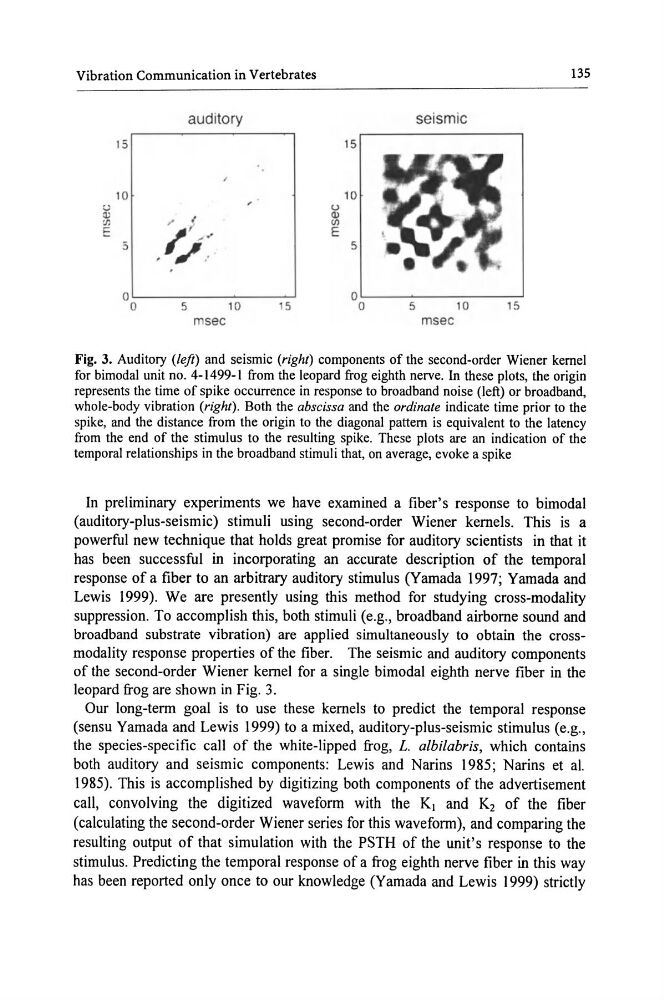
Fig. 3. Auditory (left) and seismic (right) components of the second-order Wiener kernel
for bimodal unit no. 4-1499-1 from the leopard frog eighth nerve. In these plots, the origin
represents the time of spike occurrence in response to broadband noise (left) or broadband,
whole-body vibration (right) . Both the abscissa and the ordinate indicate time prior to the
spike, and the distance from the origin to the diagonal pattern is equivalent to the latency
from the end of the stimulus to the resulting spike. These plots are an indication of the
temporal relationships in the broadband stimuli that, on average, evoke a spike
In preliminary experiments we have examined a fiber's response to bimodal
(auditory-plus-seismic) stimuli using second-order Wiener kernels. This is a
powerful new technique that holds great promise for auditory scientists in that it
has been successful in incorporating an accurate description of the temporal
response of a fiber to an arbitrary auditory stimulus (Yamada 1997; Yamada and
Lewis 1999). We are presently using this method for studying cross-modality
suppression. To accomplish this, both stimuli (e.g., broadband airborne sound and
broadband substrate vibration) are applied simultaneously to obtain the crossmodality response properties of the fiber. The seismic and auditory components
of the second-order Wiener kernel for a single bimodal eighth nerve fiber in the
leopard frog are shown in Fig. 3.
Our long-term goal is to use these kernels to predict the temporal response
(sensu Yamada and Lewis I 999) to a mixed, auditory-plus-seismic stimulus (e.g.,
the species-specific call of the white-lipped frog, L. albilabris, which contains
both auditory and seismic components: Lewis and Narins I 985; Narins et al.
1985). This is accomplished by digitizing both components of the advertisement
call, convolving the digitized waveform with the K1 and K2 of the fiber
(calculating the second-order Wiener series for this waveform), and comparing the
resulting output of that simulation with the PSTH of the unit's response to the
stimulus. Predicting the temporal response of a frog eighth nerve fiber in this way
has been reported only once to our knowledge (Yamada and Lewis 1999) strictly
135
auditory
seismic
15
15
10
10
a;
u
,. j
(!)
E
Vl
/ / ~
E
5
, / , .
5
0
0
0
5
10
15
0
5
10
15
msec
msec
Fig. 3. Auditory (left) and seismic (right) components of the second-order Wiener kernel
for bimodal unit no. 4-1499-1 from the leopard frog eighth nerve. In these plots, the origin
represents the time of spike occurrence in response to broadband noise (left) or broadband,
whole-body vibration (right) . Both the abscissa and the ordinate indicate time prior to the
spike, and the distance from the origin to the diagonal pattern is equivalent to the latency
from the end of the stimulus to the resulting spike. These plots are an indication of the
temporal relationships in the broadband stimuli that, on average, evoke a spike
In preliminary experiments we have examined a fiber's response to bimodal
(auditory-plus-seismic) stimuli using second-order Wiener kernels. This is a
powerful new technique that holds great promise for auditory scientists in that it
has been successful in incorporating an accurate description of the temporal
response of a fiber to an arbitrary auditory stimulus (Yamada 1997; Yamada and
Lewis 1999). We are presently using this method for studying cross-modality
suppression. To accomplish this, both stimuli (e.g., broadband airborne sound and
broadband substrate vibration) are applied simultaneously to obtain the crossmodality response properties of the fiber. The seismic and auditory components
of the second-order Wiener kernel for a single bimodal eighth nerve fiber in the
leopard frog are shown in Fig. 3.
Our long-term goal is to use these kernels to predict the temporal response
(sensu Yamada and Lewis I 999) to a mixed, auditory-plus-seismic stimulus (e.g.,
the species-specific call of the white-lipped frog, L. albilabris, which contains
both auditory and seismic components: Lewis and Narins I 985; Narins et al.
1985). This is accomplished by digitizing both components of the advertisement
call, convolving the digitized waveform with the K1 and K2 of the fiber
(calculating the second-order Wiener series for this waveform), and comparing the
resulting output of that simulation with the PSTH of the unit's response to the
stimulus. Predicting the temporal response of a frog eighth nerve fiber in this way
has been reported only once to our knowledge (Yamada and Lewis 1999) strictly