

Vibration Communication in Vertebrates
133
1000~--~----~----r---~----~
N'
I
A
>.
Iff-A
(.)
A
c
A
Q)
A
::::l 100
A A
cr
s
Q)
A A
sss
"LL
A
s
-
s
(/)
ss
Q)
(1)
s
100
20
40
60
80
100
s-v Offset (dB)
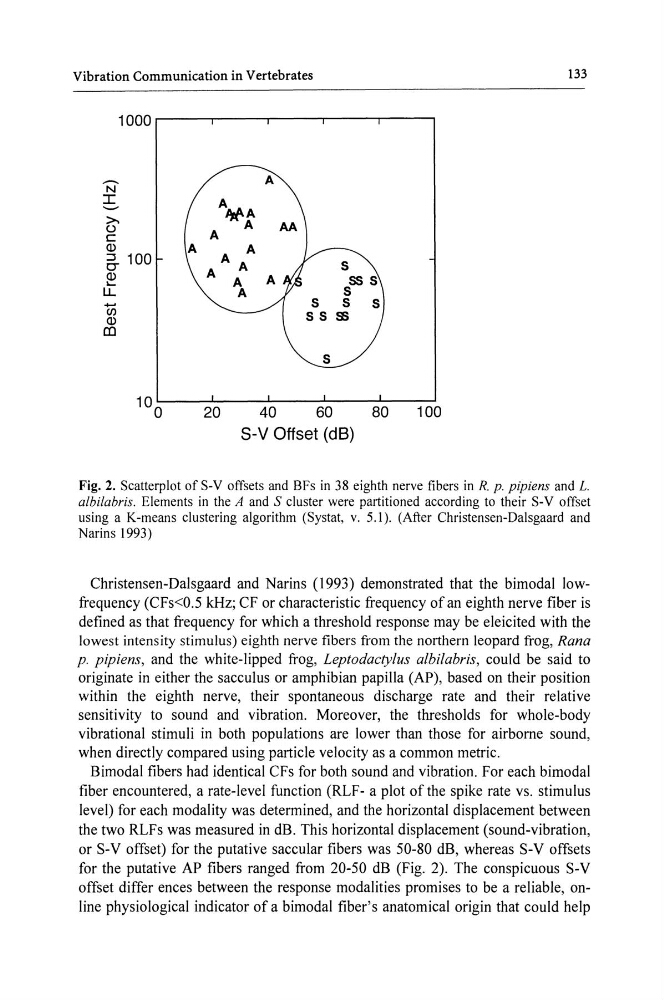
Fig. 2. Scatterplot of S-V offsets and BFs in 38 eighth nerve fibers in R. p. pipiens and L.
albilabris. Elements in the A and S cluster were partitioned according to their S-V offset
using a K-means clustering algorithm (Systat, v. 5.1 ). (After Christensen-Dalsgaard and
Narins 1993)
Christensen-Dalsgaard and Narins (1993) demonstrated that the bimodal lowfrequency (CFs<0.5 kHz; CF or characteristic frequency of an eighth nerve fiber is
defined as that frequency for which a threshold response may be eleicited with the
lowest intensity stimulus) eighth nerve fibers from the northern leopard frog, Rana
p. pipiens, and the white-lipped frog, Leptodactylus albilabris, could be said to
originate in either the sacculus or amphibian papilla (AP), based on their position
within the eighth nerve, their spontaneous discharge rate and their relative
sensitivity to sound and vibration. Moreover, the thresholds for whole-body
vibrational stimuli in both populations are lower than those for airborne sound,
when directly compared using particle velocity as a common metric.
Bimodal fibers had identical CFs for both sound and vibration. For each bimodal
fiber encountered, a rate-level function (RLF- a plot of the spike rate vs. stimulus
level) for each modality was determined, and the horizontal displacement between
the two RLFs was measured in dB. This horizontal displacement (sound-vibration,
or S-V offset) for the putative saccular fibers was 50-80 dB, whereas S-V offsets
for the putative AP fibers ranged from 20-50 dB (Fig. 2). The conspicuous S-V
offset differ ences between the response modalities promises to be a reliable, online physiological indicator of a bimodal fiber's anatomical origin that could help
133
1000~--~----~----r---~----~
N'
I
A
>.
Iff-A
(.)
A
c
A
Q)
A
::::l 100
A A
cr
s
Q)
A A
sss
"LL
A
s
-
s
(/)
ss
Q)
(1)
s
100
20
40
60
80
100
s-v Offset (dB)
Fig. 2. Scatterplot of S-V offsets and BFs in 38 eighth nerve fibers in R. p. pipiens and L.
albilabris. Elements in the A and S cluster were partitioned according to their S-V offset
using a K-means clustering algorithm (Systat, v. 5.1 ). (After Christensen-Dalsgaard and
Narins 1993)
Christensen-Dalsgaard and Narins (1993) demonstrated that the bimodal lowfrequency (CFs<0.5 kHz; CF or characteristic frequency of an eighth nerve fiber is
defined as that frequency for which a threshold response may be eleicited with the
lowest intensity stimulus) eighth nerve fibers from the northern leopard frog, Rana
p. pipiens, and the white-lipped frog, Leptodactylus albilabris, could be said to
originate in either the sacculus or amphibian papilla (AP), based on their position
within the eighth nerve, their spontaneous discharge rate and their relative
sensitivity to sound and vibration. Moreover, the thresholds for whole-body
vibrational stimuli in both populations are lower than those for airborne sound,
when directly compared using particle velocity as a common metric.
Bimodal fibers had identical CFs for both sound and vibration. For each bimodal
fiber encountered, a rate-level function (RLF- a plot of the spike rate vs. stimulus
level) for each modality was determined, and the horizontal displacement between
the two RLFs was measured in dB. This horizontal displacement (sound-vibration,
or S-V offset) for the putative saccular fibers was 50-80 dB, whereas S-V offsets
for the putative AP fibers ranged from 20-50 dB (Fig. 2). The conspicuous S-V
offset differ ences between the response modalities promises to be a reliable, online physiological indicator of a bimodal fiber's anatomical origin that could help