

128
Peter M. Narins
teach us that the essence of what is human is in a real sense defined by contrast to
what is not human.
Propagation of Mechanical Waves in the Ground
No Boundary:
Primary (P-) waves
Surtace:
~
- s
Love (L-) waves
-
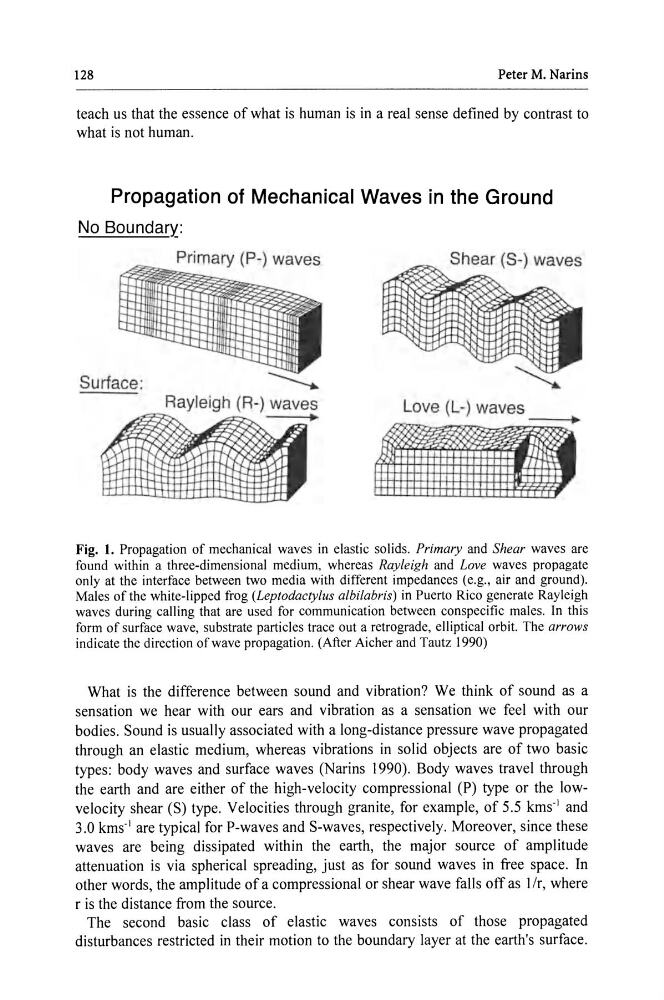
Fig. 1. Propagation of mechanical waves in elastic solids. Primary and Shear waves are
found within a three-dimensional medium, whereas Rayleigh and Love waves propagate
only at the interface between two media with different impedances (e.g., air and ground).
Males of the white-lipped frog (Leptodactylus albilabris) in Puerto Rico generate Rayleigh
waves during calling that are used for communication between conspecific males. In this
form of surface wave, substrate particles trace out a retrograde, elliptical orbit. The arrows
indicate the direction of wave propagation. (After Aicher and Tautz 1990)
What is the difference between sound and vibration? We think of sound as a
sensation we hear with our ears and vibration as a sensation we feel with our
bodies. Sound is usually associated with a long-distance pressure wave propagated
through an elastic medium, whereas vibrations in solid objects are of two basic
types: body waves and surface waves (Narins 1990). Body waves travel through
the earth and are either of the high-velocity compressional (P) type or the lowvelocity shear (S) type. Velocities through granite, for example, of 5.5 kms· 1 and
3.0 kms· 1 are typical for P-waves and S-waves, respectively. Moreover, since these
waves are being dissipated within the earth, the major source of amplitude
attenuation is via spherical spreading, just as for sound waves in free space. In
other words, the amplitude of a compressional or shear wave falls off as 1 /r, where
r is the distance from the source.
The second basic class of elastic waves consists of those propagated
disturbances restricted in their motion to the boundary layer at the earth's surface.
Peter M. Narins
teach us that the essence of what is human is in a real sense defined by contrast to
what is not human.
Propagation of Mechanical Waves in the Ground
No Boundary:
Primary (P-) waves
Surtace:
~
- s
Love (L-) waves
-
Fig. 1. Propagation of mechanical waves in elastic solids. Primary and Shear waves are
found within a three-dimensional medium, whereas Rayleigh and Love waves propagate
only at the interface between two media with different impedances (e.g., air and ground).
Males of the white-lipped frog (Leptodactylus albilabris) in Puerto Rico generate Rayleigh
waves during calling that are used for communication between conspecific males. In this
form of surface wave, substrate particles trace out a retrograde, elliptical orbit. The arrows
indicate the direction of wave propagation. (After Aicher and Tautz 1990)
What is the difference between sound and vibration? We think of sound as a
sensation we hear with our ears and vibration as a sensation we feel with our
bodies. Sound is usually associated with a long-distance pressure wave propagated
through an elastic medium, whereas vibrations in solid objects are of two basic
types: body waves and surface waves (Narins 1990). Body waves travel through
the earth and are either of the high-velocity compressional (P) type or the lowvelocity shear (S) type. Velocities through granite, for example, of 5.5 kms· 1 and
3.0 kms· 1 are typical for P-waves and S-waves, respectively. Moreover, since these
waves are being dissipated within the earth, the major source of amplitude
attenuation is via spherical spreading, just as for sound waves in free space. In
other words, the amplitude of a compressional or shear wave falls off as 1 /r, where
r is the distance from the source.
The second basic class of elastic waves consists of those propagated
disturbances restricted in their motion to the boundary layer at the earth's surface.