

The Motion-Sensing Hairs of Arthropods
121
d ( +)
L (-)
R (-)
S ( +)
vise(-)
de11 (-)
Paramerer
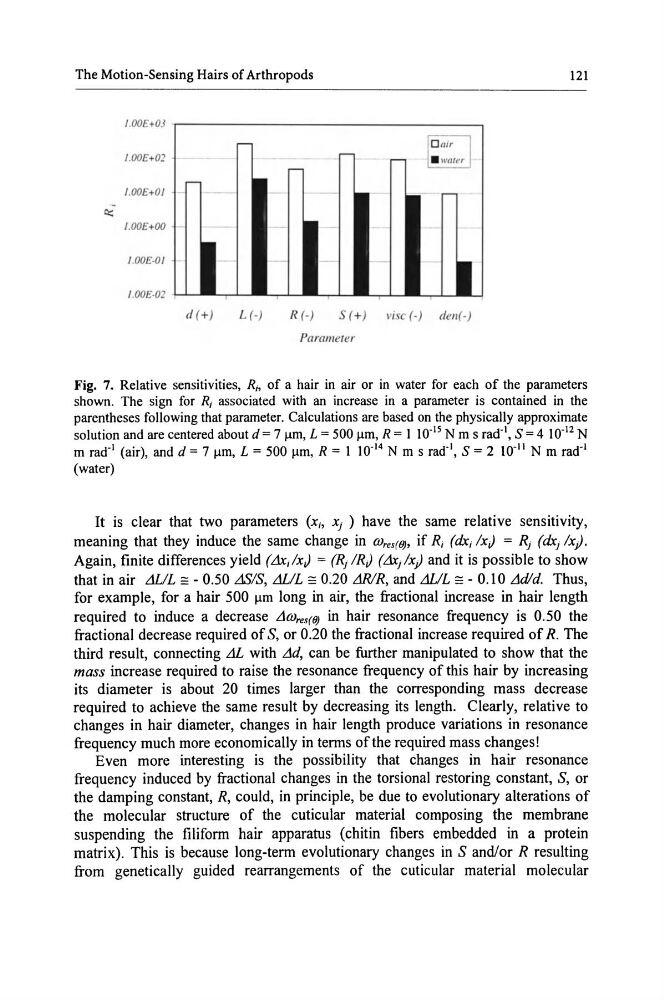
Fig. 7. Relative sensitivities, R;, of a hair in air or in water for each of the parameters
shown. The sign for R; associated with an increase in a parameter is contained in the
parentheses following that parameter. Calculations are based on the physically approximate
solution and are centered about d = 7 J.lm, L = 500 J.lm, R = I 10" 15 N m s rad- 1 , S = 4 10" 12 N
m rad- 1 (air), and d = 7 J.lffi, L = 500 J.lm, R = I 10· 14 N m s rad· 1 , S = 2 10· 11 N m rad· 1
(water)
It is clear that two parameters (x;, x 1 ) have the same relative sensitivity,
meaning that they induce the same change in Wres(8J• if R; (dx; lxJ = R 1 (dx 1 lx).
Again, finite differences yield ( L1x; lxJ = (R 1 IRJ ( L1x 1 lx) and it is possible to show
that in air MIL := - 0.50 LISIS, MIL := 0.20 .1RIR, and L1LIL := - 0.10 LJdld. Thus,
for example, for a hair 500 J.lm long in air, the fractional increase in hair length
required to induce a decrease L1mres(8J in hair resonance frequency is 0.50 the
fractional decrease required of S, or 0.20 the fractional increase required of R. The
third result, connecting M with LJd, can be further manipulated to show that the
mass increase required to raise the resonance frequency of this hair by increasing
its diameter is about 20 times larger than the corresponding mass decrease
required to achieve the same result by decreasing its length. Clearly, relative to
changes in hair diameter, changes in hair length produce variations in resonance
frequency much more economically in terms of the required mass changes!
Even more interesting is the possibility that changes in hair resonance
frequency induced by fractional changes in the torsional restoring constant, S, or
the damping constant, R, could, in principle, be due to evolutionary alterations of
the molecular structure of the cuticular material composing the membrane
suspending the filiform hair apparatus (chitin fibers embedded in a protein
matrix). This is because long-term evolutionary changes in S and/or R resulting
from genetically guided rearrangements of the cuticular material molecular
121
d ( +)
L (-)
R (-)
S ( +)
vise(-)
de11 (-)
Paramerer
Fig. 7. Relative sensitivities, R;, of a hair in air or in water for each of the parameters
shown. The sign for R; associated with an increase in a parameter is contained in the
parentheses following that parameter. Calculations are based on the physically approximate
solution and are centered about d = 7 J.lm, L = 500 J.lm, R = I 10" 15 N m s rad- 1 , S = 4 10" 12 N
m rad- 1 (air), and d = 7 J.lffi, L = 500 J.lm, R = I 10· 14 N m s rad· 1 , S = 2 10· 11 N m rad· 1
(water)
It is clear that two parameters (x;, x 1 ) have the same relative sensitivity,
meaning that they induce the same change in Wres(8J• if R; (dx; lxJ = R 1 (dx 1 lx).
Again, finite differences yield ( L1x; lxJ = (R 1 IRJ ( L1x 1 lx) and it is possible to show
that in air MIL := - 0.50 LISIS, MIL := 0.20 .1RIR, and L1LIL := - 0.10 LJdld. Thus,
for example, for a hair 500 J.lm long in air, the fractional increase in hair length
required to induce a decrease L1mres(8J in hair resonance frequency is 0.50 the
fractional decrease required of S, or 0.20 the fractional increase required of R. The
third result, connecting M with LJd, can be further manipulated to show that the
mass increase required to raise the resonance frequency of this hair by increasing
its diameter is about 20 times larger than the corresponding mass decrease
required to achieve the same result by decreasing its length. Clearly, relative to
changes in hair diameter, changes in hair length produce variations in resonance
frequency much more economically in terms of the required mass changes!
Even more interesting is the possibility that changes in hair resonance
frequency induced by fractional changes in the torsional restoring constant, S, or
the damping constant, R, could, in principle, be due to evolutionary alterations of
the molecular structure of the cuticular material composing the membrane
suspending the filiform hair apparatus (chitin fibers embedded in a protein
matrix). This is because long-term evolutionary changes in S and/or R resulting
from genetically guided rearrangements of the cuticular material molecular