

The Motion-Sensing Hairs of Arthropods
115
substitute best-guess values for w into the right-hand side of the equations and
compare with the values calculated from the equations. The results obtained when
the substituted and calculated values agree are Wres(O) and Wres(V)• respectively.
When resubstituted into their corresponding Eqs. ( l9b) and (20b ), these quantities
yield Bres and Vres·
The results for hair maximum deflection resonance frequency and maximum
deflection angle at resonance frequency are given in Figs. I and 2, respectively.
(Note that in the figures we plot fres(fJ) = Wres(O) /2;r.) The approximate solution
yields results in good qualitative agreement with the experimental fits. Because
the exact solution accounts for the experimental variations of d, R and S with L, it
shows better overall agreement for both Ires( B) and Bres· Results for hair velocity
resonance frequency and the maximum velocity at that frequency are plotted in
Figs. 3 and 4 where comparisons are made with values determined numerically by
Barth et al. (1993). Again, both the exact and the approximate analytical solutions
yield results in good agreement with the earlier calculations of fres(V) = Wres(V) 12 ;r
by Barth et al. (1993). Although the physically approximate result for Vres
corresponding to L = 250 11m deviates markedly from the present exact solution
and the earlier numerical calculation, Fig. 4 shows that the discrepancy is removed
if the physically approximate calculation is repeated using the experimental values
for d, R, and S.
2.3.2 Filiform Hairs in Water: Determination of RandS
The evaluation performed in Section 2.3.1 is for hairs in air, for which values of
the damping constant R and the torsional restoring constant S are known.
Unfortunately, corresponding values of R and S are not known for motion-sensing
hairs in water. On this topic the literature is very sparse and most measurements
do not provide the accuracy or precision needed. In many or even most cases, the
hair is directly coupled to a vibrating stylus as opposed to being driven by fluid
motion, and in many other cases the control of the water movement used as a
stimulus is inadequate. The best we can say at this point is that, for comparable
mechanical sensitivities, hairs that are sensitive to hydrodynamic stimuli are
probably much shorter, in general, than their aerodynamic counterparts (Barth et
al. 1993; Bleckmann 1994; Devarakonda et al. 1996), with resonance frequencies
lying below 150Hz (as determined electrophysiologically through cell response).
We do not know of any investigation in which the mechanical response of a
hydrodynamic receptor hair has been studied adequately enough to draw any
conclusion regarding its values of R and S.
Notwithstanding, it is possible to obtain estimates of R and S for hairs in air
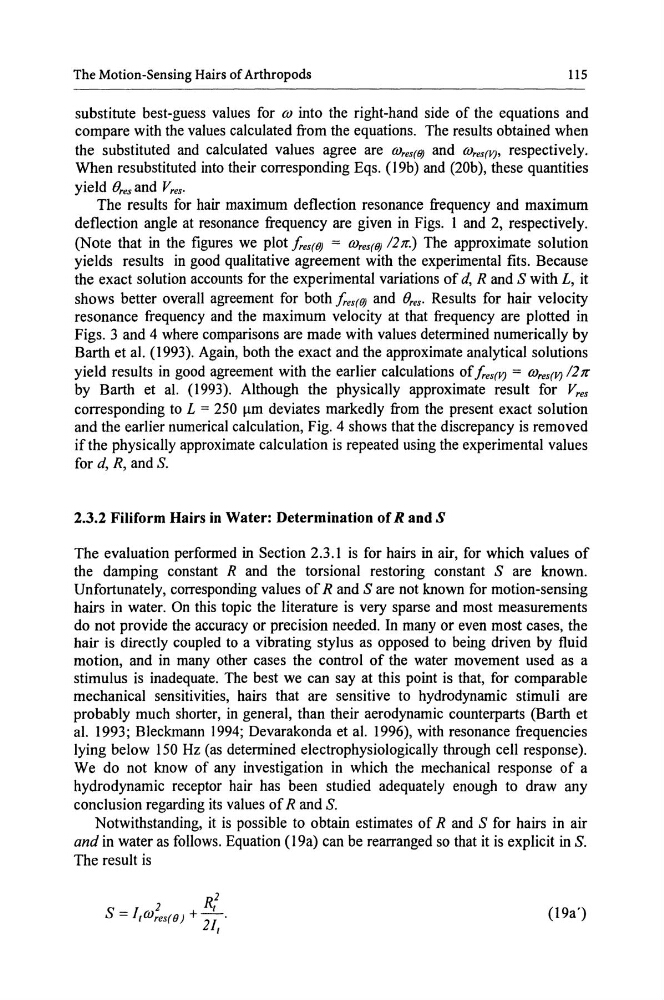
and in water as follows. Equation ( l9a) can be rearranged so that it is explicit inS.
The result is
(19a')
115
substitute best-guess values for w into the right-hand side of the equations and
compare with the values calculated from the equations. The results obtained when
the substituted and calculated values agree are Wres(O) and Wres(V)• respectively.
When resubstituted into their corresponding Eqs. ( l9b) and (20b ), these quantities
yield Bres and Vres·
The results for hair maximum deflection resonance frequency and maximum
deflection angle at resonance frequency are given in Figs. I and 2, respectively.
(Note that in the figures we plot fres(fJ) = Wres(O) /2;r.) The approximate solution
yields results in good qualitative agreement with the experimental fits. Because
the exact solution accounts for the experimental variations of d, R and S with L, it
shows better overall agreement for both Ires( B) and Bres· Results for hair velocity
resonance frequency and the maximum velocity at that frequency are plotted in
Figs. 3 and 4 where comparisons are made with values determined numerically by
Barth et al. (1993). Again, both the exact and the approximate analytical solutions
yield results in good agreement with the earlier calculations of fres(V) = Wres(V) 12 ;r
by Barth et al. (1993). Although the physically approximate result for Vres
corresponding to L = 250 11m deviates markedly from the present exact solution
and the earlier numerical calculation, Fig. 4 shows that the discrepancy is removed
if the physically approximate calculation is repeated using the experimental values
for d, R, and S.
2.3.2 Filiform Hairs in Water: Determination of RandS
The evaluation performed in Section 2.3.1 is for hairs in air, for which values of
the damping constant R and the torsional restoring constant S are known.
Unfortunately, corresponding values of R and S are not known for motion-sensing
hairs in water. On this topic the literature is very sparse and most measurements
do not provide the accuracy or precision needed. In many or even most cases, the
hair is directly coupled to a vibrating stylus as opposed to being driven by fluid
motion, and in many other cases the control of the water movement used as a
stimulus is inadequate. The best we can say at this point is that, for comparable
mechanical sensitivities, hairs that are sensitive to hydrodynamic stimuli are
probably much shorter, in general, than their aerodynamic counterparts (Barth et
al. 1993; Bleckmann 1994; Devarakonda et al. 1996), with resonance frequencies
lying below 150Hz (as determined electrophysiologically through cell response).
We do not know of any investigation in which the mechanical response of a
hydrodynamic receptor hair has been studied adequately enough to draw any
conclusion regarding its values of R and S.
Notwithstanding, it is possible to obtain estimates of R and S for hairs in air
and in water as follows. Equation ( l9a) can be rearranged so that it is explicit inS.
The result is
(19a')