

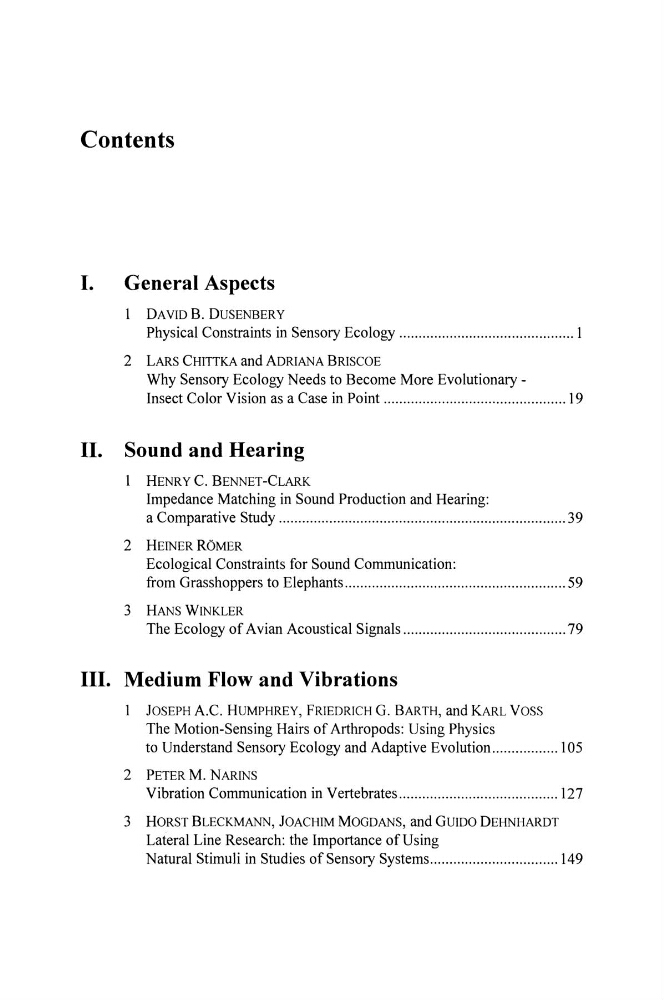
Contents
I. General Aspects
DAVID B. DUSENBERY
Physical Constraints in Sensory Ecology oooooooooooooooooooooooooooo ooooooooooooooooo 1
2 LARS CHITTKA and ADRIANA BRISCOE
Why Sensory Ecology Needs to Become More EvolutionaryInsect Color Vision as a Case in Point 0 0 0 0 0 0 0 0 0 0 0 0 0 0 0 0 0 0 0 0 0 0 0 0 0 0 0 0 0 0 0 0 0 0 0 0 0 0 0 0 0 0 0 0 0 0 0 19
II. Sound and Hearing
HENRY C. BENNET-CLARK
Impedance Matching in Sound Production and Hearing:
a Comparative Study ············oo··oo·················oo········oooooooooooooooooo·····oo···· 39
2 HEINER ROMER
Ecological Constraints for Sound Communication:
from Grasshoppers to Elephants OOOOOOOOOOOOOOOOOOOOOOOOOOOOOOOOOOOOOOooOOOOooOOOOOOooOOO 59
3 HANS WINKLER
The Ecology of A vi an Acoustical Signals 00 00 00 00 00 00 00 00 00 00 00 00 00 00 00 00 00 00 000000 79
III. Medium Flow and Vibrations
JOSEPH A.C. HUMPHREY, FRIEDRICH G. BARTH, and KARL VOSS
The Motion-Sensing Hairs of Arthropods: Using Physics
to Understand Sensory Ecology and Adaptive Evolutionoooooooooooooooo.l05
2 PETER M. NARINS
Vibration Communication in Vertebratesoooooooooooooooooooooooooooooooooooooooo.l27
3 HORST BLECKMANN, JOACHIM MOGDANS, and GUIDO DEHNHARDT
Lateral Line Research: the Importance of Using
Natural Stimuli in Studies of Sensory Systemsoooooooooooooooooooooooooooooooool49
I. General Aspects
DAVID B. DUSENBERY
Physical Constraints in Sensory Ecology oooooooooooooooooooooooooooo ooooooooooooooooo 1
2 LARS CHITTKA and ADRIANA BRISCOE
Why Sensory Ecology Needs to Become More EvolutionaryInsect Color Vision as a Case in Point 0 0 0 0 0 0 0 0 0 0 0 0 0 0 0 0 0 0 0 0 0 0 0 0 0 0 0 0 0 0 0 0 0 0 0 0 0 0 0 0 0 0 0 0 0 0 0 19
II. Sound and Hearing
HENRY C. BENNET-CLARK
Impedance Matching in Sound Production and Hearing:
a Comparative Study ············oo··oo·················oo········oooooooooooooooooo·····oo···· 39
2 HEINER ROMER
Ecological Constraints for Sound Communication:
from Grasshoppers to Elephants OOOOOOOOOOOOOOOOOOOOOOOOOOOOOOOOOOOOOOooOOOOooOOOOOOooOOO 59
3 HANS WINKLER
The Ecology of A vi an Acoustical Signals 00 00 00 00 00 00 00 00 00 00 00 00 00 00 00 00 00 00 000000 79
III. Medium Flow and Vibrations
JOSEPH A.C. HUMPHREY, FRIEDRICH G. BARTH, and KARL VOSS
The Motion-Sensing Hairs of Arthropods: Using Physics
to Understand Sensory Ecology and Adaptive Evolutionoooooooooooooooo.l05
2 PETER M. NARINS
Vibration Communication in Vertebratesoooooooooooooooooooooooooooooooooooooooo.l27
3 HORST BLECKMANN, JOACHIM MOGDANS, and GUIDO DEHNHARDT
Lateral Line Research: the Importance of Using
Natural Stimuli in Studies of Sensory Systemsoooooooooooooooooooooooooooooooool49