

Part E | 27.4
670 Part E Marine Microbiology and Biotechnology
Fig. 27.4 Growth characteristics of USC-633 on marine
agar (Difco) after 4 weeks of incubation
Fig. 27.5 Growth characteristics of USC-633 on GYM
agar after 4 weeks of incubation
sortium as a whole [27.50]. Microorganisms co-exist in
tiny ecosystems. As a result, these microbial communities can hold the potential for production of novel compounds through diverse signalling, and cross-feeding
between organisms that might elicit production of
novel compounds [27.50, 90, 91]. Burgess et al. [27.92]
showed that bacteria associated with starfish and seaweed have the ability to produce antimicrobial compounds against other marine bacteria and also against
terrestrial pathogenic bacteria. Furthermore, when culture supernatants were added, antibiotic production in
marine surface-associated bacteria was elicited. Following cross-species induction enhanced microbial activity
in marine bacteria has also been shown by MearnsSpragg et al. [27.93] as well as by Slattery et al. [27.94]
on the competition-mediated antibiotic induction in the
marine bacterium Streptomyces tenjimariensis.
27.4.2 Natural Product Chemistry
In order to explore the secondary metabolite production of the marine-derived actinomycete USC-633,
the strain was grown on several different agar-based
media, and the ethyl acetate extracts analyzed by
high performance liquid chromatography (HPLC), liqFig. 27.6 Electron micrograph of the growth characteristics of USC-633 on GYM agar after 4 weeks of incubation
(bar indicates 20 m)
uid chromatography mass spectrometry (LC-MS), and
proton nuclear magnetic resonance (
1 H NMR). Isolation and compound identification work revealed that
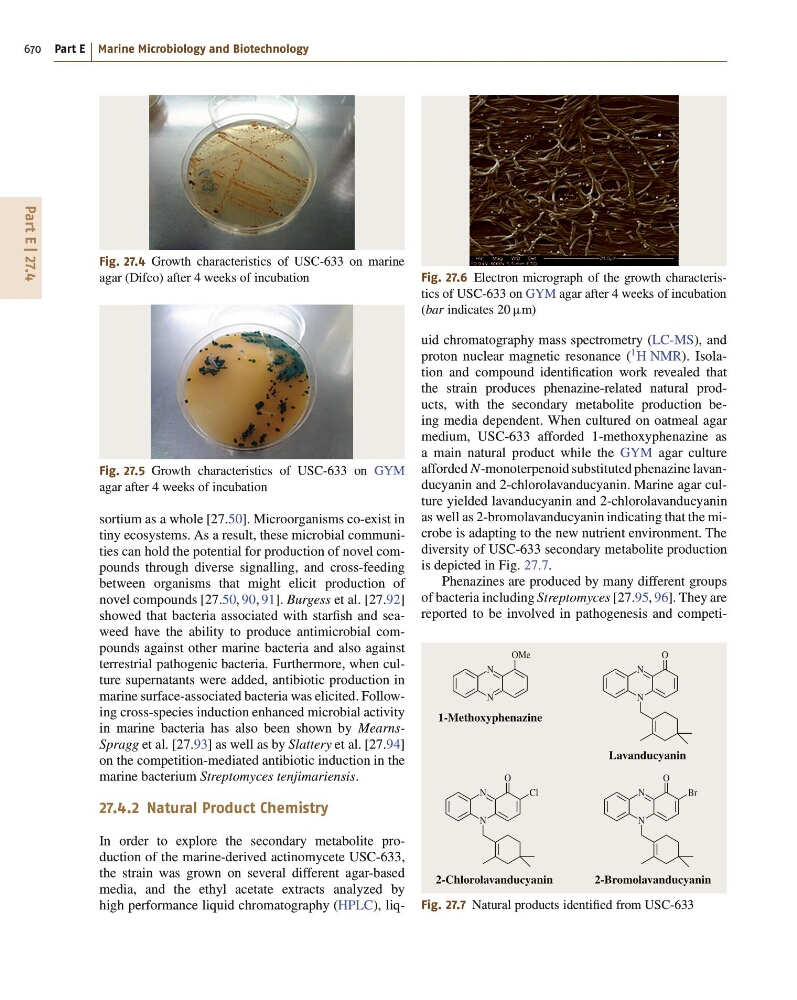
the strain produces phenazine-related natural products, with the secondary metabolite production being media dependent. When cultured on oatmeal agar
medium, USC-633 afforded 1-methoxyphenazine as
a main natural product while the GYM agar culture
afforded N-monoterpenoid substituted phenazine lavanducyanin and 2-chlorolavanducyanin. Marine agar culture yielded lavanducyanin and 2-chlorolavanducyanin
as well as 2-bromolavanducyanin indicating that the microbe is adapting to the new nutrient environment. The
diversity of USC-633 secondary metabolite production
is depicted in Fig. 27.7.
Phenazines are produced by many different groups
of bacteria including Streptomyces [27.95, 96]. They are
reported to be involved in pathogenesis and competi1-Methoxyphenazine
OMe
N
N
Lavanducyanin
O
N
N
2-Chlorolavanducyanin
O
N
N
C l
2-Bromolavanducyanin
O
N
N
B r
Fig. 27.7 Natural products identified from USC-633