

Part D | 25.5
634 Part D Marine Algal Biotechnology
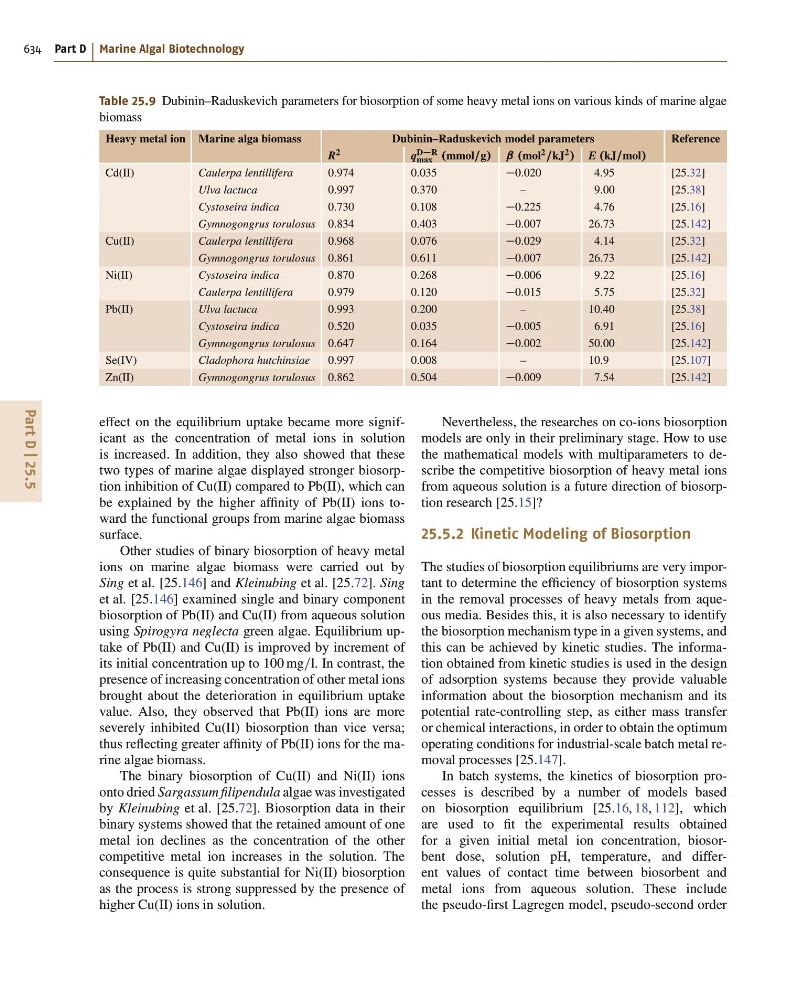
Table 25.9 Dubinin–Raduskevich parameters for biosorption of some heavy metal ions on various kinds of marine algae
biomass
Heavy metal ion Marine alga biomass
Dubinin–Raduskevich model parameters
Reference
R 2
q DR
max .mmol=g/ ˇ .mol 2 =kJ 2 / E .kJ=mol/
Cd(II)
Caulerpa lentillifera
0.974
0.035
0.020
4.95
[25.32]
Ulva lactuca
0.997
0.370
–
9.00
[25.38]
Cystoseira indica
0.730
0.108
0.225
4.76
[25.16]
Gymnogongrus torulosus 0.834
0.403
0.007
26.73
[25.142]
Cu(II)
Caulerpa lentillifera
0.968
0.076
0.029
4.14
[25.32]
Gymnogongrus torulosus 0.861
0.611
0.007
26.73
[25.142]
Ni(II)
Cystoseira indica
0.870
0.268
0.006
9.22
[25.16]
Caulerpa lentillifera
0.979
0.120
0.015
5.75
[25.32]
Pb(II)
Ulva lactuca
0.993
0.200
–
10.40
[25.38]
Cystoseira indica
0.520
0.035
0.005
6.91
[25.16]
Gymnogongrus torulosus 0.647
0.164
0.002
50.00
[25.142]
Se(IV)
Cladophora hutchinsiae
0.997
0.008
–
10.9
[25.107]
Zn(II)
Gymnogongrus torulosus 0.862
0.504
0.009
7.54
[25.142]
effect on the equilibrium uptake became more significant as the concentration of metal ions in solution
is increased. In addition, they also showed that these
two types of marine algae displayed stronger biosorption inhibition of Cu(II) compared to Pb(II), which can
be explained by the higher affinity of Pb(II) ions toward the functional groups from marine algae biomass
surface.
Other studies of binary biosorption of heavy metal
ions on marine algae biomass were carried out by
Sing et al. [25.146] and Kleinubing et al. [25.72]. Sing
et al. [25.146] examined single and binary component
biosorption of Pb(II) and Cu(II) from aqueous solution
using Spirogyra neglecta green algae. Equilibrium uptake of Pb(II) and Cu(II) is improved by increment of
its initial concentration up to 100 mg=l. In contrast, the
presence of increasing concentration of other metal ions
brought about the deterioration in equilibrium uptake
value. Also, they observed that Pb(II) ions are more
severely inhibited Cu(II) biosorption than vice versa;
thus reflecting greater affinity of Pb(II) ions for the marine algae biomass.
The binary biosorption of Cu(II) and Ni(II) ions
onto dried Sargassum filipendula algae was investigated
by Kleinubing et al. [25.72]. Biosorption data in their
binary systems showed that the retained amount of one
metal ion declines as the concentration of the other
competitive metal ion increases in the solution. The
consequence is quite substantial for Ni(II) biosorption
as the process is strong suppressed by the presence of
higher Cu(II) ions in solution.
Nevertheless, the researches on co-ions biosorption
models are only in their preliminary stage. How to use
the mathematical models with multiparameters to describe the competitive biosorption of heavy metal ions
from aqueous solution is a future direction of biosorption research [25.15]?
25.5.2 Kinetic Modeling of Biosorption
The studies of biosorption equilibriums are very important to determine the efficiency of biosorption systems
in the removal processes of heavy metals from aqueous media. Besides this, it is also necessary to identify
the biosorption mechanism type in a given systems, and
this can be achieved by kinetic studies. The information obtained from kinetic studies is used in the design
of adsorption systems because they provide valuable
information about the biosorption mechanism and its
potential rate-controlling step, as either mass transfer
or chemical interactions, in order to obtain the optimum
operating conditions for industrial-scale batch metal removal processes [25.147].
In batch systems, the kinetics of biosorption processes is described by a number of models based
on biosorption equilibrium [25.16, 18, 112], which
are used to fit the experimental results obtained
for a given initial metal ion concentration, biosorbent dose, solution pH, temperature, and different values of contact time between biosorbent and
metal ions from aqueous solution. These include
the pseudo-first Lagregen model, pseudo-second order