

Marine Algae Biomass for Removal of Heavy Metal Ions 25.4 Influence of Experimental Parameters 619
Part D | 25.4
Pb(II)
Cd(II)
Co(II)
1
2
3
4
5
6
7
R (%)
Initial solution pH
100
80
60
40
20
0
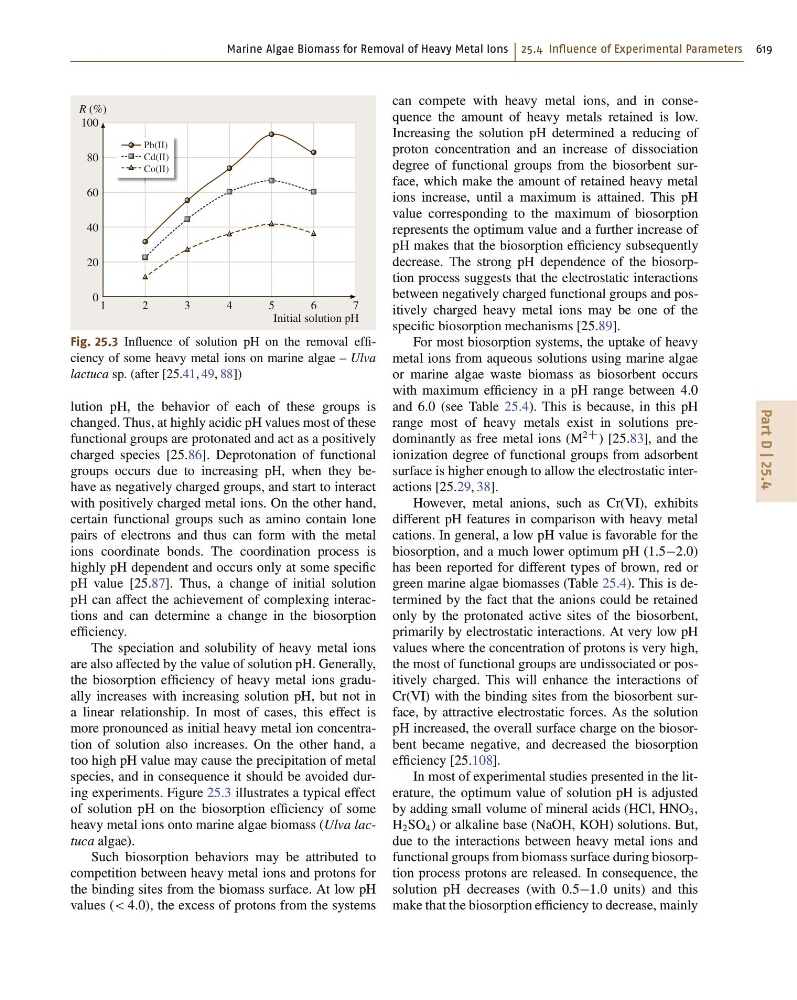
Fig. 25.3 Influence of solution pH on the removal efficiency of some heavy metal ions on marine algae – Ulva
lactuca sp. (after [25.41, 49, 88])
lution pH, the behavior of each of these groups is
changed. Thus, at highly acidic pH values most of these
functional groups are protonated and act as a positively
charged species [25.86]. Deprotonation of functional
groups occurs due to increasing pH, when they behave as negatively charged groups, and start to interact
with positively charged metal ions. On the other hand,
certain functional groups such as amino contain lone
pairs of electrons and thus can form with the metal
ions coordinate bonds. The coordination process is
highly pH dependent and occurs only at some specific
pH value [25.87]. Thus, a change of initial solution
pH can affect the achievement of complexing interactions and can determine a change in the biosorption
efficiency.
The speciation and solubility of heavy metal ions
are also affected by the value of solution pH. Generally,
the biosorption efficiency of heavy metal ions gradually increases with increasing solution pH, but not in
a linear relationship. In most of cases, this effect is
more pronounced as initial heavy metal ion concentration of solution also increases. On the other hand, a
too high pH value may cause the precipitation of metal
species, and in consequence it should be avoided during experiments. Figure 25.3 illustrates a typical effect
of solution pH on the biosorption efficiency of some
heavy metal ions onto marine algae biomass (Ulva lactuca algae).
Such biosorption behaviors may be attributed to
competition between heavy metal ions and protons for
the binding sites from the biomass surface. At low pH
values (< 4:0), the excess of protons from the systems
can compete with heavy metal ions, and in consequence the amount of heavy metals retained is low.
Increasing the solution pH determined a reducing of
proton concentration and an increase of dissociation
degree of functional groups from the biosorbent surface, which make the amount of retained heavy metal
ions increase, until a maximum is attained. This pH
value corresponding to the maximum of biosorption
represents the optimum value and a further increase of
pH makes that the biosorption efficiency subsequently
decrease. The strong pH dependence of the biosorption process suggests that the electrostatic interactions
between negatively charged functional groups and positively charged heavy metal ions may be one of the
specific biosorption mechanisms [25.89].
For most biosorption systems, the uptake of heavy
metal ions from aqueous solutions using marine algae
or marine algae waste biomass as biosorbent occurs
with maximum efficiency in a pH range between 4:0
and 6:0 (see Table 25.4). This is because, in this pH
range most of heavy metals exist in solutions predominantly as free metal ions (M
2C ) [25.83], and the
ionization degree of functional groups from adsorbent
surface is higher enough to allow the electrostatic interactions [25.29, 38].
However, metal anions, such as Cr(VI), exhibits
different pH features in comparison with heavy metal
cations. In general, a low pH value is favorable for the
biosorption, and a much lower optimum pH (1:52:0)
has been reported for different types of brown, red or
green marine algae biomasses (Table 25.4). This is determined by the fact that the anions could be retained
only by the protonated active sites of the biosorbent,
primarily by electrostatic interactions. At very low pH
values where the concentration of protons is very high,
the most of functional groups are undissociated or positively charged. This will enhance the interactions of
Cr(VI) with the binding sites from the biosorbent surface, by attractive electrostatic forces. As the solution
pH increased, the overall surface charge on the biosorbent became negative, and decreased the biosorption
efficiency [25.108].
In most of experimental studies presented in the literature, the optimum value of solution pH is adjusted
by adding small volume of mineral acids (HCl, HNO 3 ,
H 2 SO 4 ) or alkaline base (NaOH, KOH) solutions. But,
due to the interactions between heavy metal ions and
functional groups from biomass surface during biosorption process protons are released. In consequence, the
solution pH decreases (with 0:51:0 units) and this
make that the biosorption efficiency to decrease, mainly