

Part D | 25.3
616 Part D Marine Algal Biotechnology
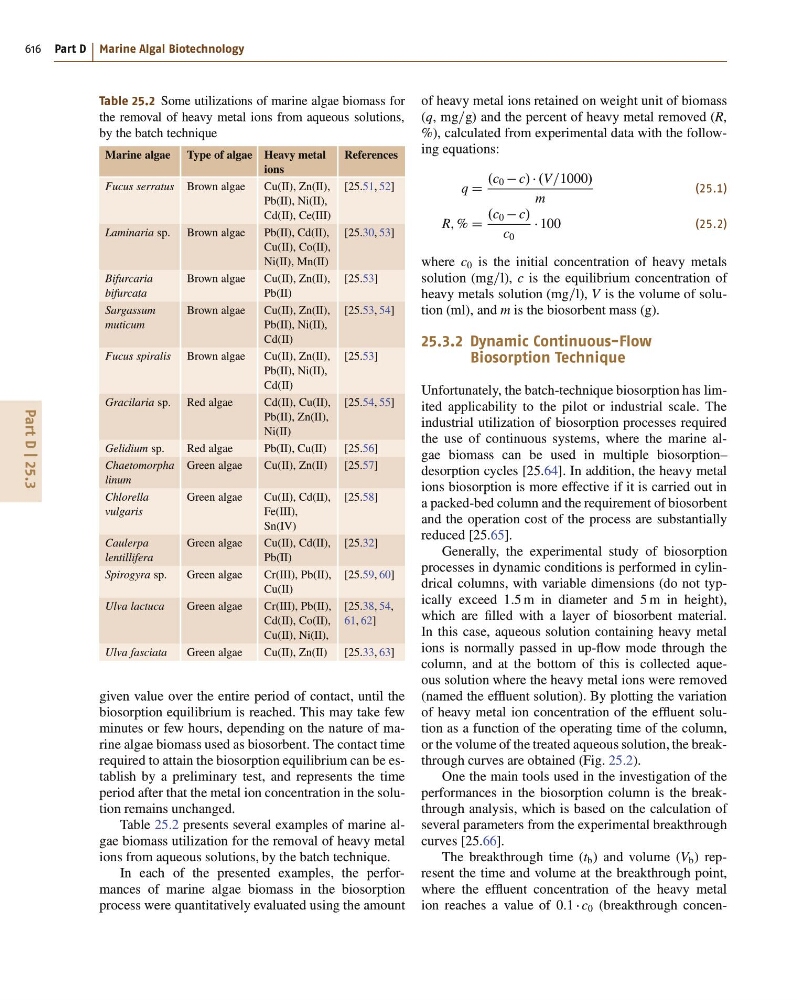
Table 25.2 Some utilizations of marine algae biomass for
the removal of heavy metal ions from aqueous solutions,
by the batch technique
Marine algae Type of algae Heavy metal
ions
References
Fucus serratus Brown algae
Cu(II), Zn(II),
Pb(II), Ni(II),
Cd(II), Ce(III)
[25.51, 52]
Laminaria sp. Brown algae
Pb(II), Cd(II),
Cu(II), Co(II),
Ni(II), Mn(II)
[25.30, 53]
Bifurcaria
bifurcata
Brown algae
Cu(II), Zn(II),
Pb(II)
[25.53]
Sargassum
muticum
Brown algae
Cu(II), Zn(II),
Pb(II), Ni(II),
Cd(II)
[25.53, 54]
Fucus spiralis Brown algae
Cu(II), Zn(II),
Pb(II), Ni(II),
Cd(II)
[25.53]
Gracilaria sp. Red algae
Cd(II), Cu(II),
Pb(II), Zn(II),
Ni(II)
[25.54, 55]
Gelidium sp.
Red algae
Pb(II), Cu(II)
[25.56]
Chaetomorpha
linum
Green algae
Cu(II), Zn(II) [25.57]
Chlorella
vulgaris
Green algae
Cu(II), Cd(II),
Fe(III),
Sn(IV)
[25.58]
Caulerpa
lentillifera
Green algae
Cu(II), Cd(II),
Pb(II)
[25.32]
Spirogyra sp.
Green algae
Cr(III), Pb(II),
Cu(II)
[25.59, 60]
Ulva lactuca
Green algae
Cr(III), Pb(II),
Cd(II), Co(II),
Cu(II), Ni(II),
[25.38, 54,
61, 62]
Ulva fasciata
Green algae
Cu(II), Zn(II) [25.33, 63]
given value over the entire period of contact, until the
biosorption equilibrium is reached. This may take few
minutes or few hours, depending on the nature of marine algae biomass used as biosorbent. The contact time
required to attain the biosorption equilibrium can be establish by a preliminary test, and represents the time
period after that the metal ion concentration in the solution remains unchanged.
Table 25.2 presents several examples of marine algae biomass utilization for the removal of heavy metal
ions from aqueous solutions, by the batch technique.
In each of the presented examples, the performances of marine algae biomass in the biosorption
process were quantitatively evaluated using the amount
of heavy metal ions retained on weight unit of biomass
(q, mg=g) and the percent of heavy metal removed (R,
%), calculated from experimental data with the following equations:
q D
.c 0 c/ .V=1000/
m
(25.1)
R; % D
.c 0 c/
c 0
100
(25.2)
where c 0 is the initial concentration of heavy metals
solution (mg=l), c is the equilibrium concentration of
heavy metals solution (mg=l), V is the volume of solution (ml), and m is the biosorbent mass (g).
25.3.2 Dynamic Continuous-Flow
Biosorption Technique
Unfortunately, the batch-technique biosorption has limited applicability to the pilot or industrial scale. The
industrial utilization of biosorption processes required
the use of continuous systems, where the marine algae biomass can be used in multiple biosorption–
desorption cycles [25.64]. In addition, the heavy metal
ions biosorption is more effective if it is carried out in
a packed-bed column and the requirement of biosorbent
and the operation cost of the process are substantially
reduced [25.65].
Generally, the experimental study of biosorption
processes in dynamic conditions is performed in cylindrical columns, with variable dimensions (do not typically exceed 1:5 m in diameter and 5 m in height),
which are filled with a layer of biosorbent material.
In this case, aqueous solution containing heavy metal
ions is normally passed in up-flow mode through the
column, and at the bottom of this is collected aqueous solution where the heavy metal ions were removed
(named the effluent solution). By plotting the variation
of heavy metal ion concentration of the effluent solution as a function of the operating time of the column,
or the volume of the treated aqueous solution, the breakthrough curves are obtained (Fig. 25.2).
One the main tools used in the investigation of the
performances in the biosorption column is the breakthrough analysis, which is based on the calculation of
several parameters from the experimental breakthrough
curves [25.66].
The breakthrough time (t b ) and volume (V b ) represent the time and volume at the breakthrough point,
where the effluent concentration of the heavy metal
ion reaches a value of 0:1 c 0 (breakthrough concen-