

Part D | 25.2
614 Part D Marine Algal Biotechnology
Table 25.1 The main constituents of some marine algae (after [25.45])
Constituent
(brown algae)
Fucus visoides
(brown algae)
Cystoseira barbata
(red algae)
Gracillaria compressa (red algae)
Gracillaria
confervoides
Ulva lactuca
(green algae)
Humidity (%)
10.50
9.40
11.30
10.80
11.09
Lipids (%)
3:204:70
1:342:36
–
–
–
Proteins (%)
12.31
13.51
17.71
29.52
13.91
Ash (%)
17.72
20.41
23.55
24.01
16.6
P (%)
0.14
0.20
0.14
0.39
0.12
I (mg=g)
0.31
0.40
0.17
0.50
0.11
Br (mg=g)
0.17
0.10
0.69
0.50
–
K (mg=g)
42.71
86.61
50.81
0.18
23.14
Ca (mg=g)
20.03
27.31
33.12
30.51
31.80
Mg (mg=g)
12.11
10.0
7.75
4.34
18.91
Zn (mg=g)
173.05
145.0
49.01
32.75
43.17
Mn (mg=g)
147.05
91.03
92.05
1693.01
–
Cu (mg=g)
11.23
18.21
7.22
22.86
10.12
4000
3000
3419.62
3406.12
2922.01
1637.48
1531.4
1419.54
1259.45
912.28
1161.09
1051.15
912.26
1161.09
1051.15
1242.09
1419.54
1531.4
1654.84
1456.18
2922.01
2000
1000
(1)
(2)
Wavenumber (cm
–1
)
–CH 2 groups
–SO 4 groups
–OH; –NH groups
–C=O stretching
–C–O
stretching
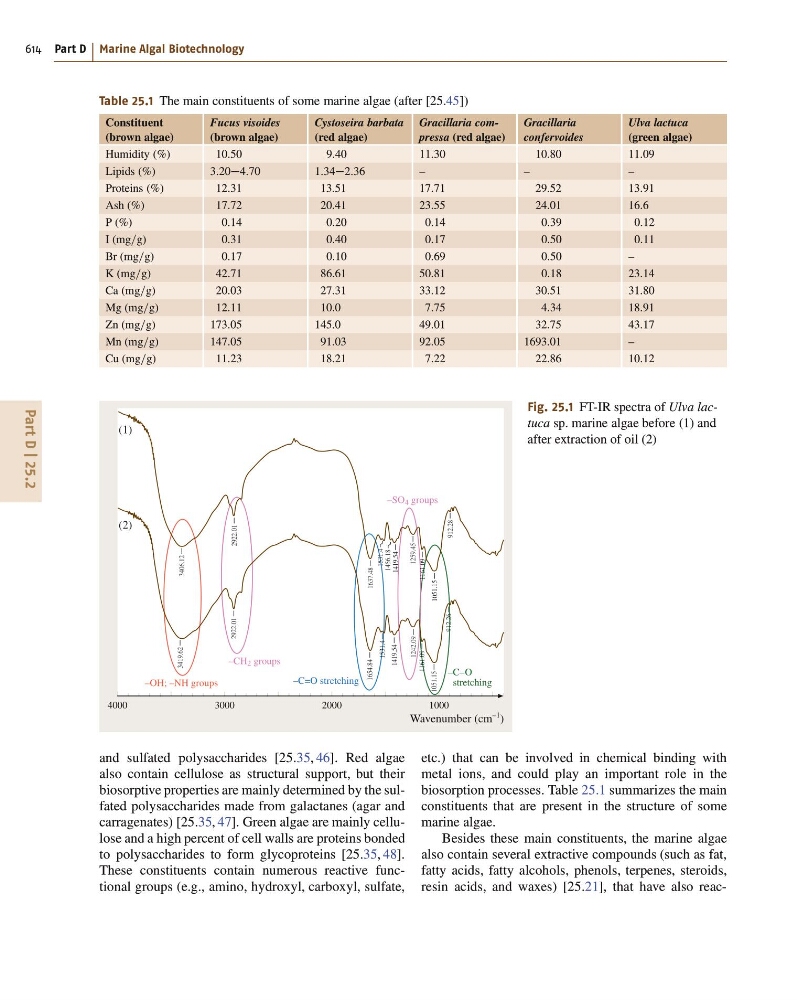
Fig. 25.1 FT-IR spectra of Ulva lactuca sp. marine algae before (1) and
after extraction of oil (2)
and sulfated polysaccharides [25.35, 46]. Red algae
also contain cellulose as structural support, but their
biosorptive properties are mainly determined by the sulfated polysaccharides made from galactanes (agar and
carragenates) [25.35, 47]. Green algae are mainly cellulose and a high percent of cell walls are proteins bonded
to polysaccharides to form glycoproteins [25.35, 48].
These constituents contain numerous reactive functional groups (e.g., amino, hydroxyl, carboxyl, sulfate,
etc.) that can be involved in chemical binding with
metal ions, and could play an important role in the
biosorption processes. Table 25.1 summarizes the main
constituents that are present in the structure of some
marine algae.
Besides these main constituents, the marine algae
also contain several extractive compounds (such as fat,
fatty acids, fatty alcohols, phenols, terpenes, steroids,
resin acids, and waxes) [25.21], that have also reac-