

Cell Wall Polysaccharides of Marine Algae 22.4 Algal Polysaccharides such as Phycocolloids 561
Part D | 22.4
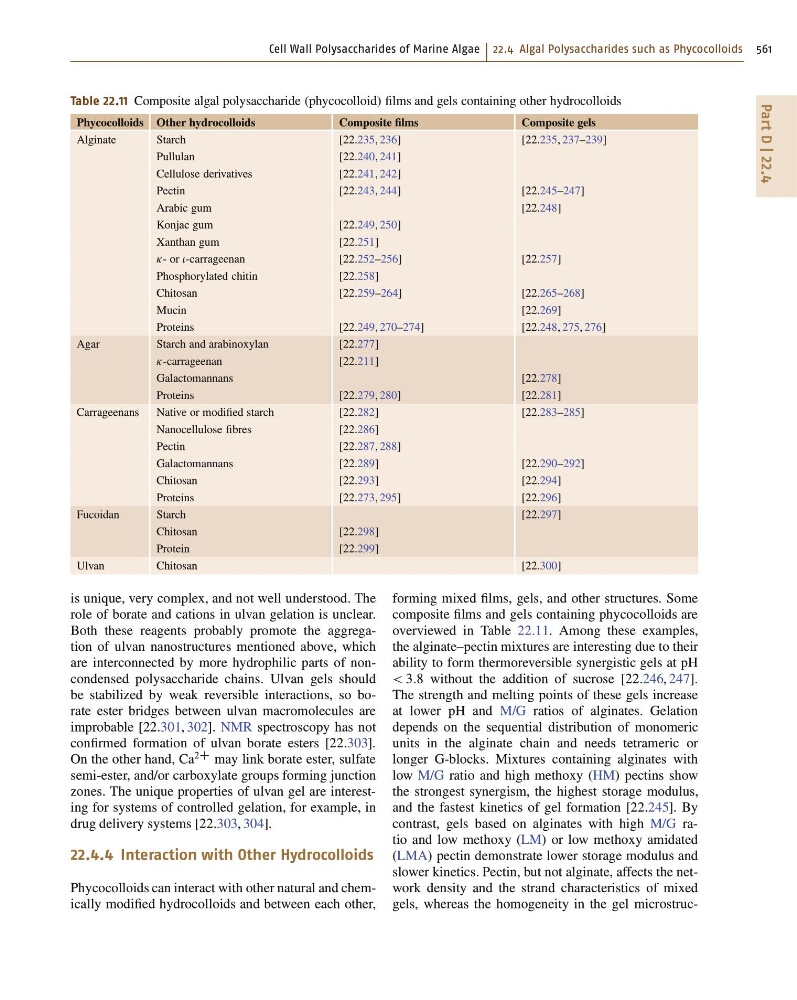
Table 22.11 Composite algal polysaccharide (phycocolloid) films and gels containing other hydrocolloids
Phycocolloids Other hydrocolloids
Composite films
Composite gels
Alginate
Starch
[22.235, 236]
[22.235, 237–239]
Pullulan
[22.240, 241]
Cellulose derivatives
[22.241, 242]
Pectin
[22.243, 244]
[22.245–247]
Arabic gum
[22.248]
Konjac gum
[22.249, 250]
Xanthan gum
[22.251]
Ä- or Ã-carrageenan
[22.252–256]
[22.257]
Phosphorylated chitin
[22.258]
Chitosan
[22.259–264]
[22.265–268]
Mucin
[22.269]
Proteins
[22.249, 270–274]
[22.248, 275, 276]
Agar
Starch and arabinoxylan
[22.277]
Ä-carrageenan
[22.211]
Galactomannans
[22.278]
Proteins
[22.279, 280]
[22.281]
Carrageenans Native or modified starch
[22.282]
[22.283–285]
Nanocellulose fibres
[22.286]
Pectin
[22.287, 288]
Galactomannans
[22.289]
[22.290–292]
Chitosan
[22.293]
[22.294]
Proteins
[22.273, 295]
[22.296]
Fucoidan
Starch
[22.297]
Chitosan
[22.298]
Protein
[22.299]
Ulvan
Chitosan
[22.300]
is unique, very complex, and not well understood. The
role of borate and cations in ulvan gelation is unclear.
Both these reagents probably promote the aggregation of ulvan nanostructures mentioned above, which
are interconnected by more hydrophilic parts of noncondensed polysaccharide chains. Ulvan gels should
be stabilized by weak reversible interactions, so borate ester bridges between ulvan macromolecules are
improbable [22.301, 302]. NMR spectroscopy has not
confirmed formation of ulvan borate esters [22.303].
On the other hand, Ca
2C may link borate ester, sulfate
semi-ester, and/or carboxylate groups forming junction
zones. The unique properties of ulvan gel are interesting for systems of controlled gelation, for example, in
drug delivery systems [22.303, 304].
22.4.4 Interaction with Other Hydrocolloids
Phycocolloids can interact with other natural and chemically modified hydrocolloids and between each other,
forming mixed films, gels, and other structures. Some
composite films and gels containing phycocolloids are
overviewed in Table 22.11. Among these examples,
the alginate–pectin mixtures are interesting due to their
ability to form thermoreversible synergistic gels at pH
< 3:8 without the addition of sucrose [22.246, 247].
The strength and melting points of these gels increase
at lower pH and M/G ratios of alginates. Gelation
depends on the sequential distribution of monomeric
units in the alginate chain and needs tetrameric or
longer G-blocks. Mixtures containing alginates with
low M/G ratio and high methoxy (HM) pectins show
the strongest synergism, the highest storage modulus,
and the fastest kinetics of gel formation [22.245]. By
contrast, gels based on alginates with high M/G ratio and low methoxy (LM) or low methoxy amidated
(LMA) pectin demonstrate lower storage modulus and
slower kinetics. Pectin, but not alginate, affects the network density and the strand characteristics of mixed
gels, whereas the homogeneity in the gel microstruc-