

Microfluidic Systems for Marine Biotechnology 20.4 Microfluidic Systems for Other Marine Biotechnology Applications 523
Part C | 20.4
V
ΔV
i
V
Brine
Fresh water
Nanojunction
Seawater
Any charged species
GND
GND
Ion depletion
boundary
V +
pressure
a)
c)
Coil C
Coil D
Coil C
Coil D
Coil B
Coil A
Decode
Coil B
Coil A
Microfluidic chip
Micromixer
Pump
Inverted microscope
Computer
Camera
Microscope bracket
Lens
4 mm
200 µm
20 µm
Microchannel
PDMS
Glas
4 mm
4 mm
4 mm
Inlet
Inlet
Pool
Pool
200 µm
200 µm
R 200 µm
R 200 µm
b)
A
B
C
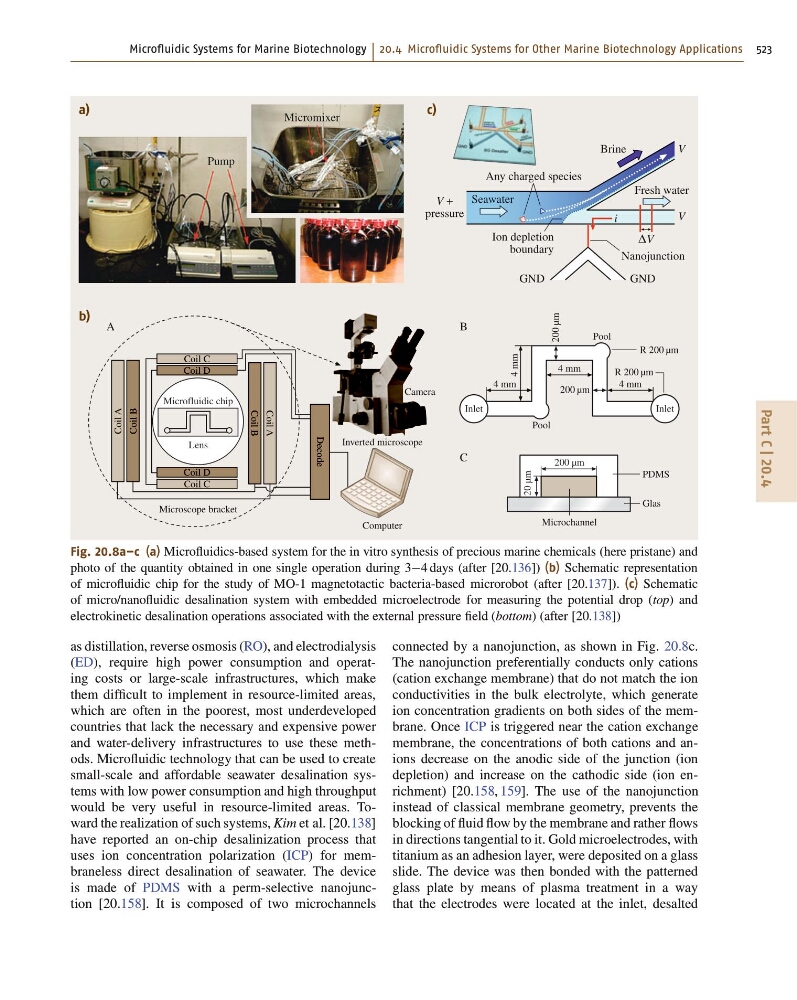
Fig. 20.8a–c (a) Microfluidics-based system for the in vitro synthesis of precious marine chemicals (here pristane) and
photo of the quantity obtained in one single operation during 34 days (after [20.136]) (b) Schematic representation
of microfluidic chip for the study of MO-1 magnetotactic bacteria-based microrobot (after [20.137]). (c) Schematic
of micro/nanofluidic desalination system with embedded microelectrode for measuring the potential drop (top) and
electrokinetic desalination operations associated with the external pressure field (bottom) (after [20.138])
as distillation, reverse osmosis (RO), and electrodialysis
(ED), require high power consumption and operating costs or large-scale infrastructures, which make
them difficult to implement in resource-limited areas,
which are often in the poorest, most underdeveloped
countries that lack the necessary and expensive power
and water-delivery infrastructures to use these methods. Microfluidic technology that can be used to create
small-scale and affordable seawater desalination systems with low power consumption and high throughput
would be very useful in resource-limited areas. Toward the realization of such systems, Kim et al. [20.138]
have reported an on-chip desalinization process that
uses ion concentration polarization (ICP) for membraneless direct desalination of seawater. The device
is made of PDMS with a perm-selective nanojunction [20.158]. It is composed of two microchannels
connected by a nanojunction, as shown in Fig. 20.8c.
The nanojunction preferentially conducts only cations
(cation exchange membrane) that do not match the ion
conductivities in the bulk electrolyte, which generate
ion concentration gradients on both sides of the membrane. Once ICP is triggered near the cation exchange
membrane, the concentrations of both cations and anions decrease on the anodic side of the junction (ion
depletion) and increase on the cathodic side (ion enrichment) [20.158, 159]. The use of the nanojunction
instead of classical membrane geometry, prevents the
blocking of fluid flow by the membrane and rather flows
in directions tangential to it. Gold microelectrodes, with
titanium as an adhesion layer, were deposited on a glass
slide. The device was then bonded with the patterned
glass plate by means of plasma treatment in a way
that the electrodes were located at the inlet, desalted
Part C | 20.4
V
ΔV
i
V
Brine
Fresh water
Nanojunction
Seawater
Any charged species
GND
GND
Ion depletion
boundary
V +
pressure
a)
c)
Coil C
Coil D
Coil C
Coil D
Coil B
Coil A
Decode
Coil B
Coil A
Microfluidic chip
Micromixer
Pump
Inverted microscope
Computer
Camera
Microscope bracket
Lens
4 mm
200 µm
20 µm
Microchannel
PDMS
Glas
4 mm
4 mm
4 mm
Inlet
Inlet
Pool
Pool
200 µm
200 µm
R 200 µm
R 200 µm
b)
A
B
C
Fig. 20.8a–c (a) Microfluidics-based system for the in vitro synthesis of precious marine chemicals (here pristane) and
photo of the quantity obtained in one single operation during 34 days (after [20.136]) (b) Schematic representation
of microfluidic chip for the study of MO-1 magnetotactic bacteria-based microrobot (after [20.137]). (c) Schematic
of micro/nanofluidic desalination system with embedded microelectrode for measuring the potential drop (top) and
electrokinetic desalination operations associated with the external pressure field (bottom) (after [20.138])
as distillation, reverse osmosis (RO), and electrodialysis
(ED), require high power consumption and operating costs or large-scale infrastructures, which make
them difficult to implement in resource-limited areas,
which are often in the poorest, most underdeveloped
countries that lack the necessary and expensive power
and water-delivery infrastructures to use these methods. Microfluidic technology that can be used to create
small-scale and affordable seawater desalination systems with low power consumption and high throughput
would be very useful in resource-limited areas. Toward the realization of such systems, Kim et al. [20.138]
have reported an on-chip desalinization process that
uses ion concentration polarization (ICP) for membraneless direct desalination of seawater. The device
is made of PDMS with a perm-selective nanojunction [20.158]. It is composed of two microchannels
connected by a nanojunction, as shown in Fig. 20.8c.
The nanojunction preferentially conducts only cations
(cation exchange membrane) that do not match the ion
conductivities in the bulk electrolyte, which generate
ion concentration gradients on both sides of the membrane. Once ICP is triggered near the cation exchange
membrane, the concentrations of both cations and anions decrease on the anodic side of the junction (ion
depletion) and increase on the cathodic side (ion enrichment) [20.158, 159]. The use of the nanojunction
instead of classical membrane geometry, prevents the
blocking of fluid flow by the membrane and rather flows
in directions tangential to it. Gold microelectrodes, with
titanium as an adhesion layer, were deposited on a glass
slide. The device was then bonded with the patterned
glass plate by means of plasma treatment in a way
that the electrodes were located at the inlet, desalted