

Part C | 20.1
510 Part C Marine Genomics
20.1 Basic Principal of Microfluidics
Microfluidics encompasses many multidisciplinary areas, including physics, chemistry, engineering, and
biotechnology. More precisely, it deals with the science and technology of systems that manipulate very
small fluid volumes, 10
9
10
18 L, through channels
with dimensions in the range of tens to hundreds of
micrometers [20.4]. Microfluidics emphasizes many
advantages compared to conventional fluidic handling
and may be summarized as follows: lower consumption
of sample volumes, less reagent wastage, cost savings
of samples, faster reaction times, faster diffusion, quick
heating and cooling, better process control, and integration of reaction steps on a single chip [20.5, 6].
Integration is the key part of microfluidics, and integrated microfluidic systems manipulate very small
fluid volumes in micro/nanometer scale channels for
the automation and integration of many biological or
chemical processes [20.4]. However, the integration aspect of microfluidics is still very young, and hence to
fully utilize the above-mentioned advantages further
engineering innovation of different strategies and optimization processes is required [20.4].
The seed of microfluidics started around three
decades ago with the development of gas chromatography and the inkjet printer [20.5]. Since then
a significantly large number of applications of microfluidics has been successfully demonstrated for
chromatography, electrophoretic separation systems,
electro-osmotic pumping systems, diffusive separation
systems, micromixers, deoxyribonucleic acid (DNA)
amplification, cytometers, and chemical microreactors,
nearly in chronological order [20.6]. In recent years,
integrated microfluidic systems have captured diverse
Parabolic velocity profile
Hydrophilic surface
Hydrophobic surface
Width δ(x)
θ
θ
a)
d)
e)
b)
Diffusive
mixing
c)
Diffusion
zone
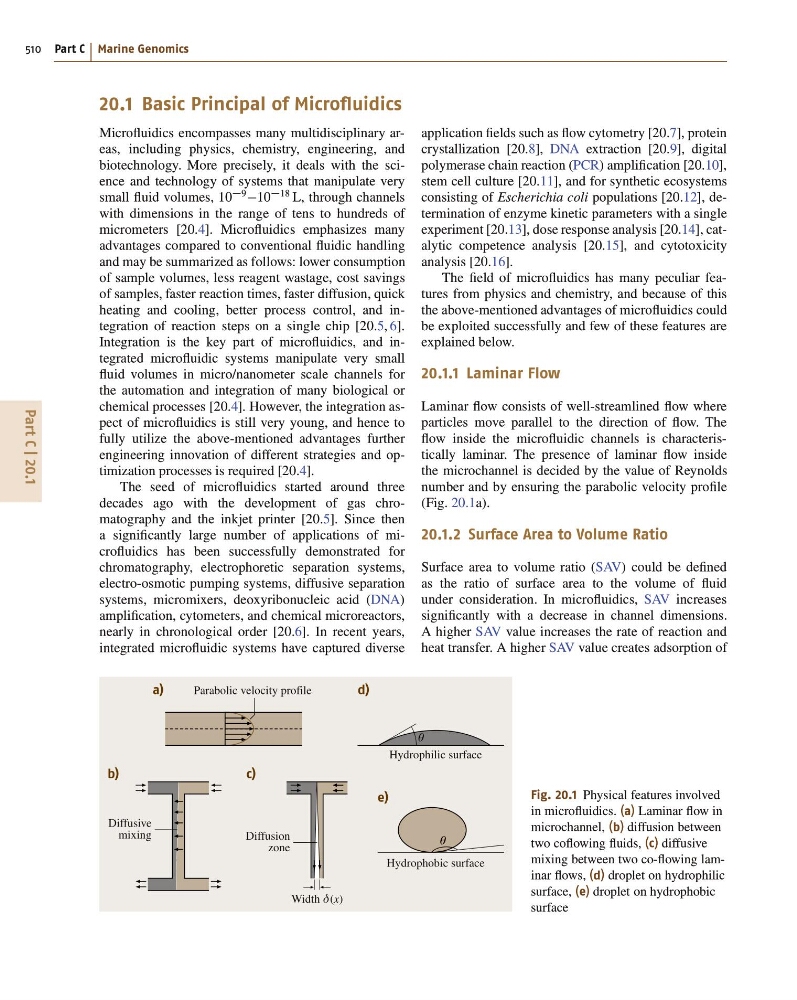
Fig. 20.1 Physical features involved
in microfluidics. (a) Laminar flow in
microchannel, (b) diffusion between
two coflowing fluids, (c) diffusive
mixing between two co-flowing laminar flows, (d) droplet on hydrophilic
surface, (e) droplet on hydrophobic
surface
application fields such as flow cytometry [20.7], protein
crystallization [20.8], DNA extraction [20.9], digital
polymerase chain reaction (PCR) amplification [20.10],
stem cell culture [20.11], and for synthetic ecosystems
consisting of Escherichia coli populations [20.12], determination of enzyme kinetic parameters with a single
experiment [20.13], dose response analysis [20.14], catalytic competence analysis [20.15], and cytotoxicity
analysis [20.16].
The field of microfluidics has many peculiar features from physics and chemistry, and because of this
the above-mentioned advantages of microfluidics could
be exploited successfully and few of these features are
explained below.
20.1.1 Laminar Flow
Laminar flow consists of well-streamlined flow where
particles move parallel to the direction of flow. The
flow inside the microfluidic channels is characteristically laminar. The presence of laminar flow inside
the microchannel is decided by the value of Reynolds
number and by ensuring the parabolic velocity profile
(Fig. 20.1a).
20.1.2 Surface Area to Volume Ratio
Surface area to volume ratio (SAV) could be defined
as the ratio of surface area to the volume of fluid
under consideration. In microfluidics, SAV increases
significantly with a decrease in channel dimensions.
A higher SAV value increases the rate of reaction and
heat transfer. A higher SAV value creates adsorption of
510 Part C Marine Genomics
20.1 Basic Principal of Microfluidics
Microfluidics encompasses many multidisciplinary areas, including physics, chemistry, engineering, and
biotechnology. More precisely, it deals with the science and technology of systems that manipulate very
small fluid volumes, 10
9
10
18 L, through channels
with dimensions in the range of tens to hundreds of
micrometers [20.4]. Microfluidics emphasizes many
advantages compared to conventional fluidic handling
and may be summarized as follows: lower consumption
of sample volumes, less reagent wastage, cost savings
of samples, faster reaction times, faster diffusion, quick
heating and cooling, better process control, and integration of reaction steps on a single chip [20.5, 6].
Integration is the key part of microfluidics, and integrated microfluidic systems manipulate very small
fluid volumes in micro/nanometer scale channels for
the automation and integration of many biological or
chemical processes [20.4]. However, the integration aspect of microfluidics is still very young, and hence to
fully utilize the above-mentioned advantages further
engineering innovation of different strategies and optimization processes is required [20.4].
The seed of microfluidics started around three
decades ago with the development of gas chromatography and the inkjet printer [20.5]. Since then
a significantly large number of applications of microfluidics has been successfully demonstrated for
chromatography, electrophoretic separation systems,
electro-osmotic pumping systems, diffusive separation
systems, micromixers, deoxyribonucleic acid (DNA)
amplification, cytometers, and chemical microreactors,
nearly in chronological order [20.6]. In recent years,
integrated microfluidic systems have captured diverse
Parabolic velocity profile
Hydrophilic surface
Hydrophobic surface
Width δ(x)
θ
θ
a)
d)
e)
b)
Diffusive
mixing
c)
Diffusion
zone
Fig. 20.1 Physical features involved
in microfluidics. (a) Laminar flow in
microchannel, (b) diffusion between
two coflowing fluids, (c) diffusive
mixing between two co-flowing laminar flows, (d) droplet on hydrophilic
surface, (e) droplet on hydrophobic
surface
application fields such as flow cytometry [20.7], protein
crystallization [20.8], DNA extraction [20.9], digital
polymerase chain reaction (PCR) amplification [20.10],
stem cell culture [20.11], and for synthetic ecosystems
consisting of Escherichia coli populations [20.12], determination of enzyme kinetic parameters with a single
experiment [20.13], dose response analysis [20.14], catalytic competence analysis [20.15], and cytotoxicity
analysis [20.16].
The field of microfluidics has many peculiar features from physics and chemistry, and because of this
the above-mentioned advantages of microfluidics could
be exploited successfully and few of these features are
explained below.
20.1.1 Laminar Flow
Laminar flow consists of well-streamlined flow where
particles move parallel to the direction of flow. The
flow inside the microfluidic channels is characteristically laminar. The presence of laminar flow inside
the microchannel is decided by the value of Reynolds
number and by ensuring the parabolic velocity profile
(Fig. 20.1a).
20.1.2 Surface Area to Volume Ratio
Surface area to volume ratio (SAV) could be defined
as the ratio of surface area to the volume of fluid
under consideration. In microfluidics, SAV increases
significantly with a decrease in channel dimensions.
A higher SAV value increases the rate of reaction and
heat transfer. A higher SAV value creates adsorption of