

Proteomics: Applications and Advances 18.4 Aquaculture 479
Part C | 18.4
In another study conducted to identify biomarkers of chronic stress, the liver proteome from gilthead
sea bream (Sparus aurata, L.) that had been stressed
by repetitive handling or stocked at high density was
compared to that of control fish using comparative
proteomics [18.37]. Approximately 299 differentially
expressed proteins were detected by 2D-PAGE, with
235 spots differentially expressed in response to handling stress, 223 spots regulated in response to overcrowding, and 70 spots that responded to both treatments. LC-MS/MS analysis allowed identification of
12 differentially expressed proteins: fatty acid binding protein and haemoglobin were up-regulated, while
calmodulin, triose-phosphate isomerase, ˇ-tubulin, glutamine synthetase, pyruvate dehydrogenase, heat shock
cognate protein 70, glyceraldehyde 3-phosphate dehydrogenase, ˛-enolase, voltage-dependent anion channel 1, and cofilin were all down-regulated [18.37].
The proteins could be assigned to key functional
groups, reflecting their role in lipid transport, antioxidation, chaperoning, Ca
2C signaling, lipid oxidation,
ammonia metabolism, cytoskeleton, and carbohydrate
metabolism. Alves et al. [18.37] list fatty acid binding protein, calmodulin, pyruvate dehydrogenase, heat
shock cognate protein 70, and voltage-dependent anion channel 1 as the most promising molecular markers
identified in their study since their role in the stress
response is better understood. However, the authors
caution that additional proteomic studies need to be
conducted using different tissues in order to ensure that
biomarkers used to monitor chronic stress in farmed
fish are robust. Furthermore, expression of these potential biomarkers during activities that affect metabolism,
such as feeding and exercise, needs to be assessed to
ensure their specificity with regard to chronic stress.
Although Moraxella sp. colonizing the internal organs of farmed fish has not been directly associated with
disease, farmers have reported slow growth rates, poor
feed conversion, and decreased weight gain in sea cagefarmed fish [18.38]. A proteomic investigation of kidney samples obtained from cage-farmed Sparus aurata
that were positive or negative for Moraxella sp. showed
that several mitochondrial enzymes were significantly
up-regulated in the Moraxella sp. infected kidneys,
reflecting what has been reported in lipopolysaccharide (LPS) challenge experiments [18.38]. A number
of nonmitochondrial proteins were found to be upregulated, including peroxiredoxins, S-adenosyl-homocysteine hydrolase, antiquitin, warm acclimation-related protein 65, transferrin, glutathione S-transferase,
carbonic anhydrase, and Cu/Zn superoxide dismutase,
many of which function in oxidative stress, infection,
inflammation, or apoptosis. The study suggested that
metabolic alterations do occur in Moraxella sp. infected
fish and identified various proteins that could potentially be used as biomarkers of Moraxella sp. infection
in farmed fish.
The protozoan parasite Marteilia sydneyi is responsible for QX disease in Sydney rock oysters (Saccostrea
glomerata), which can result in up to 95% mortality [18.39]. A proteomic approach to identify markers
of QX disease resistance among Sydney rock oysters
was undertaken by developing proteome maps of total
haemolymph proteins from the fifth generation of a QX
resistant oyster line derived from successive generations of selective breeding in which parental broodstock
had survived disease outbreaks (QXR5), and comparing these to proteome maps from uninfected and
infected wild-type oysters. Six proteins, found to be
uniquely associated with resistance, were characterized
by ESIMS/MS, which showed that two proteins were
homologous to cavortin from the Pacific oyster Crassostrea agigas and domin in from the Eastern oyster
Crassostrea avirginica [18.39]. Although the remaining
four proteins could not be identified due to the absence
of homologous sequences in the National Center for
Biotechnology Information (NCBI) database, the two
superoxide dismutase-like molecules are being investigated further as potential markers for selective breeding
of QX disease-resistant oysters.
As previously mentioned, probiotic treatment of
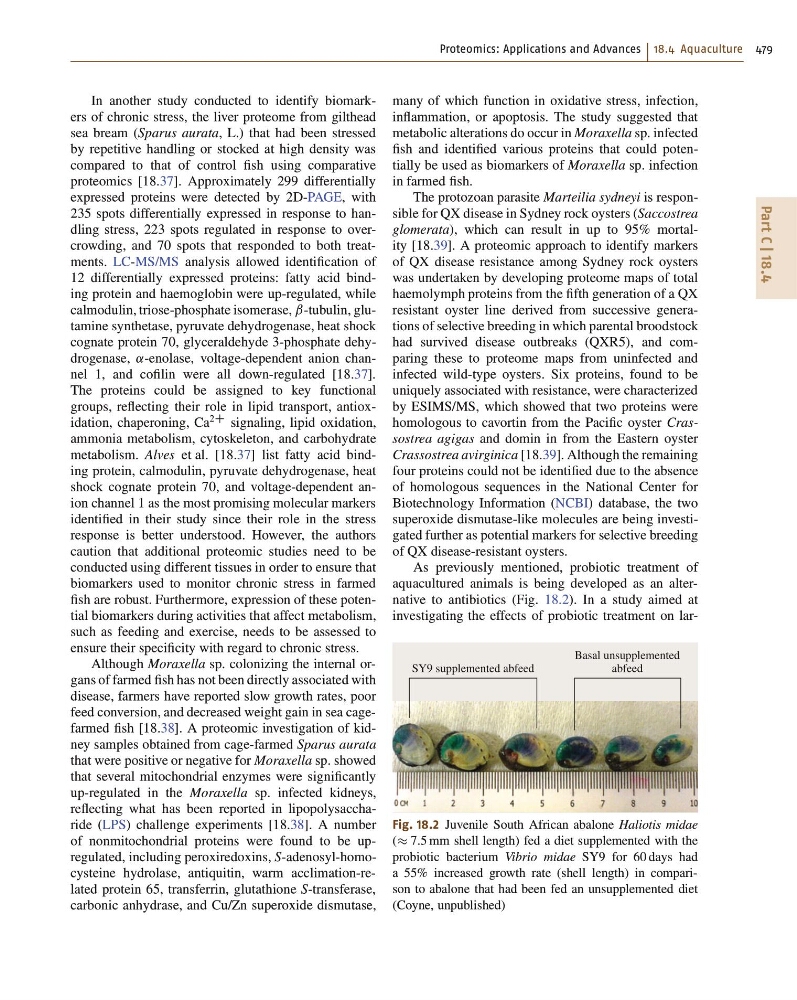
aquacultured animals is being developed as an alternative to antibiotics (Fig. 18.2). In a study aimed at
investigating the effects of probiotic treatment on larSY9 supplemented abfeed
Basal unsupplemented
abfeed
Fig. 18.2 Juvenile South African abalone Haliotis midae
( 7:5 mm shell length) fed a diet supplemented with the
probiotic bacterium Vibrio midae SY9 for 60 days had
a 55% increased growth rate (shell length) in comparison to abalone that had been fed an unsupplemented diet
(Coyne, unpublished)
Part C | 18.4
In another study conducted to identify biomarkers of chronic stress, the liver proteome from gilthead
sea bream (Sparus aurata, L.) that had been stressed
by repetitive handling or stocked at high density was
compared to that of control fish using comparative
proteomics [18.37]. Approximately 299 differentially
expressed proteins were detected by 2D-PAGE, with
235 spots differentially expressed in response to handling stress, 223 spots regulated in response to overcrowding, and 70 spots that responded to both treatments. LC-MS/MS analysis allowed identification of
12 differentially expressed proteins: fatty acid binding protein and haemoglobin were up-regulated, while
calmodulin, triose-phosphate isomerase, ˇ-tubulin, glutamine synthetase, pyruvate dehydrogenase, heat shock
cognate protein 70, glyceraldehyde 3-phosphate dehydrogenase, ˛-enolase, voltage-dependent anion channel 1, and cofilin were all down-regulated [18.37].
The proteins could be assigned to key functional
groups, reflecting their role in lipid transport, antioxidation, chaperoning, Ca
2C signaling, lipid oxidation,
ammonia metabolism, cytoskeleton, and carbohydrate
metabolism. Alves et al. [18.37] list fatty acid binding protein, calmodulin, pyruvate dehydrogenase, heat
shock cognate protein 70, and voltage-dependent anion channel 1 as the most promising molecular markers
identified in their study since their role in the stress
response is better understood. However, the authors
caution that additional proteomic studies need to be
conducted using different tissues in order to ensure that
biomarkers used to monitor chronic stress in farmed
fish are robust. Furthermore, expression of these potential biomarkers during activities that affect metabolism,
such as feeding and exercise, needs to be assessed to
ensure their specificity with regard to chronic stress.
Although Moraxella sp. colonizing the internal organs of farmed fish has not been directly associated with
disease, farmers have reported slow growth rates, poor
feed conversion, and decreased weight gain in sea cagefarmed fish [18.38]. A proteomic investigation of kidney samples obtained from cage-farmed Sparus aurata
that were positive or negative for Moraxella sp. showed
that several mitochondrial enzymes were significantly
up-regulated in the Moraxella sp. infected kidneys,
reflecting what has been reported in lipopolysaccharide (LPS) challenge experiments [18.38]. A number
of nonmitochondrial proteins were found to be upregulated, including peroxiredoxins, S-adenosyl-homocysteine hydrolase, antiquitin, warm acclimation-related protein 65, transferrin, glutathione S-transferase,
carbonic anhydrase, and Cu/Zn superoxide dismutase,
many of which function in oxidative stress, infection,
inflammation, or apoptosis. The study suggested that
metabolic alterations do occur in Moraxella sp. infected
fish and identified various proteins that could potentially be used as biomarkers of Moraxella sp. infection
in farmed fish.
The protozoan parasite Marteilia sydneyi is responsible for QX disease in Sydney rock oysters (Saccostrea
glomerata), which can result in up to 95% mortality [18.39]. A proteomic approach to identify markers
of QX disease resistance among Sydney rock oysters
was undertaken by developing proteome maps of total
haemolymph proteins from the fifth generation of a QX
resistant oyster line derived from successive generations of selective breeding in which parental broodstock
had survived disease outbreaks (QXR5), and comparing these to proteome maps from uninfected and
infected wild-type oysters. Six proteins, found to be
uniquely associated with resistance, were characterized
by ESIMS/MS, which showed that two proteins were
homologous to cavortin from the Pacific oyster Crassostrea agigas and domin in from the Eastern oyster
Crassostrea avirginica [18.39]. Although the remaining
four proteins could not be identified due to the absence
of homologous sequences in the National Center for
Biotechnology Information (NCBI) database, the two
superoxide dismutase-like molecules are being investigated further as potential markers for selective breeding
of QX disease-resistant oysters.
As previously mentioned, probiotic treatment of
aquacultured animals is being developed as an alternative to antibiotics (Fig. 18.2). In a study aimed at
investigating the effects of probiotic treatment on larSY9 supplemented abfeed
Basal unsupplemented
abfeed
Fig. 18.2 Juvenile South African abalone Haliotis midae
( 7:5 mm shell length) fed a diet supplemented with the
probiotic bacterium Vibrio midae SY9 for 60 days had
a 55% increased growth rate (shell length) in comparison to abalone that had been fed an unsupplemented diet
(Coyne, unpublished)