

Part C | 17.1
458 Part C Marine Genomics
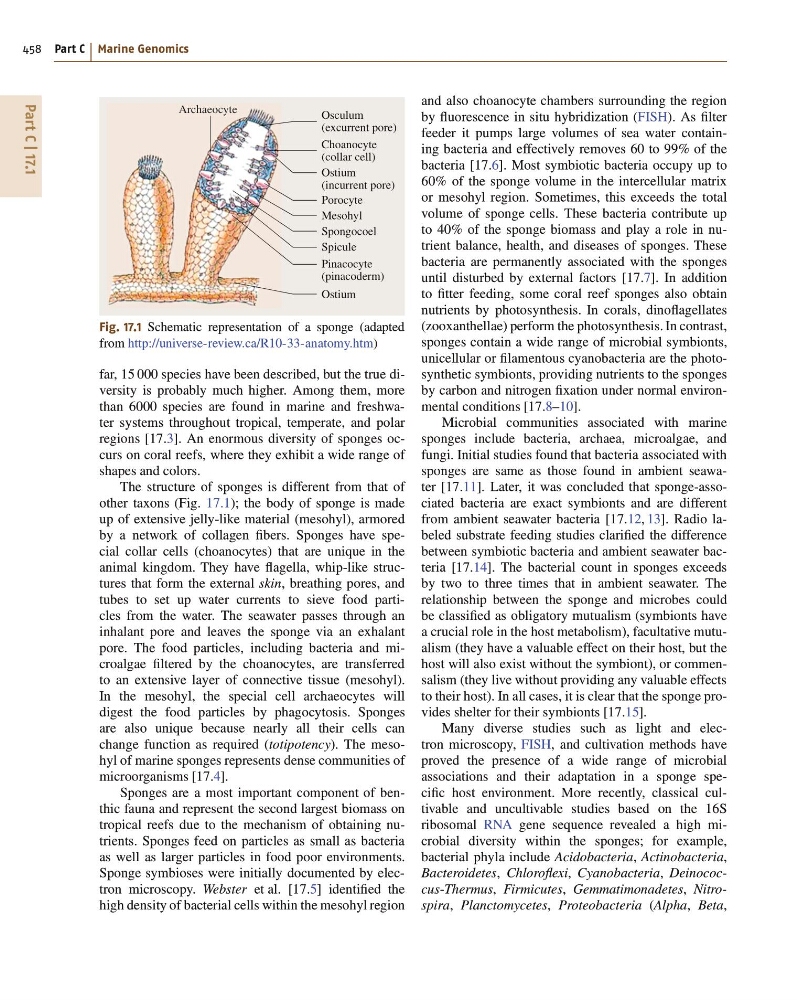
Archaeocyte
Osculum
(excurrent pore)
Choanocyte
(collar cell)
Ostium
(incurrent pore)
Ostium
Pinacocyte
(pinacoderm)
Porocyte
Mesohyl
Spongocoel
Spicule
Fig. 17.1 Schematic representation of a sponge (adapted
from http://universe-review.ca/R10-33-anatomy.htm)
far, 15 000 species have been described, but the true diversity is probably much higher. Among them, more
than 6000 species are found in marine and freshwater systems throughout tropical, temperate, and polar
regions [17.3]. An enormous diversity of sponges occurs on coral reefs, where they exhibit a wide range of
shapes and colors.
The structure of sponges is different from that of
other taxons (Fig. 17.1); the body of sponge is made
up of extensive jelly-like material (mesohyl), armored
by a network of collagen fibers. Sponges have special collar cells (choanocytes) that are unique in the
animal kingdom. They have flagella, whip-like structures that form the external skin, breathing pores, and
tubes to set up water currents to sieve food particles from the water. The seawater passes through an
inhalant pore and leaves the sponge via an exhalant
pore. The food particles, including bacteria and microalgae filtered by the choanocytes, are transferred
to an extensive layer of connective tissue (mesohyl).
In the mesohyl, the special cell archaeocytes will
digest the food particles by phagocytosis. Sponges
are also unique because nearly all their cells can
change function as required (totipotency). The mesohyl of marine sponges represents dense communities of
microorganisms [17.4].
Sponges are a most important component of benthic fauna and represent the second largest biomass on
tropical reefs due to the mechanism of obtaining nutrients. Sponges feed on particles as small as bacteria
as well as larger particles in food poor environments.
Sponge symbioses were initially documented by electron microscopy. Webster et al. [17.5] identified the
high density of bacterial cells within the mesohyl region
and also choanocyte chambers surrounding the region
by fluorescence in situ hybridization (FISH). As filter
feeder it pumps large volumes of sea water containing bacteria and effectively removes 60 to 99% of the
bacteria [17.6]. Most symbiotic bacteria occupy up to
60% of the sponge volume in the intercellular matrix
or mesohyl region. Sometimes, this exceeds the total
volume of sponge cells. These bacteria contribute up
to 40% of the sponge biomass and play a role in nutrient balance, health, and diseases of sponges. These
bacteria are permanently associated with the sponges
until disturbed by external factors [17.7]. In addition
to fitter feeding, some coral reef sponges also obtain
nutrients by photosynthesis. In corals, dinoflagellates
(zooxanthellae) perform the photosynthesis. In contrast,
sponges contain a wide range of microbial symbionts,
unicellular or filamentous cyanobacteria are the photosynthetic symbionts, providing nutrients to the sponges
by carbon and nitrogen fixation under normal environmental conditions [17.8–10].
Microbial communities associated with marine
sponges include bacteria, archaea, microalgae, and
fungi. Initial studies found that bacteria associated with
sponges are same as those found in ambient seawater [17.11]. Later, it was concluded that sponge-associated bacteria are exact symbionts and are different
from ambient seawater bacteria [17.12, 13]. Radio labeled substrate feeding studies clarified the difference
between symbiotic bacteria and ambient seawater bacteria [17.14]. The bacterial count in sponges exceeds
by two to three times that in ambient seawater. The
relationship between the sponge and microbes could
be classified as obligatory mutualism (symbionts have
a crucial role in the host metabolism), facultative mutualism (they have a valuable effect on their host, but the
host will also exist without the symbiont), or commensalism (they live without providing any valuable effects
to their host). In all cases, it is clear that the sponge provides shelter for their symbionts [17.15].
Many diverse studies such as light and electron microscopy, FISH, and cultivation methods have
proved the presence of a wide range of microbial
associations and their adaptation in a sponge specific host environment. More recently, classical cultivable and uncultivable studies based on the 16S
ribosomal RNA gene sequence revealed a high microbial diversity within the sponges; for example,
bacterial phyla include Acidobacteria, Actinobacteria,
Bacteroidetes, Chloroflexi, Cyanobacteria, Deinococcus-Thermus, Firmicutes, Gemmatimonadetes, Nitrospira, Planctomycetes, Proteobacteria (Alpha, Beta,
458 Part C Marine Genomics
Archaeocyte
Osculum
(excurrent pore)
Choanocyte
(collar cell)
Ostium
(incurrent pore)
Ostium
Pinacocyte
(pinacoderm)
Porocyte
Mesohyl
Spongocoel
Spicule
Fig. 17.1 Schematic representation of a sponge (adapted
from http://universe-review.ca/R10-33-anatomy.htm)
far, 15 000 species have been described, but the true diversity is probably much higher. Among them, more
than 6000 species are found in marine and freshwater systems throughout tropical, temperate, and polar
regions [17.3]. An enormous diversity of sponges occurs on coral reefs, where they exhibit a wide range of
shapes and colors.
The structure of sponges is different from that of
other taxons (Fig. 17.1); the body of sponge is made
up of extensive jelly-like material (mesohyl), armored
by a network of collagen fibers. Sponges have special collar cells (choanocytes) that are unique in the
animal kingdom. They have flagella, whip-like structures that form the external skin, breathing pores, and
tubes to set up water currents to sieve food particles from the water. The seawater passes through an
inhalant pore and leaves the sponge via an exhalant
pore. The food particles, including bacteria and microalgae filtered by the choanocytes, are transferred
to an extensive layer of connective tissue (mesohyl).
In the mesohyl, the special cell archaeocytes will
digest the food particles by phagocytosis. Sponges
are also unique because nearly all their cells can
change function as required (totipotency). The mesohyl of marine sponges represents dense communities of
microorganisms [17.4].
Sponges are a most important component of benthic fauna and represent the second largest biomass on
tropical reefs due to the mechanism of obtaining nutrients. Sponges feed on particles as small as bacteria
as well as larger particles in food poor environments.
Sponge symbioses were initially documented by electron microscopy. Webster et al. [17.5] identified the
high density of bacterial cells within the mesohyl region
and also choanocyte chambers surrounding the region
by fluorescence in situ hybridization (FISH). As filter
feeder it pumps large volumes of sea water containing bacteria and effectively removes 60 to 99% of the
bacteria [17.6]. Most symbiotic bacteria occupy up to
60% of the sponge volume in the intercellular matrix
or mesohyl region. Sometimes, this exceeds the total
volume of sponge cells. These bacteria contribute up
to 40% of the sponge biomass and play a role in nutrient balance, health, and diseases of sponges. These
bacteria are permanently associated with the sponges
until disturbed by external factors [17.7]. In addition
to fitter feeding, some coral reef sponges also obtain
nutrients by photosynthesis. In corals, dinoflagellates
(zooxanthellae) perform the photosynthesis. In contrast,
sponges contain a wide range of microbial symbionts,
unicellular or filamentous cyanobacteria are the photosynthetic symbionts, providing nutrients to the sponges
by carbon and nitrogen fixation under normal environmental conditions [17.8–10].
Microbial communities associated with marine
sponges include bacteria, archaea, microalgae, and
fungi. Initial studies found that bacteria associated with
sponges are same as those found in ambient seawater [17.11]. Later, it was concluded that sponge-associated bacteria are exact symbionts and are different
from ambient seawater bacteria [17.12, 13]. Radio labeled substrate feeding studies clarified the difference
between symbiotic bacteria and ambient seawater bacteria [17.14]. The bacterial count in sponges exceeds
by two to three times that in ambient seawater. The
relationship between the sponge and microbes could
be classified as obligatory mutualism (symbionts have
a crucial role in the host metabolism), facultative mutualism (they have a valuable effect on their host, but the
host will also exist without the symbiont), or commensalism (they live without providing any valuable effects
to their host). In all cases, it is clear that the sponge provides shelter for their symbionts [17.15].
Many diverse studies such as light and electron microscopy, FISH, and cultivation methods have
proved the presence of a wide range of microbial
associations and their adaptation in a sponge specific host environment. More recently, classical cultivable and uncultivable studies based on the 16S
ribosomal RNA gene sequence revealed a high microbial diversity within the sponges; for example,
bacterial phyla include Acidobacteria, Actinobacteria,
Bacteroidetes, Chloroflexi, Cyanobacteria, Deinococcus-Thermus, Firmicutes, Gemmatimonadetes, Nitrospira, Planctomycetes, Proteobacteria (Alpha, Beta,