

1.2 Marine Biotechnology – Tools 3
Introduction
Marine environment sample
Extract metagenomic DNA
Clone into vector
HTP screen for
enzymatic activities
Clone
libary
Alernative hosts
E. coli
Enrichment culture
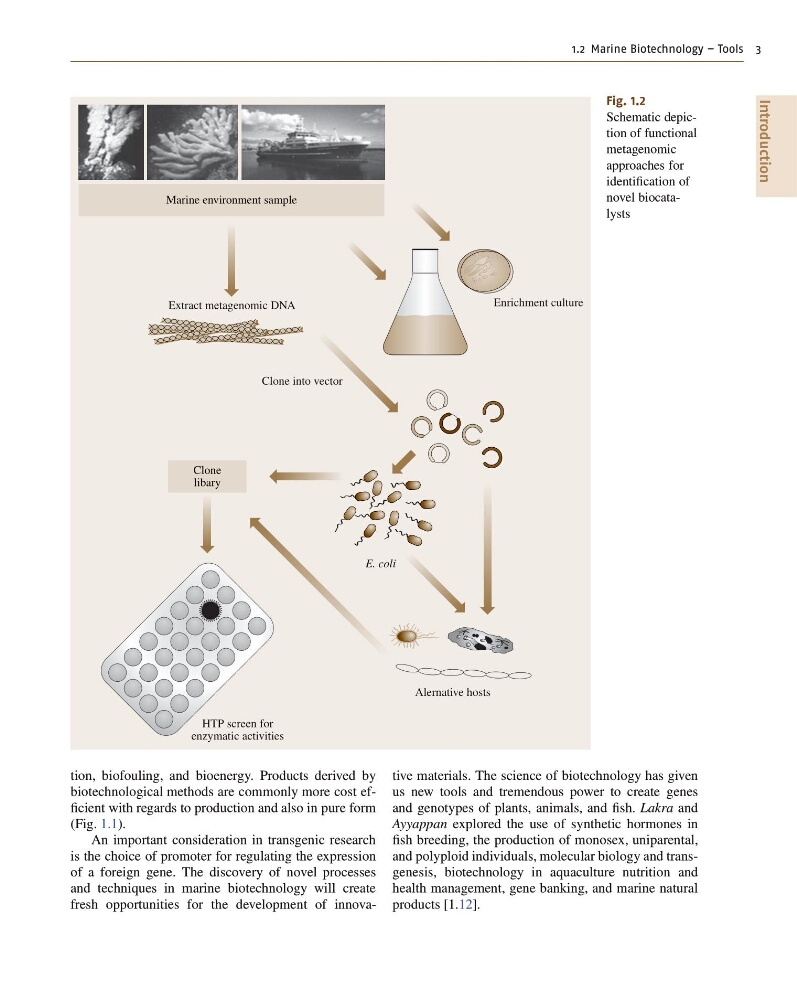
Fig. 1.2
Schematic depiction of functional
metagenomic
approaches for
identification of
novel biocatalysts
tion, biofouling, and bioenergy. Products derived by
biotechnological methods are commonly more cost efficient with regards to production and also in pure form
(Fig. 1.1).
An important consideration in transgenic research
is the choice of promoter for regulating the expression
of a foreign gene. The discovery of novel processes
and techniques in marine biotechnology will create
fresh opportunities for the development of innovative materials. The science of biotechnology has given
us new tools and tremendous power to create genes
and genotypes of plants, animals, and fish. Lakra and
Ayyappan explored the use of synthetic hormones in
fish breeding, the production of monosex, uniparental,
and polyploid individuals, molecular biology and transgenesis, biotechnology in aquaculture nutrition and
health management, gene banking, and marine natural
products [1.12].
Introduction
Marine environment sample
Extract metagenomic DNA
Clone into vector
HTP screen for
enzymatic activities
Clone
libary
Alernative hosts
E. coli
Enrichment culture
Fig. 1.2
Schematic depiction of functional
metagenomic
approaches for
identification of
novel biocatalysts
tion, biofouling, and bioenergy. Products derived by
biotechnological methods are commonly more cost efficient with regards to production and also in pure form
(Fig. 1.1).
An important consideration in transgenic research
is the choice of promoter for regulating the expression
of a foreign gene. The discovery of novel processes
and techniques in marine biotechnology will create
fresh opportunities for the development of innovative materials. The science of biotechnology has given
us new tools and tremendous power to create genes
and genotypes of plants, animals, and fish. Lakra and
Ayyappan explored the use of synthetic hormones in
fish breeding, the production of monosex, uniparental,
and polyploid individuals, molecular biology and transgenesis, biotechnology in aquaculture nutrition and
health management, gene banking, and marine natural
products [1.12].