

Part B | 16.5
446 Part B Tools and Methods in Marine Biotechnology
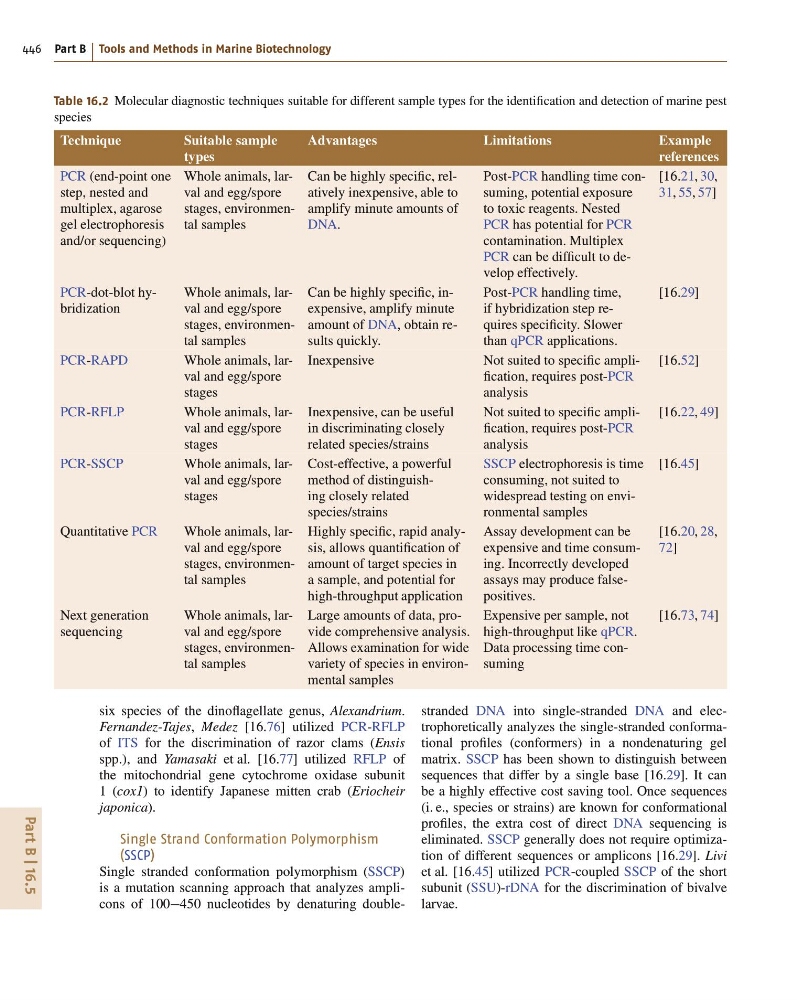
Table 16.2 Molecular diagnostic techniques suitable for different sample types for the identification and detection of marine pest
species
Technique
Suitable sample
types
Advantages
Limitations
Example
references
PCR (end-point one
step, nested and
multiplex, agarose
gel electrophoresis
and/or sequencing)
Whole animals, larval and egg/spore
stages, environmental samples
Can be highly specific, relatively inexpensive, able to
amplify minute amounts of
DNA.
Post-PCR handling time consuming, potential exposure
to toxic reagents. Nested
PCR has potential for PCR
contamination. Multiplex
PCR can be difficult to develop effectively.
[16.21, 30,
31, 55, 57]
PCR-dot-blot hybridization
Whole animals, larval and egg/spore
stages, environmental samples
Can be highly specific, inexpensive, amplify minute
amount of DNA, obtain results quickly.
Post-PCR handling time,
if hybridization step requires specificity. Slower
than qPCR applications.
[16.29]
PCR-RAPD
Whole animals, larval and egg/spore
stages
Inexpensive
Not suited to specific amplification, requires post-PCR
analysis
[16.52]
PCR-RFLP
Whole animals, larval and egg/spore
stages
Inexpensive, can be useful
in discriminating closely
related species/strains
Not suited to specific amplification, requires post-PCR
analysis
[16.22, 49]
PCR-SSCP
Whole animals, larval and egg/spore
stages
Cost-effective, a powerful
method of distinguishing closely related
species/strains
SSCP electrophoresis is time
consuming, not suited to
widespread testing on environmental samples
[16.45]
Quantitative PCR
Whole animals, larval and egg/spore
stages, environmental samples
Highly specific, rapid analysis, allows quantification of
amount of target species in
a sample, and potential for
high-throughput application
Assay development can be
expensive and time consuming. Incorrectly developed
assays may produce falsepositives.
[16.20, 28,
72]
Next generation
sequencing
Whole animals, larval and egg/spore
stages, environmental samples
Large amounts of data, provide comprehensive analysis.
Allows examination for wide
variety of species in environmental samples
Expensive per sample, not
high-throughput like qPCR.
Data processing time consuming
[16.73, 74]
six species of the dinoflagellate genus, Alexandrium.
Fernandez-Tajes, Medez [16.76] utilized PCR-RFLP
of ITS for the discrimination of razor clams (Ensis
spp.), and Yamasaki et al. [16.77] utilized RFLP of
the mitochondrial gene cytochrome oxidase subunit
1 (cox1) to identify Japanese mitten crab (Eriocheir
japonica).
Single Strand Conformation Polymorphism
(SSCP)
Single stranded conformation polymorphism (SSCP)
is a mutation scanning approach that analyzes amplicons of 100450 nucleotides by denaturing doublestranded DNA into single-stranded DNA and electrophoretically analyzes the single-stranded conformational profiles (conformers) in a nondenaturing gel
matrix. SSCP has been shown to distinguish between
sequences that differ by a single base [16.29]. It can
be a highly effective cost saving tool. Once sequences
(i. e., species or strains) are known for conformational
profiles, the extra cost of direct DNA sequencing is
eliminated. SSCP generally does not require optimization of different sequences or amplicons [16.29]. Livi
et al. [16.45] utilized PCR-coupled SSCP of the short
subunit (SSU)-rDNA for the discrimination of bivalve
larvae.
446 Part B Tools and Methods in Marine Biotechnology
Table 16.2 Molecular diagnostic techniques suitable for different sample types for the identification and detection of marine pest
species
Technique
Suitable sample
types
Advantages
Limitations
Example
references
PCR (end-point one
step, nested and
multiplex, agarose
gel electrophoresis
and/or sequencing)
Whole animals, larval and egg/spore
stages, environmental samples
Can be highly specific, relatively inexpensive, able to
amplify minute amounts of
DNA.
Post-PCR handling time consuming, potential exposure
to toxic reagents. Nested
PCR has potential for PCR
contamination. Multiplex
PCR can be difficult to develop effectively.
[16.21, 30,
31, 55, 57]
PCR-dot-blot hybridization
Whole animals, larval and egg/spore
stages, environmental samples
Can be highly specific, inexpensive, amplify minute
amount of DNA, obtain results quickly.
Post-PCR handling time,
if hybridization step requires specificity. Slower
than qPCR applications.
[16.29]
PCR-RAPD
Whole animals, larval and egg/spore
stages
Inexpensive
Not suited to specific amplification, requires post-PCR
analysis
[16.52]
PCR-RFLP
Whole animals, larval and egg/spore
stages
Inexpensive, can be useful
in discriminating closely
related species/strains
Not suited to specific amplification, requires post-PCR
analysis
[16.22, 49]
PCR-SSCP
Whole animals, larval and egg/spore
stages
Cost-effective, a powerful
method of distinguishing closely related
species/strains
SSCP electrophoresis is time
consuming, not suited to
widespread testing on environmental samples
[16.45]
Quantitative PCR
Whole animals, larval and egg/spore
stages, environmental samples
Highly specific, rapid analysis, allows quantification of
amount of target species in
a sample, and potential for
high-throughput application
Assay development can be
expensive and time consuming. Incorrectly developed
assays may produce falsepositives.
[16.20, 28,
72]
Next generation
sequencing
Whole animals, larval and egg/spore
stages, environmental samples
Large amounts of data, provide comprehensive analysis.
Allows examination for wide
variety of species in environmental samples
Expensive per sample, not
high-throughput like qPCR.
Data processing time consuming
[16.73, 74]
six species of the dinoflagellate genus, Alexandrium.
Fernandez-Tajes, Medez [16.76] utilized PCR-RFLP
of ITS for the discrimination of razor clams (Ensis
spp.), and Yamasaki et al. [16.77] utilized RFLP of
the mitochondrial gene cytochrome oxidase subunit
1 (cox1) to identify Japanese mitten crab (Eriocheir
japonica).
Single Strand Conformation Polymorphism
(SSCP)
Single stranded conformation polymorphism (SSCP)
is a mutation scanning approach that analyzes amplicons of 100450 nucleotides by denaturing doublestranded DNA into single-stranded DNA and electrophoretically analyzes the single-stranded conformational profiles (conformers) in a nondenaturing gel
matrix. SSCP has been shown to distinguish between
sequences that differ by a single base [16.29]. It can
be a highly effective cost saving tool. Once sequences
(i. e., species or strains) are known for conformational
profiles, the extra cost of direct DNA sequencing is
eliminated. SSCP generally does not require optimization of different sequences or amplicons [16.29]. Livi
et al. [16.45] utilized PCR-coupled SSCP of the short
subunit (SSU)-rDNA for the discrimination of bivalve
larvae.