

Part B | 16.4
444 Part B Tools and Methods in Marine Biotechnology
Table 16.1 Examples of molecular methods and markers used for the detection of different taxonomic groups of marine
pests
Taxonomic group
DNA loci
Methods
References
Dinophyceae
ITS 1 and 2, 5.8S rDNA
PCR coupled rDNA probe
[16.19]
qPCR
[16.20]
rDNA
PCR
[16.21]
LSU rDNA
PCR-RFLP
[16.22]
PCR
[16.23, 24]
FISH
[16.25]
SHA
[16.7]
SSU rDNA
FISH
[16.26]
PCR-FISH
[16.27]
5.8S rDNA
qPCR
[16.28]
Macroalgae
ITS 1 and 2, 5.8S rDNA
PCR coupled dot-blot hybridization
[16.29]
IGS
PCR
[16.30, 31]
rbcL gene
PCR
[16.32, 33]
Mitochondrial: cox1, 16S
PCR
[16.34]
Mitochondrial: cytochrome b and cox1
PCR
[16.35]
Gastropods
Mitochondrial: cox1
PCR
[16.36]
Bivalves
Mitochondrial: cox1, nad4, 16S
Multiplex PCR
[16.37]
Nested PCR
[16.38]
PCR
[16.39–41]
Microsatellite loci
PCR
[16.42]
SSU rDNA
Nested multiplex
[16.43, 44]
PCR-SSCP
[16.45]
FISH
[16.46, 47]
SHA
[16.48]
ITS
PCR-RFLP
[16.49]
IGS
PCR
[16.30]
Crustaceans
Mitochondrial: cox1
qPCR 64
PCR
[16.50, 51]
PCR-dot blot
[16.29]
ITS
PCR
[16.50, 51]
SSU-rDNA
PCR
[16.51]
IGS
PCR
[16.30]
Not applicable
RAPD-PCR
[16.52]
Echinoderms
SSU rDNA
PCR
[16.53]
FISH
[16.54]
Ascidians
SSU rDNA
PCR
[16.55]
SSU rDNA/Mitochondrial: cox1
PCR
[16.56]
Microsatellite loci
PCR
[16.57]
spacers (ITS-1 and ITS-2). The rDNA genes, ITS, and
IGS/NTS regions have been shown to be particularly
useful in defining species specific markers for marine
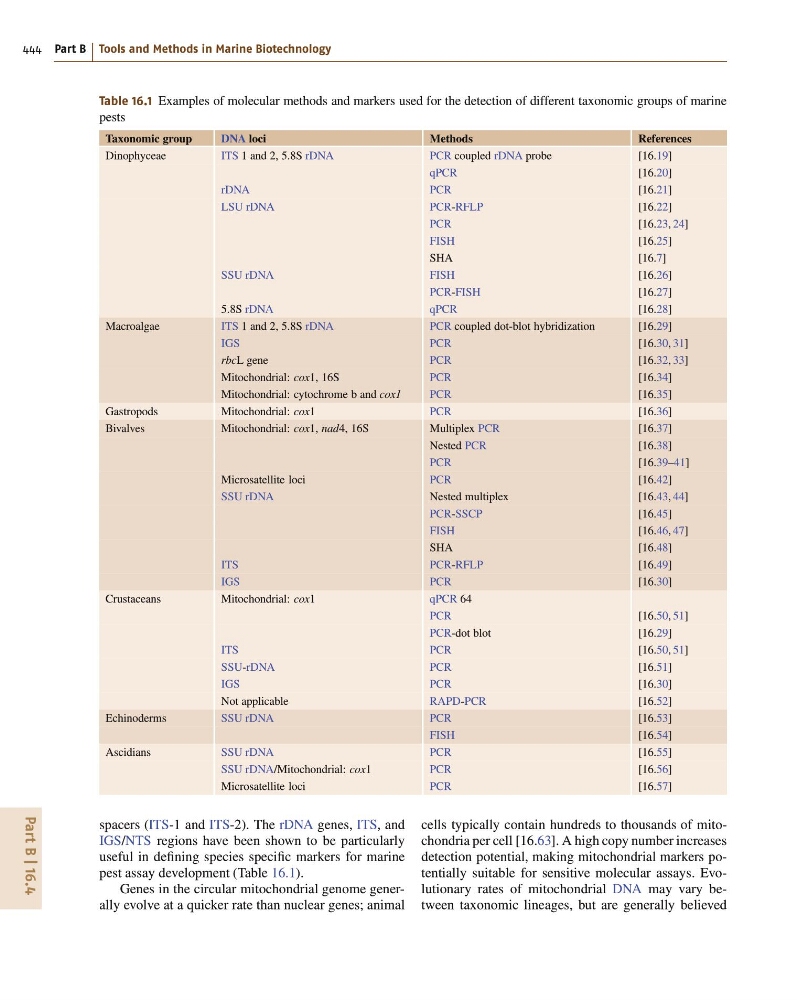
pest assay development (Table 16.1).
Genes in the circular mitochondrial genome generally evolve at a quicker rate than nuclear genes; animal
cells typically contain hundreds to thousands of mitochondria per cell [16.63]. A high copy number increases
detection potential, making mitochondrial markers potentially suitable for sensitive molecular assays. Evolutionary rates of mitochondrial DNA may vary between taxonomic lineages, but are generally believed
444 Part B Tools and Methods in Marine Biotechnology
Table 16.1 Examples of molecular methods and markers used for the detection of different taxonomic groups of marine
pests
Taxonomic group
DNA loci
Methods
References
Dinophyceae
ITS 1 and 2, 5.8S rDNA
PCR coupled rDNA probe
[16.19]
qPCR
[16.20]
rDNA
PCR
[16.21]
LSU rDNA
PCR-RFLP
[16.22]
PCR
[16.23, 24]
FISH
[16.25]
SHA
[16.7]
SSU rDNA
FISH
[16.26]
PCR-FISH
[16.27]
5.8S rDNA
qPCR
[16.28]
Macroalgae
ITS 1 and 2, 5.8S rDNA
PCR coupled dot-blot hybridization
[16.29]
IGS
PCR
[16.30, 31]
rbcL gene
PCR
[16.32, 33]
Mitochondrial: cox1, 16S
PCR
[16.34]
Mitochondrial: cytochrome b and cox1
PCR
[16.35]
Gastropods
Mitochondrial: cox1
PCR
[16.36]
Bivalves
Mitochondrial: cox1, nad4, 16S
Multiplex PCR
[16.37]
Nested PCR
[16.38]
PCR
[16.39–41]
Microsatellite loci
PCR
[16.42]
SSU rDNA
Nested multiplex
[16.43, 44]
PCR-SSCP
[16.45]
FISH
[16.46, 47]
SHA
[16.48]
ITS
PCR-RFLP
[16.49]
IGS
PCR
[16.30]
Crustaceans
Mitochondrial: cox1
qPCR 64
PCR
[16.50, 51]
PCR-dot blot
[16.29]
ITS
PCR
[16.50, 51]
SSU-rDNA
PCR
[16.51]
IGS
PCR
[16.30]
Not applicable
RAPD-PCR
[16.52]
Echinoderms
SSU rDNA
PCR
[16.53]
FISH
[16.54]
Ascidians
SSU rDNA
PCR
[16.55]
SSU rDNA/Mitochondrial: cox1
PCR
[16.56]
Microsatellite loci
PCR
[16.57]
spacers (ITS-1 and ITS-2). The rDNA genes, ITS, and
IGS/NTS regions have been shown to be particularly
useful in defining species specific markers for marine
pest assay development (Table 16.1).
Genes in the circular mitochondrial genome generally evolve at a quicker rate than nuclear genes; animal
cells typically contain hundreds to thousands of mitochondria per cell [16.63]. A high copy number increases
detection potential, making mitochondrial markers potentially suitable for sensitive molecular assays. Evolutionary rates of mitochondrial DNA may vary between taxonomic lineages, but are generally believed