

Part B | 14.3
416 Part B Tools and Methods in Marine Biotechnology
cation of microorganisms. Moreover, Yan et al. have
shown that secondary metabolite production of marine microorganisms can be induced by cross-species
interactions [14.21]. They used a novel air-membrane
surface bioreactor, allowing the bacteria to grow attached to a surface as a biofilm in contact with air.
By exposure of the isolates to Bacillus sp. production of antimicrobial substances was induced. It can
be assumed that this approach might also be transferable to the production of enzymes by raising the
enzyme expression due to QS stimuli. Other reactor
types that have shown their potential for cultivation
of the biofilm state of marine microorganisms are the
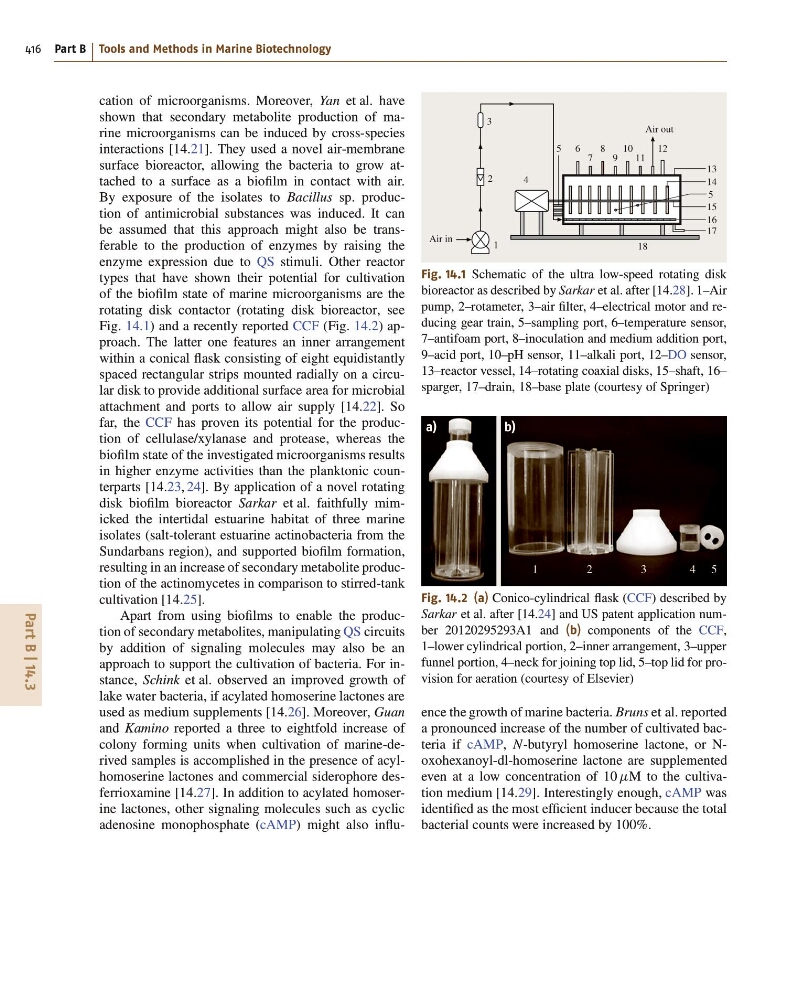
rotating disk contactor (rotating disk bioreactor, see
Fig. 14.1) and a recently reported CCF (Fig. 14.2) approach. The latter one features an inner arrangement
within a conical flask consisting of eight equidistantly
spaced rectangular strips mounted radially on a circular disk to provide additional surface area for microbial
attachment and ports to allow air supply [14.22]. So
far, the CCF has proven its potential for the production of cellulase/xylanase and protease, whereas the
biofilm state of the investigated microorganisms results
in higher enzyme activities than the planktonic counterparts [14.23, 24]. By application of a novel rotating
disk biofilm bioreactor Sarkar et al. faithfully mimicked the intertidal estuarine habitat of three marine
isolates (salt-tolerant estuarine actinobacteria from the
Sundarbans region), and supported biofilm formation,
resulting in an increase of secondary metabolite production of the actinomycetes in comparison to stirred-tank
cultivation [14.25].
Apart from using biofilms to enable the production of secondary metabolites, manipulating QS circuits
by addition of signaling molecules may also be an
approach to support the cultivation of bacteria. For instance, Schink et al. observed an improved growth of
lake water bacteria, if acylated homoserine lactones are
used as medium supplements [14.26]. Moreover, Guan
and Kamino reported a three to eightfold increase of
colony forming units when cultivation of marine-derived samples is accomplished in the presence of acylhomoserine lactones and commercial siderophore desferrioxamine [14.27]. In addition to acylated homoserine lactones, other signaling molecules such as cyclic
adenosine monophosphate (cAMP) might also influAir out
12
10
8
6
11
9
7
Air in
3
2
1
4
5
13
14
15
5
16
17
18
Fig. 14.1 Schematic of the ultra low-speed rotating disk
bioreactor as described by Sarkar et al. after [14.28]. 1–Air
pump, 2–rotameter, 3–air filter, 4–electrical motor and reducing gear train, 5–sampling port, 6–temperature sensor,
7–antifoam port, 8–inoculation and medium addition port,
9–acid port, 10–pH sensor, 11–alkali port, 12–DO sensor,
13–reactor vessel, 14–rotating coaxial disks, 15–shaft, 16–
sparger, 17–drain, 18–base plate (courtesy of Springer)
1
2
3
4 5
a)
b)
Fig. 14.2 (a) Conico-cylindrical flask (CCF) described by
Sarkar et al. after [14.24] and US patent application number 20120295293A1 and (b) components of the CCF,
1–lower cylindrical portion, 2–inner arrangement, 3–upper
funnel portion, 4–neck for joining top lid, 5–top lid for provision for aeration (courtesy of Elsevier)
ence the growth of marine bacteria. Bruns et al. reported
a pronounced increase of the number of cultivated bacteria if cAMP, N-butyryl homoserine lactone, or Noxohexanoyl-dl-homoserine lactone are supplemented
even at a low concentration of 10 M to the cultivation medium [14.29]. Interestingly enough, cAMP was
identified as the most efficient inducer because the total
bacterial counts were increased by 100%.
416 Part B Tools and Methods in Marine Biotechnology
cation of microorganisms. Moreover, Yan et al. have
shown that secondary metabolite production of marine microorganisms can be induced by cross-species
interactions [14.21]. They used a novel air-membrane
surface bioreactor, allowing the bacteria to grow attached to a surface as a biofilm in contact with air.
By exposure of the isolates to Bacillus sp. production of antimicrobial substances was induced. It can
be assumed that this approach might also be transferable to the production of enzymes by raising the
enzyme expression due to QS stimuli. Other reactor
types that have shown their potential for cultivation
of the biofilm state of marine microorganisms are the
rotating disk contactor (rotating disk bioreactor, see
Fig. 14.1) and a recently reported CCF (Fig. 14.2) approach. The latter one features an inner arrangement
within a conical flask consisting of eight equidistantly
spaced rectangular strips mounted radially on a circular disk to provide additional surface area for microbial
attachment and ports to allow air supply [14.22]. So
far, the CCF has proven its potential for the production of cellulase/xylanase and protease, whereas the
biofilm state of the investigated microorganisms results
in higher enzyme activities than the planktonic counterparts [14.23, 24]. By application of a novel rotating
disk biofilm bioreactor Sarkar et al. faithfully mimicked the intertidal estuarine habitat of three marine
isolates (salt-tolerant estuarine actinobacteria from the
Sundarbans region), and supported biofilm formation,
resulting in an increase of secondary metabolite production of the actinomycetes in comparison to stirred-tank
cultivation [14.25].
Apart from using biofilms to enable the production of secondary metabolites, manipulating QS circuits
by addition of signaling molecules may also be an
approach to support the cultivation of bacteria. For instance, Schink et al. observed an improved growth of
lake water bacteria, if acylated homoserine lactones are
used as medium supplements [14.26]. Moreover, Guan
and Kamino reported a three to eightfold increase of
colony forming units when cultivation of marine-derived samples is accomplished in the presence of acylhomoserine lactones and commercial siderophore desferrioxamine [14.27]. In addition to acylated homoserine lactones, other signaling molecules such as cyclic
adenosine monophosphate (cAMP) might also influAir out
12
10
8
6
11
9
7
Air in
3
2
1
4
5
13
14
15
5
16
17
18
Fig. 14.1 Schematic of the ultra low-speed rotating disk
bioreactor as described by Sarkar et al. after [14.28]. 1–Air
pump, 2–rotameter, 3–air filter, 4–electrical motor and reducing gear train, 5–sampling port, 6–temperature sensor,
7–antifoam port, 8–inoculation and medium addition port,
9–acid port, 10–pH sensor, 11–alkali port, 12–DO sensor,
13–reactor vessel, 14–rotating coaxial disks, 15–shaft, 16–
sparger, 17–drain, 18–base plate (courtesy of Springer)
1
2
3
4 5
a)
b)
Fig. 14.2 (a) Conico-cylindrical flask (CCF) described by
Sarkar et al. after [14.24] and US patent application number 20120295293A1 and (b) components of the CCF,
1–lower cylindrical portion, 2–inner arrangement, 3–upper
funnel portion, 4–neck for joining top lid, 5–top lid for provision for aeration (courtesy of Elsevier)
ence the growth of marine bacteria. Bruns et al. reported
a pronounced increase of the number of cultivated bacteria if cAMP, N-butyryl homoserine lactone, or Noxohexanoyl-dl-homoserine lactone are supplemented
even at a low concentration of 10 M to the cultivation medium [14.29]. Interestingly enough, cAMP was
identified as the most efficient inducer because the total
bacterial counts were increased by 100%.