

Novel Bioreactors for Culturing Marine Organisms 12.8 High-Temperature and/or High-Pressure Bioreactors (HP-/HTBR) 371
Part B | 12.8
Microbiological
sub-sampling
chamber
Axial sub-core
extrusion chamber
Microbiological
experimental
chamber
DeepIsoBUG
Aseptically collected
sub-sample in
pressurized chamber
Camera
Minipusher
Rotating cutter
Split pusher
Axial sub-core
Sliver of sub-core
Core section
chamber
Press
Manipulator
chamber
Axial sub-corer
Whole-round core sction
Quick-release clamp
Push rod
Ball valve
a)
c)
b)
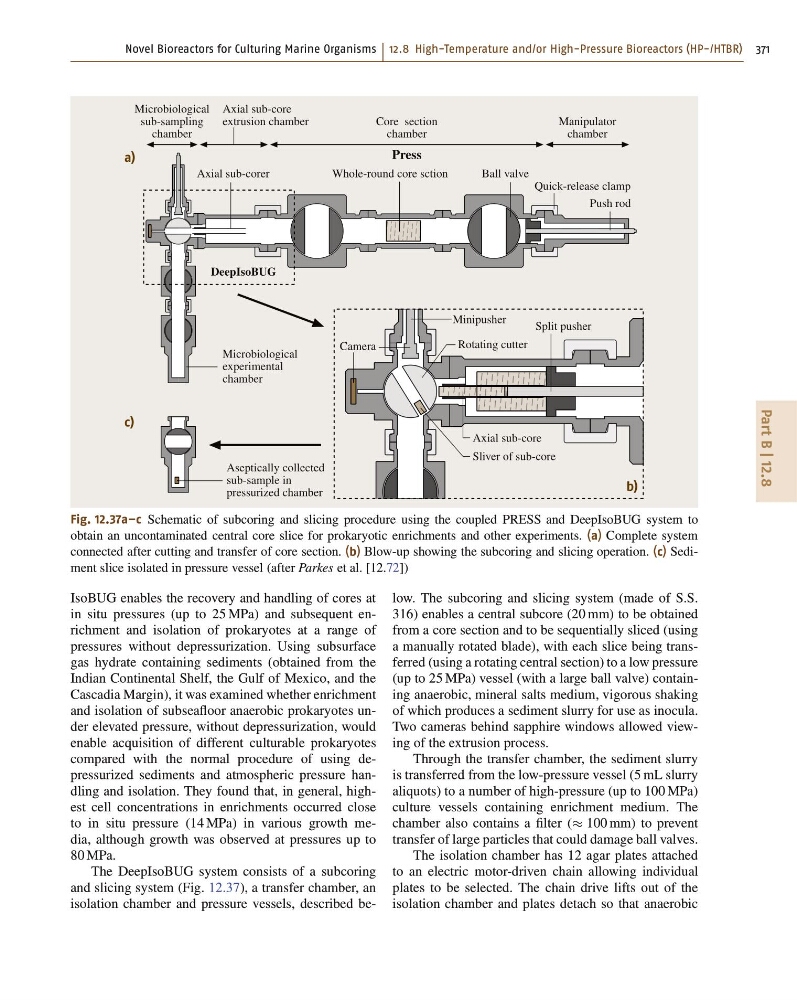
Fig. 12.37a–c Schematic of subcoring and slicing procedure using the coupled PRESS and DeepIsoBUG system to
obtain an uncontaminated central core slice for prokaryotic enrichments and other experiments. (a) Complete system
connected after cutting and transfer of core section. (b) Blow-up showing the subcoring and slicing operation. (c) Sediment slice isolated in pressure vessel (after Parkes et al. [12.72])
IsoBUG enables the recovery and handling of cores at
in situ pressures (up to 25 MPa) and subsequent enrichment and isolation of prokaryotes at a range of
pressures without depressurization. Using subsurface
gas hydrate containing sediments (obtained from the
Indian Continental Shelf, the Gulf of Mexico, and the
Cascadia Margin), it was examined whether enrichment
and isolation of subseafloor anaerobic prokaryotes under elevated pressure, without depressurization, would
enable acquisition of different culturable prokaryotes
compared with the normal procedure of using depressurized sediments and atmospheric pressure handling and isolation. They found that, in general, highest cell concentrations in enrichments occurred close
to in situ pressure (14 MPa) in various growth media, although growth was observed at pressures up to
80 MPa.
The DeepIsoBUG system consists of a subcoring
and slicing system (Fig. 12.37), a transfer chamber, an
isolation chamber and pressure vessels, described below. The subcoring and slicing system (made of S.S.
316) enables a central subcore (20 mm) to be obtained
from a core section and to be sequentially sliced (using
a manually rotated blade), with each slice being transferred (using a rotating central section) to a low pressure
(up to 25 MPa) vessel (with a large ball valve) containing anaerobic, mineral salts medium, vigorous shaking
of which produces a sediment slurry for use as inocula.
Two cameras behind sapphire windows allowed viewing of the extrusion process.
Through the transfer chamber, the sediment slurry
is transferred from the low-pressure vessel (5 mL slurry
aliquots) to a number of high-pressure (up to 100 MPa)
culture vessels containing enrichment medium. The
chamber also contains a filter ( 100 mm) to prevent
transfer of large particles that could damage ball valves.
The isolation chamber has 12 agar plates attached
to an electric motor-driven chain allowing individual
plates to be selected. The chain drive lifts out of the
isolation chamber and plates detach so that anaerobic
Part B | 12.8
Microbiological
sub-sampling
chamber
Axial sub-core
extrusion chamber
Microbiological
experimental
chamber
DeepIsoBUG
Aseptically collected
sub-sample in
pressurized chamber
Camera
Minipusher
Rotating cutter
Split pusher
Axial sub-core
Sliver of sub-core
Core section
chamber
Press
Manipulator
chamber
Axial sub-corer
Whole-round core sction
Quick-release clamp
Push rod
Ball valve
a)
c)
b)
Fig. 12.37a–c Schematic of subcoring and slicing procedure using the coupled PRESS and DeepIsoBUG system to
obtain an uncontaminated central core slice for prokaryotic enrichments and other experiments. (a) Complete system
connected after cutting and transfer of core section. (b) Blow-up showing the subcoring and slicing operation. (c) Sediment slice isolated in pressure vessel (after Parkes et al. [12.72])
IsoBUG enables the recovery and handling of cores at
in situ pressures (up to 25 MPa) and subsequent enrichment and isolation of prokaryotes at a range of
pressures without depressurization. Using subsurface
gas hydrate containing sediments (obtained from the
Indian Continental Shelf, the Gulf of Mexico, and the
Cascadia Margin), it was examined whether enrichment
and isolation of subseafloor anaerobic prokaryotes under elevated pressure, without depressurization, would
enable acquisition of different culturable prokaryotes
compared with the normal procedure of using depressurized sediments and atmospheric pressure handling and isolation. They found that, in general, highest cell concentrations in enrichments occurred close
to in situ pressure (14 MPa) in various growth media, although growth was observed at pressures up to
80 MPa.
The DeepIsoBUG system consists of a subcoring
and slicing system (Fig. 12.37), a transfer chamber, an
isolation chamber and pressure vessels, described below. The subcoring and slicing system (made of S.S.
316) enables a central subcore (20 mm) to be obtained
from a core section and to be sequentially sliced (using
a manually rotated blade), with each slice being transferred (using a rotating central section) to a low pressure
(up to 25 MPa) vessel (with a large ball valve) containing anaerobic, mineral salts medium, vigorous shaking
of which produces a sediment slurry for use as inocula.
Two cameras behind sapphire windows allowed viewing of the extrusion process.
Through the transfer chamber, the sediment slurry
is transferred from the low-pressure vessel (5 mL slurry
aliquots) to a number of high-pressure (up to 100 MPa)
culture vessels containing enrichment medium. The
chamber also contains a filter ( 100 mm) to prevent
transfer of large particles that could damage ball valves.
The isolation chamber has 12 agar plates attached
to an electric motor-driven chain allowing individual
plates to be selected. The chain drive lifts out of the
isolation chamber and plates detach so that anaerobic